
Transparent sapphire monoliths conceal an amber and purple threat path blocked by a blue-edged titanium containment layer.Transparent sapphire monoliths conceal an amber and purple threat path blocked by a blue-edged titanium containment layer.
Part of Cybersecurity Blind Spots

The Uninvited Guest:
What Happens Before the Attack Becomes Visible

Why normal operations can conceal the preparation for a ransomware attack.

The deceptive calm of silent mapping

Your front door is locked, the cameras are working and the people inside are going about their day. A ransomware intrusion can create the same deceptive calm: systems respond, staff can log in and the morning report shows no disruption, even though an attacker has already gained access.

Before files are encrypted or a service stops, the intruder may be identifying privileged accounts, exploring server connections, collecting sensitive information or locating the systems your organisation would need for recovery. The visible crisis can arrive after some of the damage has already been done.

For a board, CIO or CISO, the question is whether security teams can recognise that preparation while the business still appears to be operating normally. Waiting for an outage means waiting for a later stage of the incident.
THE BLIND SPOT
The absence of visible disruption tells you that services are running.
It does not establish that an attacker has gained no access or made no preparations.

The uninvited guest

Imagine an uninvited guest staying in your house for 45 days while you continue your normal routine. They do not damage the furniture or announce their presence. They learn which doors you use, where you keep the keys, which rooms contain valuables and how you would leave in an emergency.

The picture makes a hidden intrusion easier to understand, but the guest does not need a long stay to become dangerous. An attacker using a stolen password or session may begin exploring your environment immediately. A working account can open doors without producing the obvious signs of a forced entry.

The important interval is the time between gaining access and being identified and interrupted. During that interval, normal business activity may continue alongside reconnaissance, theft or preparations for encryption. The incident has begun even if the people responsible for essential services have not yet seen an operational consequence.

What happens while operations look normal

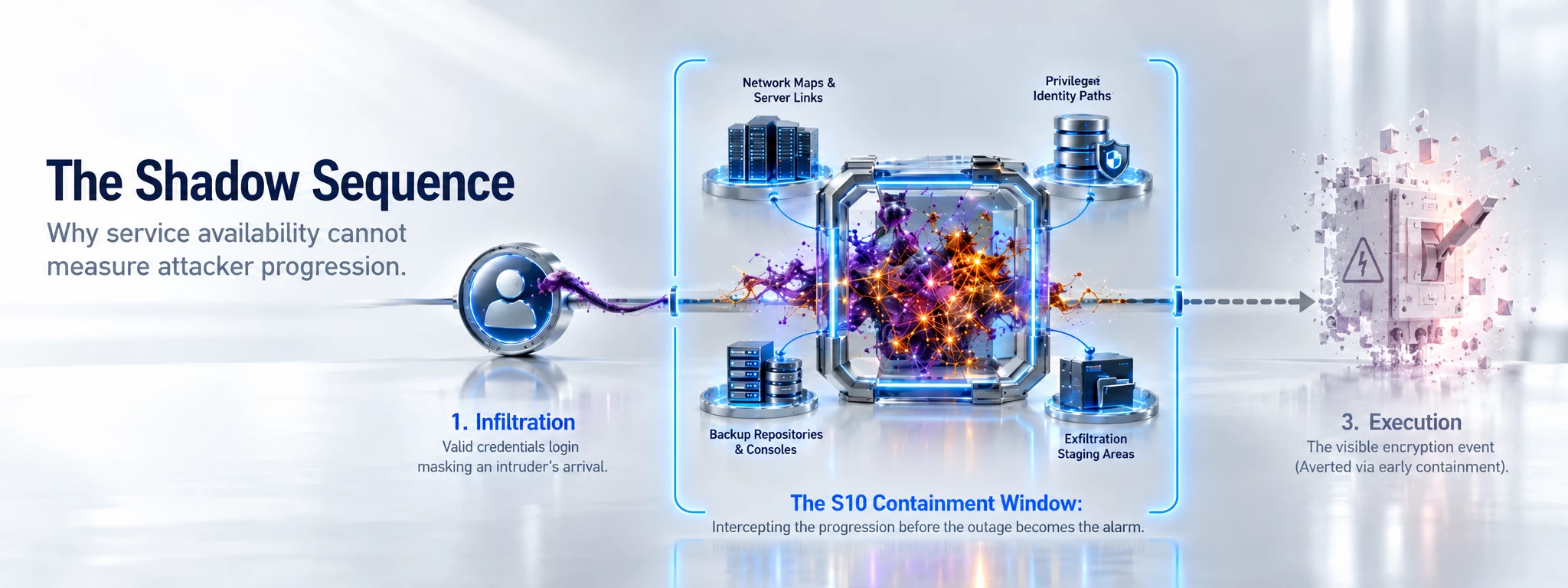
The house metaphor translates into specific activity that your security and infrastructure teams need to distinguish from ordinary work. An intruder may be:

  • Mapping the environment: identifying important servers, shared data, privileged users and the connections between them.
  • Expanding access: using stolen credentials, existing sessions or additional privileges to reach systems beyond the initial point of entry.
  • Finding recovery dependencies: locating backup repositories, management consoles and the accounts used to administer or restore them.
  • Preparing data theft: collecting and packaging sensitive information for transfer outside your organisation.
  • Preparing disruption: arranging access or execution mechanisms that could later be used to deploy ransomware or disable security controls.

These activities do not have to occur in a fixed order, and not every intrusion includes all of them. Some attackers steal information without encrypting files. Others move rapidly from entry to disruption. The common issue is that service availability alone cannot tell your incident team how far the attacker has progressed.

A cybersecurity timeline infographic on a light white background titled The Shadow Sequence, illustrating the S10 containment window for CISOs. The visual maps a 3-step threat progression: 1. Infiltration via a valid credential login; 2. Reconnaissance, where a titanium and sapphire-glass containment cube isolates a hidden amber malware threat mapping infrastructure and hunting backups; and 3. Execution, which is grayed out and averted. A prominent neon-blue bracket emphasizes intercepting the intruder before an outage becomes the alarm.

The unseen phase may be shorter than you expect

A 45-day stay makes the metaphor memorable. It must not become an assumption about the time available to respond. The relevant systems may be within reach long before an executive meeting can be arranged.

Activity can progress behind normal operations

Sophos: a short window in investigated intrusions
‍
The 2026 Active Adversary Report analysed 661 selected IR and MDR cases from November 2024 to October 2025. Median dwell time was three days; the median interval to an attempt to access Active Directory was 3.4 hours. The observations show why an apparently normal working day should not be treated as a response window.
‍
Source:
https://www.sophos.com/en-us/blog/2026-sophos-active-adversary-report

Eye Security: a valid session can conceal an intruder
‍
The 2026 business email compromise report describes abuse of legitimate credentials and sessions, including session hijacking that bypassed MFA. An email account can remain usable while the person directing its activity is an intruder.

Source:
https://eye.security/report/business-email-compromise-report-europe/


What this means for your organisation:
‍
For your organisation, the shared question is which activity reveals misuse while essential services still work. Account acceptance and service availability are useful facts, but neither identifies the person behind the activity.

Scope of the public record:
‍
Sophos reports selected investigation cases, not a universal ransomware timetable. An AD access attempt does not prove takeover.
Eye Security’s findings concern email and identity compromise; they are not a ransomware prevalence measure.

View more details chevron A white downward-facing V-shaped chevron on a transparent background.
View more details
Close more details

Active Directory manages identities and access in many organisations. An attacker trying to reach those servers is therefore approaching infrastructure that can influence access to much of the environment. The practical implication is that the response window may already be narrowing while ordinary services remain available.

Shorter dwell time also reflects faster detection by defenders. It should not be read simply as evidence that every attacker has become faster, or that artificial intelligence caused the change. Your response planning needs to account for rapid progression without treating one report’s median as a guaranteed deadline.

When the account works for the wrong person

A valid login confirms that a credential or session has been accepted. It does not establish that the person using it is the employee, administrator or supplier to whom the access was granted.

An intruder may use the same remote-access tool, server connection or cloud workflow as an authorised colleague. The distinction lies in what the account does: connecting to unfamiliar servers, seeking higher privileges, changing security settings or collecting information outside its normal role.

Firewall, endpoint and identity protections remain essential, and they may detect or block that activity. The question for your organisation is what happens when access has nevertheless been compromised: which signals reveal the misuse, and who investigates them before the account reaches additional systems?

Why the guest looks for the backup room

An attacker preparing ransomware has a reason to examine how your organisation would recover. Backup repositories, recovery accounts and management consoles can reveal where copies are held and which permissions could be used to alter or delete them.

A successful backup job does not tell your security team whether an intruder is exploring the account or console that administers it. The question on this page is whether that preparation would be recognised in time. Whether the copies themselves can survive an attack and support restoration is the separate recovery question.

What changes when an alert arrives

Suspicious preparation may produce a warning before any business service fails. Its value depends on someone reviewing it, establishing what the account or process is doing and taking a proportionate action.

Missed recognition and recovery preparation

CISA: an intrusion before the operational picture caught up

AA25-266A describes a federal agency compromise that remained undetected for three weeks. The agency missed an earlier endpoint alert. The case illustrates an opportunity to recognise activity before the later response began.

Source:
https://www.cisa.gov/sites/default/files/2025-09/AA25-266A_advisory_cisa_shares_lessons_learned_from_ir_engagement.pdf

Veeam: the recovery environment belongs in the threat picture
The 2024 Ransomware Trends Report documents attempts to target backup repositories in the surveyed attacks. Backup consoles, recovery accounts and repositories therefore deserve attention during investigation, while the team still has options to intervene.

Source:
https://www.veeam.com/analyst-reports/2024-ransomware-trends-report_wp.pdf

What this means for your organisation:
Your monitoring enquiry should include access to the systems used for recovery, alongside production activity. Recognising preparation and establishing whether a backup can survive and be used remain different questions.

Analytical boundaries:
‍
CISA’s case is not evidence that every ransomware intrusion remains hidden for weeks.
Veeam’s survey does not establish the order of activity in a particular incident.

View more details chevron A white downward-facing V-shaped chevron on a transparent background.
View more details
Close more details

For your incident team, the immediate questions are concrete: which account or server is implicated, what access should be restricted, which services depend on it and who can authorise the action? A reviewed alert and a terminated session are different outcomes. The wider design of that response belongs to the detection-to-interruption question; here, the concern is how much preparation can continue before the warning changes anything.

Questions to ask before the outage

Executive oversight does not require the reconstruction of every technical step. It requires evidence that the teams responsible for monitoring, investigation, and response can recognise an intrusion before service failure becomes the alarm.

  • If a valid account starts accessing unfamiliar servers or sensitive repositories, which team receives the signal and how quickly is it reviewed?
  • If an intruder attempts to access identity infrastructure, which responder can restrict the account or session while the investigation continues?
  • Would attempts to access backup consoles or recovery accounts be visible before copies or settings were altered?
  • Outside business hours, who owns an alert from first review through to a confirmed containment action?
  • Which targeted action could your team take before an outage, and how would it establish the effect on essential services?

Answers should identify systems, people, coverage and actions. A list of installed tools or a general assurance that the incident plan exists cannot demonstrate how those responsibilities work together during the hidden phase.

How our platform addresses specific attack activity

Our contribution is containment at defined points in the attack, alongside your existing prevention, identity security, monitoring, backup and response arrangements.

Ransomware Containment is our platform. It agentlessly monitors file activity in the protected data environment and isolates the responsible user, session or device when illegitimate encryption begins. Its ransomware-containment function acts immediately on active encryption; it does not by itself identify every preparatory activity described on this page.

Additional Server Intrusion Protection (SIP) and Virtual Server Protection (VSP) features run on our platform. SIP detects and contains compromised server access, while VSP protects supported hypervisor environments against attacks directed at that layer. These capabilities address particular server and infrastructure risks; they do not replace the investigation needed to establish what an intruder has accessed or changed.

The relevance to the uninvited guest is precise: recognising suspicious preparation is valuable when your responders also have a way to interrupt the harmful activity within the protected scope. Your incident team still determines the wider exposure and response.

Would your team see the preparation?

The uninvited guest challenges one assumption: that an apparently normal working day means there is still time before the incident becomes serious. A stolen account can be used to explore systems, collect data or approach recovery infrastructure while essential services continue to run.

If someone gained access tonight, which activity would reveal the intrusion before files were encrypted or a service stopped, and who could act on that evidence?

See what changes when encryption begins

Our remote ransomware resilience assessment provides evidence for one narrower part of that response. In your isolated test environment, we run controlled file-encryption scenarios with your existing security controls active, first without Ransomware Containment enabled and then with it enabled.

The comparison shows how active encryption is handled within the agreed test scope. It does not test the discovery of hidden intruders, SIP, VSP, lateral-movement interruption, data-exfiltration prevention, backup recoverability, decision authority or wider business continuity. These broader operational controls, structural boundaries, and strategic implications are formally presented and reviewed during the session.

Request a ransomware resilience assessment!

Further readings