


Tiered sapphire structure with amber and purple threat particles stopped by a blue-edged titanium containment block.Tiered sapphire structure with amber and purple threat particles stopped by a blue-edged titanium containment block.
Part of Cybersecurity Blind Spots

Is Doing Nothing
Still a Defensible Option?

Cyber resilience is no longer judged by what you can prevent,
but by what you can still control after entry

The invisible cost of operational delay

Doing nothing is rarely a declared decision.

More often, delay begins with choices that make sense in isolation: wait for the forensic picture, keep a supplier connection open, avoid unnecessary disruption, watch the dashboard or restore systems before every dependency has been validated.

Your teams may be working hard throughout. The risk appears when waiting becomes the only available response while the incident can still move through identities, data, systems or external connections.

The relevant question is therefore not whether you have invested in cybersecurity. Most companies have. It is whether those investments leave your executive team with a proportionate action that can still change the outcome.
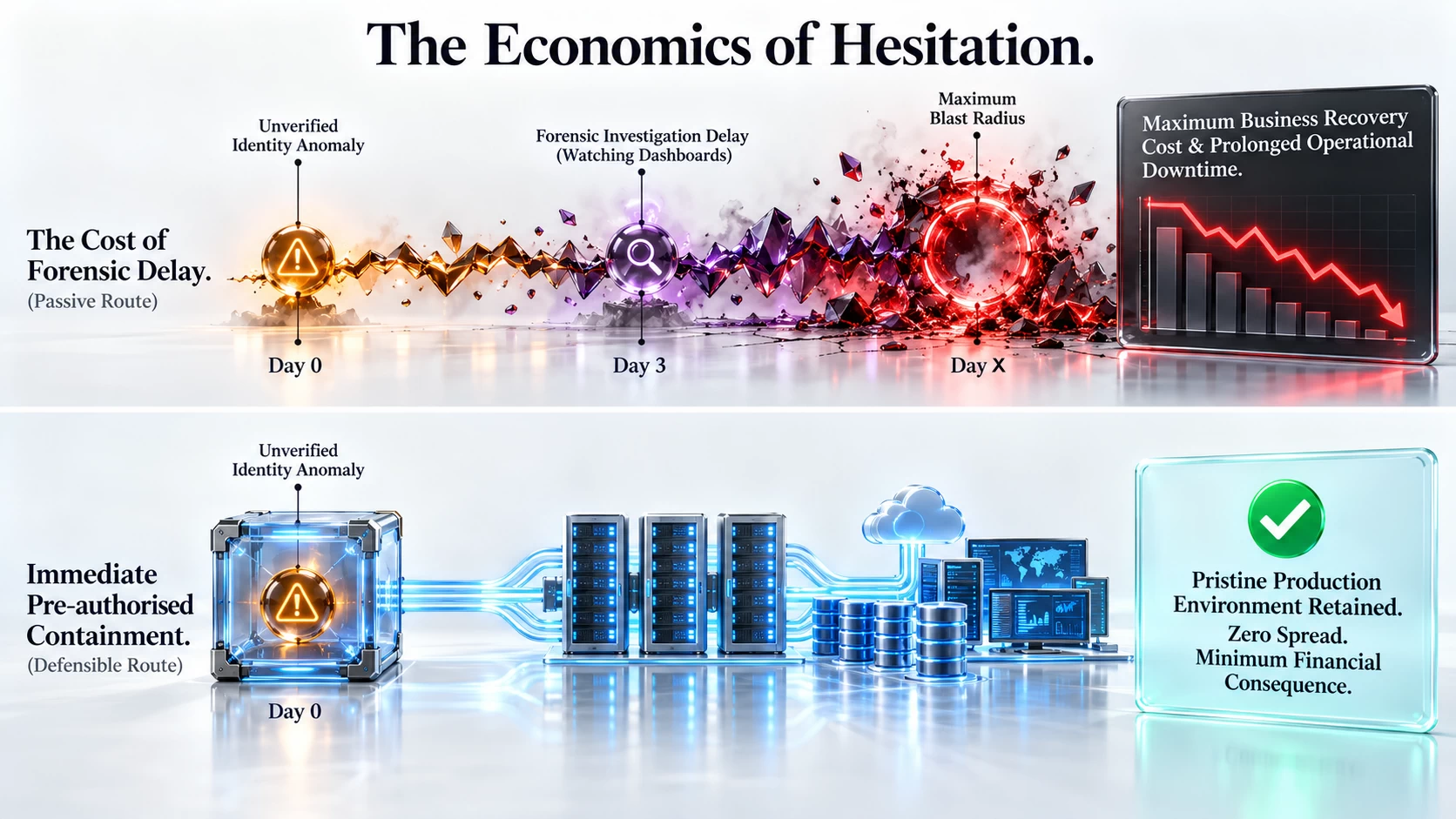

A cybersecurity risk infographic on a light background titled The Economics of Hesitation, illustrating the financial impact of operational delay for CISOs. The top row maps a passive route over a timeline from Day 0 to Day 3 and Day X, where forensic delay leads to an uncontained blast radius and maximum business recovery costs. The bottom row maps a defensible route where a titanium containment cube isolates a deep-amber malware threat at Day 0, leaving the main production environment pristine and active.
Waiting is not neutral when the incident can keep moving

Most companies are already acting

You may already have endpoint protection, identity controls, monitoring, backups, incident-response plans and capable specialists. You may test recovery, review risk and brief the board. Those measures reduce likelihood, improve visibility and create options.

Yet a modern ransomware attack or data breach does not need to take every system offline to create lasting damage. Sensitive data can leave while applications remain available. A critical supplier can fail while your own environment is untouched. A known risk can remain visible without becoming an authorised action. Systems can be restored while unsafe access paths or copied data remain outside recovery control.

A mature security programme can therefore be active and well funded, yet still lack a reliable way to interrupt the path from compromise to consequence.

When waiting becomes the operating model

Delay becomes dangerous when certainty is treated as a prerequisite for every containment decision. The connection remains open because closing it may affect operations. The account remains active because ownership is not yet proven. The affected workload stays online because no one knows which dependent service will fail. The dashboard grows more precise while authority remains unresolved.

Each choice may be understandable. Taken together, they preserve the conditions an attacker needs: time, reach and ordinary-looking access.

The standard for a defensible response is not whether activity took place. It is whether your available actions could still alter the trajectory of the incident.

The test is whether action can still change the outcome

Seven ways consequence keeps growing

The following seven case profiles provide direct evidence of how a technical intrusion expands outward. Each example demonstrates a specific pivot point where a localised incident escalated into severe operational, financial, or reputational consequence because the available intervention arrived too late, lacked precision, or depended on unverified external dependencies.

1. People carry what your systems lose

When therapy notes, identity documents or medical records leave your environment, the incident does not remain inside your systems. It follows people into their private lives, where restoration cannot retrieve what has already been copied.

Vastaamo

What appeared manageable:
Services could continue while the breach remained out of view, creating the appearance that there was still time to investigate quietly.

What the public record shows:
Finland’s Data Protection Ombudsman found that Vastaamo’s patient database had been exposed through an unprotected internet-facing database port, a root account without password protection and inadequate logging. The database was copied, and patients were later targeted directly with extortion demands.

Why the consequence persisted:
No technical recovery could make the copied therapy records private again. Vastaamo entered liquidation in January 2021 and filed for bankruptcy the following month. That sequence should be stated carefully: it demonstrates the scale of the organisational aftermath without reducing a complex failure to one simplistic cause.

The governance reality:
A functioning business can still have no effective digital compartments. Restricting reach and interrupting suspicious data movement before exposure becomes irreversible are continuity decisions, not only security controls.

Sources:

Finnish Data Protection Ombudsman:
‍
‍https://valtioneuvosto.fi/en/-/6927448/administrative-fine-imposed-on-psychotherapy-centre-vastaamo-for-data-protection-violations
‍

Yle liquidation report:

https://yle.fi/a/3-11762655
‍
Yle bankruptcy report:
‍https://yle.fi/a/3-11785891‍

View more details chevron A white downward-facing V-shaped chevron on a transparent background.
View more details
Close more details

2. A supplier incident can become your operating problem

A cyber crisis does not need to begin inside your perimeter to affect cash flow, service delivery or patient care. Once a critical provider becomes unavailable, your practical question is local: what can your teams detach, reroute or continue without waiting for the supplier to recover?

Change Healthcare

What appeared manageable:
The technical incident belonged to the service provider, so downstream healthcare organisations might reasonably expect to preserve normal connections and wait for restoration.

What the public record shows:
After the 2024 Change Healthcare attack disrupted claims, payment and eligibility functions, an American Hospital Association survey of nearly 1,000 hospitals found that 94% reported financial impact, 83% reported cash-flow impact and 74% reported an effect on direct patient care.

Why the consequence spread:
The provider’s outage removed operational options from hospitals and medical practices that had not themselves been breached. Technical concentration became sector-wide process concentration.

The governance reality:
Critical dependencies need an agreed local response: who can restrict the route, which functions can continue in a degraded mode and what alternative processing is available while the provider remains uncertain.

‍

Source:

American Hospital Association survey:
‍
‍https://www.aha.org/2024-03-15-aha-survey-change-healthcare-cyberattack-significantly-disrupts-patient-care-hospitals-finances‍

View more details chevron A white downward-facing V-shaped chevron on a transparent background.
View more details
Close more details

3. Backend downtime can reach the front line

A pathology or diagnostic service may sit behind care delivery, but its loss changes what clinicians can decide, schedule and perform. Operational consequence arrives before every technical fact is known.

Synnovis and the NHS

What appeared manageable:
A specialist supplier outage could be treated as a contained technical queue while hospitals continued with normal clinical workflows.

What the public record shows:
The June 2024 ransomware attack on Synnovis significantly reduced pathology capacity. NHS England reports that more than 11,000 outpatient and elective-procedure appointments were delayed, with the greatest impact in south-east London.

Why the consequence persisted:
Pathology results help determine what can proceed safely. When that information flow is disrupted, scarce capacity, clinical priorities and alternative processes all need active coordination.

The governance reality:
Continuity planning needs safe degraded modes, alternative laboratory routes, clear prioritisation and boundaries that keep one supplier failure from obscuring the wider operating picture.

Source:

NHS England Synnovis incident updates
‍
‍https://www.england.nhs.uk/synnovis-cyber-incident/‍

View more details chevron A white downward-facing V-shaped chevron on a transparent background.
View more details
Close more details

4. Restored systems do not recall copied data

Infrastructure can be rebuilt. Privacy cannot. Once sensitive information has been copied or published, the incident continues through customer protection, identity risk, regulation and extortion leverage long after services return.

Medibank

What appeared manageable:
Service restoration could be mistaken for closure once core systems were available again.

What the public record shows:
Australia’s privacy regulator alleges that Medibank failed to take reasonable steps to protect personal information belonging to 9.7 million people. The regulator records that stolen personal and sensitive information was subsequently released on the dark web.

Why the consequence persisted:
Rebuilding technology could not bring copied information back inside the boundary. Exposure remained relevant to the people affected and to the legal and regulatory response.

The governance reality:
The most valuable intervention happens before exfiltration becomes irreversible: reduce what can be reached, recognise abnormal movement and act while investigation continues.

Source:

Office of the Australian Information Commissioner:
‍
‍https://www.oaic.gov.au/news/media-centre/oaic-takes-civil-penalty-action-against-medibank‍

View more details chevron A white downward-facing V-shaped chevron on a transparent background.
View more details
Close more details

5. An alert is only the beginning of response

Visibility helps your teams recognise and reconstruct suspicious activity. It does not by itself isolate an affected system, disable compromised access or stop data from moving.

CISA ransomware response guidance

What appeared manageable:
A stronger monitoring record can feel like evidence that the risk is already being controlled.

What the guidance requires:
CISA’s StopRansomware response checklist begins with action: determine which systems are affected, isolate them immediately, secure accounts and remote-access paths, remove persistence, rebuild priority services and reconnect only after the environment has been cleaned.

Why the distinction matters:
Logs can support investigation and accountability, but they do not change what an attacker can reach next. Without thresholds, authority and executable moves, visibility becomes a clearer history of an incident that continued.

The governance reality:
Define in advance which identities, systems and connections may be restricted, who can authorise the move and how evidence will be preserved while containment proceeds.

Source:

CISA StopRansomware Guide:
‍https://www.cisa.gov/stopransomware/ransomware-guide‍

View more details chevron A white downward-facing V-shaped chevron on a transparent background.
View more details
Close more details

6. A bounded interruption can preserve operational freedom

No executive team wants to stop productive systems unnecessarily. Yet a precise interruption made early can preserve far more operational room than a larger shutdown imposed later by the incident.

Jaguar Land Rover

What appeared manageable:
Avoiding interruption can look like the best way to protect production velocity and supplier stability.

What the public record shows:
The UK government described the 2025 cyber incident at Jaguar Land Rover as having a significant impact on the company and the wider automotive supply chain. Production remained paused while recovery continued, and the government later backed a loan guarantee expected to unlock up to £1.5 billion to support the affected supply chain.

Why the consequence spread:
Production concentration connected the incident to suppliers, jobs and liquidity far beyond the original technical environment.

The governance reality:
Design for proportionate interruption: isolate affected paths, preserve safe segments, prepare degraded modes and validate a phased restart before pressure forces an indiscriminate stop.

Sources:

UK government supplier statement:
‍
‍https://www.gov.uk/government/news/joint-statement-on-government-industry-supplier-meeting-regarding-jaguar-land-rover-cyber-incident
‍

UK government loan guarantee:

https://www.gov.uk/government/news/government-backs-jaguar-land-rover-with-15-billion-loan-guarantee‍

View more details chevron A white downward-facing V-shaped chevron on a transparent background.
View more details
Close more details

7. Smaller institutions still hold powerful leverage

Schools and public services may not have the revenue profile of a multinational, but they hold sensitive records and serve communities with limited tolerance for disruption. Their responsibility to students, families and staff creates leverage of its own.

Framwellgate School and the wider education risk

What appeared manageable:
A local school might seem too small to attract a deliberate extortion attempt or to justify the same level of response preparation as a large enterprise.

What the public record shows:
Durham’s Police and Crime Commissioner reported that Framwellgate School received an extortion email claiming 40 GB of sensitive data had been stolen. Investigators concluded that criminals had been present in the network for some time. The school secured specialist support within a day and restored full service.

Why the consequence mattered:
The value to the attacker came from sensitive community data and the pressure created by disruption, not from corporate scale.

The governance reality:
Preparation must be proportionate, not absent: limit privileged access, separate sensitive records, maintain recoverable backups and make rapid isolation possible without improvising authority during the incident.

Sources:

Durham Police and Crime Commissioner:
‍
‍https://www.durham-pcc.gov.uk/news/pcc-funded-scheme-comes-to-the-aid-of-secondary-school-hit-by-cyber-attack
‍

NCSC cyber security for schools:

https://www.ncsc.gov.uk/section/education-skills/cyber-security-schools‍

View more details chevron A white downward-facing V-shaped chevron on a transparent background.
View more details
Close more details

Prevention is necessary but cannot carry the whole outcome

None of these examples argues against prevention. Endpoint security, identity controls, patching, monitoring and recovery planning remain essential because they reduce the likelihood and frequency of successful attacks.

Containment answers a different question: "how much consequence can still be prevented after an attacker has gained a foothold, a supplier has failed or sensitive data has started to move?"

That distinction matters because consequence accumulates during the wait. Access remains available, data travels, supplier uncertainty spreads and operational backlogs deepen.

Prevention changes probability.
Containment changes trajectory.

What a defensible position looks like

A defensible position does not promise that every incident will be avoided or painless. It demonstrates that your teams have designed the decisions they may need to make before pressure arrives.

The foundation is practical: clear boundaries around identities, systems, workloads, data stores and supplier routes; named authority to restrict or detach them before every fact is known; safe degraded modes for critical services; and evidence that containment and recovery have been tested under realistic conditions.

The aim is not a dramatic emergency shutdown. It is the smallest effective intervention that stops what must not continue while preserving what can still operate safely.

Where our platform fits

We built our Ransomware Containment platform for the live phase after prevention has been bypassed. It does not add another stream of observations. It provides defined containment actions that change what a security incident could become.

Our platform stops ransomware encryption and helps interrupt lateral movement, and data theft before they expand the blast radius.
Server Intrusion Protection and Virtual Server Protection extend that containment logic to server-side activity and virtualised environments.

This gives your teams a more precise choice than watching the incident continue or disconnecting everything. Our platform will narrow unsafe paths, preserve operational room and support investigation and recovery while the operational picture remains unverified.

Control under pressure begins before waiting becomes the only option

Test one critical assumption

Use our controlled ransomware-resilience assessment to compare how a protected environment responds with your existing AV or EDR controls active and with our Ransomware Containment platform active.

This assessment does not claim to validate every part of cyber resilience. It shows whether ransomware encryption can be interrupted before it reaches the full test environment and gives your executive team evidence for the next investment decision.

If a security incident began tomorrow, what could your teams restrict, detach or preserve before waiting became the decision that shaped the outcome?
Bright conceptual visual of frosted-glass blocks where the first block is stopped by a titanium pillar, representing ransomware containment before wider operational disruption spreads.

Further readings