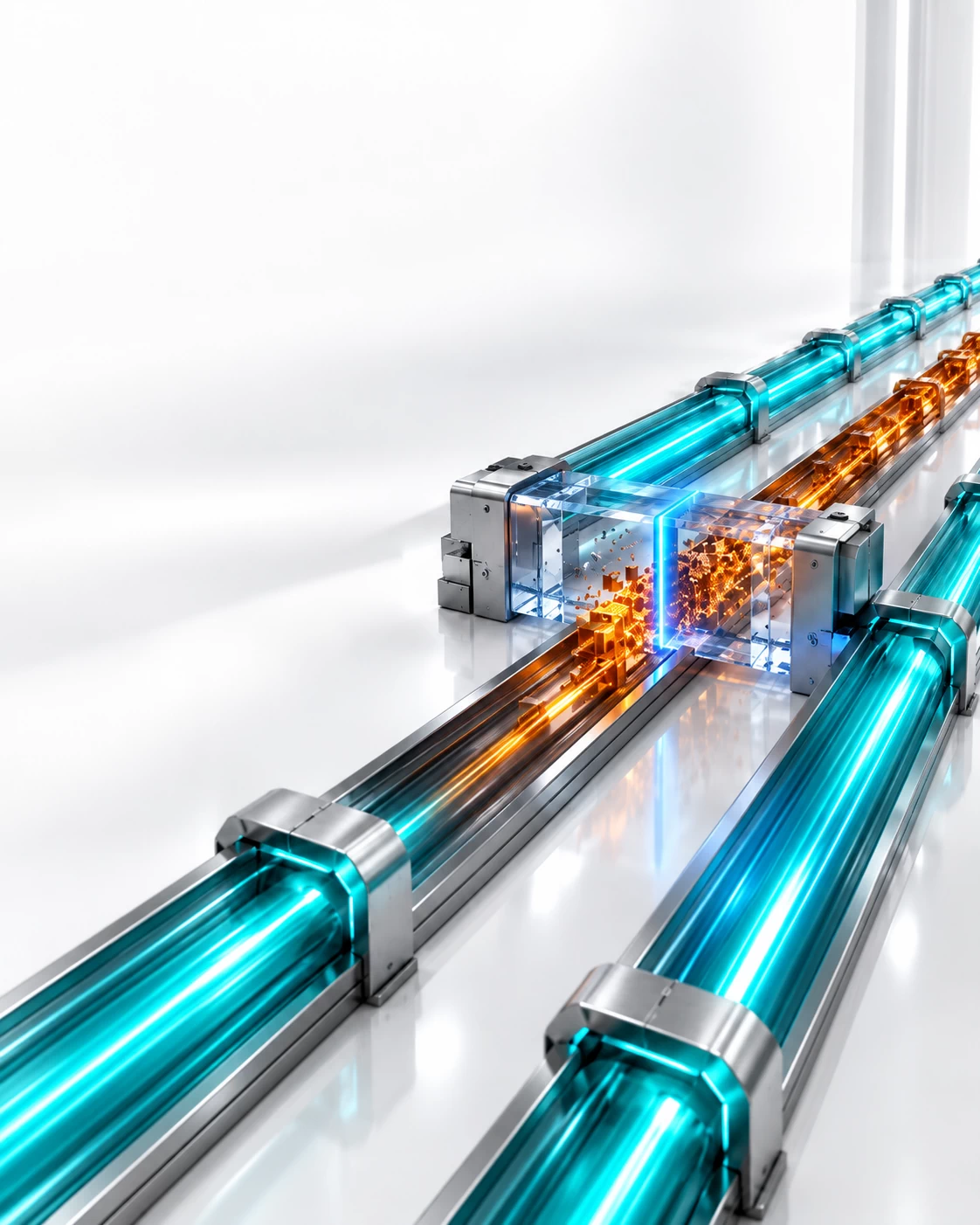
Manufacturing sector represented by a premium conceptual engineering graphic on a reflective white background illustrating manufacturing production continuity. A silver titanium multi-track system on the right carries ongoing, safe teal production streams, while an incoming deep-amber threat pulse on the center track is cleanly intercepted and isolated by a sapphire glass barrier emitting a sharp neon light-blue containment line, ensuring the broader factory operations on the left continue to run smoothly and securely.Manufacturing sector represented by a premium conceptual engineering graphic on a reflective white background illustrating manufacturing production continuity. A silver titanium multi-track system on the right carries ongoing, safe teal production streams, while an incoming deep-amber threat pulse on the center track is cleanly intercepted and isolated by a sapphire glass barrier emitting a sharp neon light-blue containment line, ensuring the broader factory operations on the left continue to run smoothly and securely.

Manufacturing Sector

Production continuity and blast-radius control
under cyber pressure

Physical readiness is not production readiness

The production line is available, the shift is staffed, materials have arrived and customer commitments are already in place. Yet a supplier message, bill of materials, engineering file, remote-maintenance session or production schedule is now under investigation.

The factory may still look ready to run. The operational problem begins when teams cannot demonstrate that the digital instructions guiding physical work are current, authorised and safe to use.

A cyber incident in manufacturing therefore creates decisions before it creates visible shutdown. Should the line continue, slow down or stop? Can product be released? Can a vendor remain connected? Can one site be isolated without affecting several others?

The plant may be physically ready.
Production can continue only when its instructions and dependencies remain verifiable.

Where physical readiness becomes fragile

Manufacturing converts digital instructions into physical output. Production schedules release work, bills of materials define what is built, engineering files determine configuration, quality systems approve product and logistics data directs movement between sites and customers.

Machines and people may therefore be available while production is no longer ready to proceed. A current-looking file may require validation. A remote-maintenance session may need to be suspended. A scheduling system may remain online while planners cannot confirm whether its data is complete.

The sector-specific risk is not limited to downtime. Continuing with the wrong instruction can create scrap, rework, quality escapes, delayed release or safety concerns. Stopping too broadly can create a different loss through idle labour, missed delivery windows and disrupted suppliers.

Manufacturing resilience depends on narrowing the affected digital paths while preserving the production information and services that teams can still verify.

When a supplier incident becomes a production decision

The Toyota supplier incident showed why manufacturing cyber risk is not confined to the organisation that is attacked.

Reuters confimed that Toyota suspended domestic factory operations after Kojima Industries, a supplier of plastic parts and electronic components, was hit by a suspected cyberattack. The suspension affected Toyota production in Japan and was expected to reduce output by around 13,000 vehicles.

Reuters later published that Toyota would restart production across its 14 domestic factories after the supplier incident created a system failure that hampered communication over parts orders.

That is the manufacturing control problem in miniature. The attacked organisation was not the only organisation affected. A supplier system failure became a production decision for one of the world’s largest manufacturers.

The lesson is not that every supplier incident will stop every plant. The lesson is sharper: in modern manufacturing, production confidence depends on digital dependency chains that may sit several steps away from the factory floor.

A manufacturer can have people, materials, machinery and customer demand, and still lose the ability to direct production because a trusted digital route has become unreliable.

What this feels like in manufacturing

Manufacturing leaders recognise this pressure because it rarely arrives as one clean technical failure. It arrives as uncertainty inside the systems that coordinate real work.

  • A supplier portal goes dark, and planning teams cannot confirm whether parts will arrive in sequence.
  • A remote maintenance account becomes suspect, but shutting it down may leave a specialist machine unsupported during a critical production window.
  • An engineering file, recipe, bill of materials or machine instruction can no longer be trusted without validation.
  • A scheduling or warehouse system remains online, but the plant does not know whether the data behind it is complete, current or safe to use.
  • Corporate IT sees suspicious activity, while operations asks whether isolating the affected route will stop the line, delay shipment or spoil a batch.
  • A virtual platform supporting multiple workloads becomes a concentration risk because the affected layer sits below several production-support applications.
  • The security team may see the signal, but the business has to decide whether to stop, continue, slow down or isolate before the full picture exists.

This is why manufacturing cannot treat cyber resilience as a back-office IT function. It is also a production continuity, supplier-dependency and operational decision function. Manufacturing must reduce the attacker’s room to move without losing the operational room required to keep the business coherent.

In manufacturing, control is not only uptime.
It is the ability to keep production direction trustworthy.

The supplier and remote-access problem

Manufacturers are not isolated plants. They are operating ecosystems. They depend on suppliers, subcontractors, logistics providers, engineering partners, equipment vendors, managed service providers, remote maintenance teams, cloud platforms and virtualised workloads that may support several sites at once.

Those connections are not peripheral. They are the operating model.

That creates a hard control problem. The same access path that helps a machinery vendor resolve a fault can become an attack lane. The same supplier integration that keeps just-in-time production efficient can become a dependency failure. The same shared virtual environment that reduces infrastructure complexity can concentrate risk across multiple production-support systems.

IBM’s 2026 X-Force reporting placed manufacturing as the most-targeted industry for the fifth consecutive year, accounting for 27.7% of cybersecurity incidents observed in 2025. IBM also reported that major supply-chain and third-party incidents had increased nearly fourfold over the previous five years.

The exact figure matters less than the direction of travel. Manufacturing is targeted because operational dependency creates pressure. A local compromise can threaten production commitments, supplier confidence, customer delivery and the ability to recover cleanly. This is why containment in manufacturing must reach beyond the infected endpoint. It must reduce movement across the routes where production actually depends on trust.

The leadership dilemma

The central manufacturing dilemma is simple to state and difficult to execute: "What can we disconnect without losing production direction?" Disconnect too much, and your organisation may create the production loss it is trying to avoid: halted lines, delayed shipments, wasted materials, idle labour, missed commitments and supplier confusion.

Continue too much, and the attacker may use trusted production paths, remote sessions, servers or virtual layers to move deeper into the environment before leadership understands the blast radius.

Under pressure, manufacturing leaders do not get perfect certainty. They get conflicting priorities: protect the plant, preserve output, protect people, preserve evidence, meet customer commitments, maintain quality and avoid turning a local incident into a multi-site consequence. That requires more than detection. It requires executable containment.
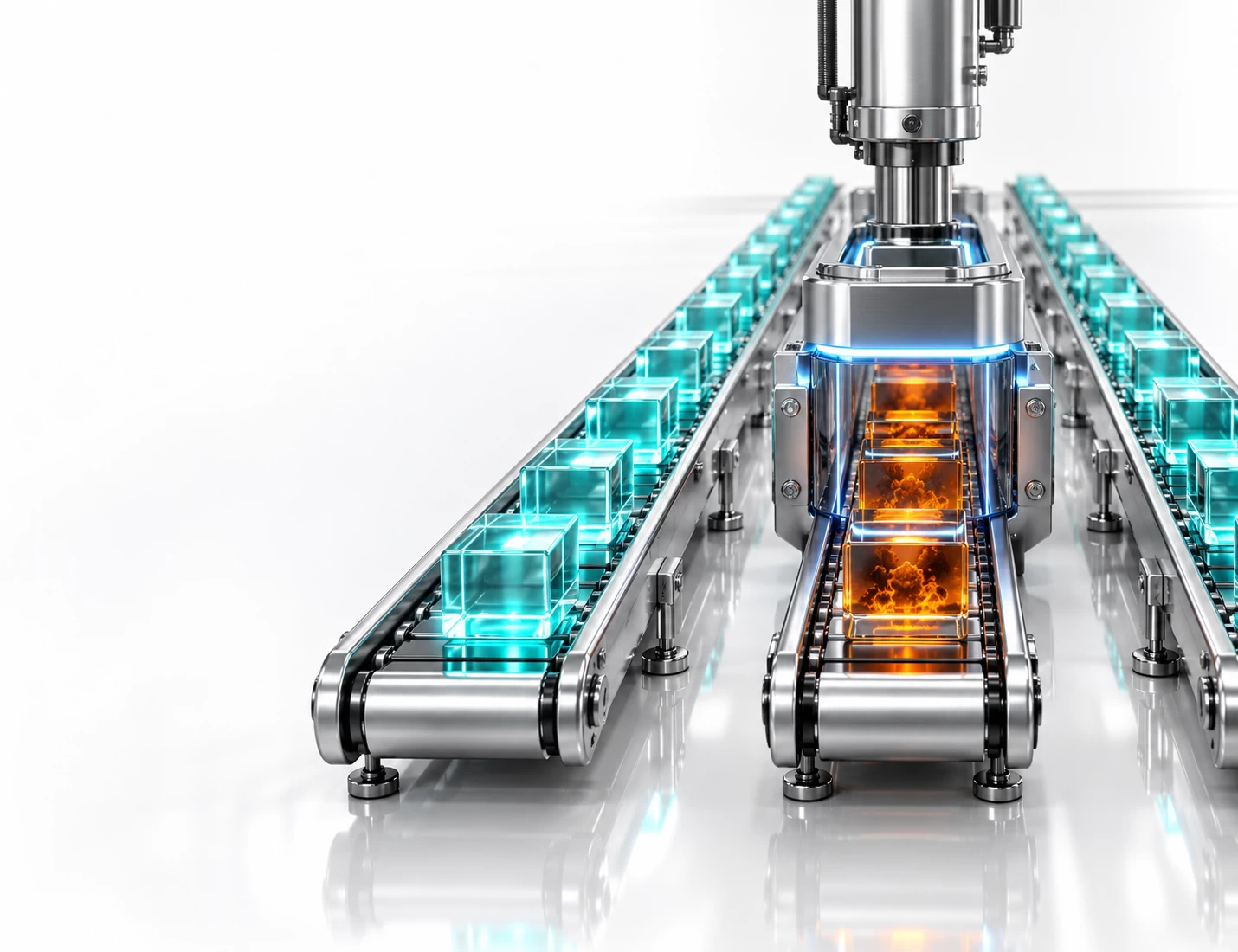
A premium conceptual engineering graphic on a reflective white background illustrating a manufacturing isolation dilemma. Three horizontal silver tracks run across the floor, with the two outer paths carrying calm, ongoing teal production lines. An automated brushed-chrome routing arm, outlined in a vibrant neon light-blue containment glow, has dropped down to isolate a compromised center path carrying a deep-amber threat pulse, demonstrating selective isolation without halting broader factory operations.

When containment is late

Late containment changes the manufacturing incident. A compromised account becomes a route into production-support systems. A server intrusion becomes a path to shared file stores, planning tools or identity infrastructure. A supplier outage becomes a scheduling problem. A virtual-layer concern becomes a multi-workload risk. A local infection becomes a site-level decision. A site-level decision becomes a customer, logistics and supply-chain consequence.

The damage is not only technical downtime. It is the loss of operational confidence: confidence in the build plan, in the supplier signal, in the quality record, in the remote session, in the shipping instruction, in the recovery point and in the evidence leadership needs to explain what happened.

Restoring servers may still leave a plant unable to schedule work, authenticate operators, trust engineering workstations, release product, reconnect assets or coordinate suppliers.

That is why recovery alone is not control. By the time recovery is the only remaining lever, the incident may already have changed what the factory can safely trust.

What changes when containment is early

Early containment protects production decisions. Restricting harmful activity before it reaches more production-support servers, supplier routes, remote-access sessions or virtual workloads reduces the number of sites and processes that must be treated as affected.

Planning teams can validate schedules and supplier inputs instead of abandoning them wholesale. Engineering and quality teams can identify which files and records require review. Operations can keep unaffected production moving while the incident team isolates the accounts, systems or routes that need attention.

The objective is not to keep every line running. It is to avoid forcing the business into a blunt choice between total shutdown and production based on instructions it cannot verify.

In manufacturing, early containment preserves the ability to make narrower decisions by line, site, workload and dependency.

How our containment platform supports production control

A cyber incident in manufacturing is constrained by physical and operational reality. Production cannot always be stopped cleanly, specialist remote access may still be required and shared systems may support planning, quality, engineering, inventory and logistics across multiple sites. Containment therefore has to restrict harmful activity without treating every connected system as equally unsafe.

Ransomware Containment is our platform. It agentlessly monitors file activity across the protected data environment and, once illegitimate encryption begins, isolates the responsible user, session or device. This gives your incident and infrastructure teams a precise way to contain active encryption without defaulting immediately to a wider shutdown.

Additional Server Intrusion Protection and Virtual Server Protection features run on the platform and extend its capabilities. SIP detects and contains compromised server access, including the misuse of administrative credentials, remote-access mechanisms and scheduled tasks. VSP monitors and protects supported VMware, vSphere, ESXi and Hyper-V environments against attacks directed at the hypervisor layer.

For a manufacturer, these controls create more options during the incident. Active encryption can be contained before it spreads across additional file shares and production-supporting data. Compromised administrative or remote-support access can be interrupted before an attacker gains deeper reach into critical servers. Attacks against supported virtual infrastructure can be addressed before one concentrated layer places multiple workloads or sites at risk.

Our platform complements existing prevention, detection, EDR, SIEM, identity controls, segmentation, OT safety disciplines and recovery planning. It adds executable containment across the protected data, server-access and virtualisation layers while production, safety and executive teams determine which lines, sites and supporting services can continue, and which production information requires verification.

How our platform strengthens manufacturing control

The value of our platform in manufacturing lies in preventing a digital incident from gaining enough reach to become a wider production event. Ransomware Containment addresses active encryption, while the additional SIP and VSP features extend protection to compromised server access and supported virtual infrastructure.

Capability
Manufacturing application
Control value
Capability:
Ransomware Containment — the platform
Application in finance:
Agentlessly monitors file activity across the protected data environment and isolates the responsible user, session or device once illegitimate encryption begins.
Control value:
Helps prevent active encryption from spreading across protected repositories containing production-critical information such as bills of materials (BOMs), engineering drawings, work instructions, quality records, production schedules, inventory data and shipping documentation.
Capability:
Server Intrusion Protection — additional feature
Application in finance:
Detects and contains server-level intrusion involving compromised administrative credentials and the misuse of remote-access or scheduled-task mechanisms.
Control value:
Helps interrupt attack progression before an intruder can move laterally, disable security controls, stage ransomware or exfiltrate data from servers supporting ERP, manufacturing execution, product lifecycle management, quality, inventory and logistics processes.
Capability:
Virtual Server Protection — additional feature
Application in finance:
Monitors and protects supported VMware, vSphere, ESXi and Hyper-V environments against attacks directed at the hypervisor layer. Depending on the supported platform and configuration, this may include additional protection for administrative paths, host processes, datastores, virtual-machine files and relevant configuration layers.
Control value:
Reduces the risk that an attack on concentrated virtual infrastructure affects multiple production-supporting workloads, recovery options or sites at the same time.

What manufacturing leaders should test

A manufacturer should establish its containment decisions before a live incident. The broader readiness review should determine whether a compromised server can be isolated before it reaches planning, quality or inventory systems; whether remote vendor access can be narrowed without uncontrolled plant disruption; how virtual workloads are prioritised; and how engineering, product and shipping records will be validated.

Those questions require architecture review, plant and safety input, continuity planning and appropriately scoped technical validation.

Our remote ransomware resilience assessment has a deliberately narrower scope. In a controlled sandbox, it compares file-encryption scenarios with your existing security controls left active, first without Ransomware Containment enabled and then with it enabled. It tests whether active encryption can be isolated before it spreads further. It does not test SIP, VSP, lateral movement, data exfiltration, supplier dependencies, production continuity or executive decision-making.

Containment changes the manufacturing question from “can the factory recover?” to “what is the attack no longer allowed to stop?”

Run a resilience assessment.

For organisations that want a focused, practical comparison, we can run a free remote ransomware resilience assessment in a controlled sandbox environment. With your existing security controls left active, we use several ransomware variants to observe how the current security stack responds once encryption begins. We then repeat the same scenarios with our ransomware-containment layer enabled and compare the outcomes.

DISCOVER HOW OUR PLATFORM WORKSRUN A RESILIENCE ASSESSMENT

Further readings