

Conceptual 3D engineering visual of connected gears where a titanium brake stops a cascading amber disruption, representing financial and operational impact control.Conceptual 3D engineering visual of connected gears where a titanium brake stops a cascading amber disruption, representing financial and operational impact control.

Financial & Operational Impact

The ransom is visible.
The disruption is where the bill expands.

The ransom is visible. The disruption is where the bill expands.

A serious ransomware incident is rarely expensive for one reason. Response specialists, legal advice, recovery work, overtime, lost output, delayed projects and customer support may sit in different budgets, but they accumulate while normal operations remain constrained.

The demand is therefore only one visible number. The larger cost depends on how many services are interrupted, how long teams rely on workarounds, how much data or infrastructure is affected and how safely the business can return to normal operation.

The ransom may be refused. The cost of disruption still continues.
The ransom is often the smallest part of the total cost.

The cost starts where normal operations stop

For years, ransomware was often discussed through the size of the demand. That view is too narrow. Even when an organisation refuses to pay, cost still accumulates. Revenue-generating work may slow. Customer service may be disrupted. Clinical care may be delayed. Production may stop. Finance teams may lose access to essential workflows. Leadership attention may be pulled away from every other priority.

The economic question is therefore not only, “How much did the attacker demand?” It is: what stopped, what slowed, what had to be rebuilt, and how much control was lost while the organisation was trying to respond?

What makes the impact grow

Modern ransomware creates pressure through interruption, uncertainty, data theft and dependency. The cost therefore develops across several parts of the business at once.

Operational interruption
Critical work slows or stops while teams determine which systems and workflows can remain in use.

Recovery friction
Restoration takes longer when identities, recovery points, data integrity or technical dependencies require additional validation.

External consequence
Customers, regulators, suppliers, insurers and legal advisers may require action before the technical investigation is complete.

Executive and management diversion
Decision-makers, specialists and operational teams are pulled away from planned work for weeks or months.

Financial impact is rarely one cost.
It is a collection of costs that compound while the business is disrupted.

Operational paralysis is the first major cost

The first material cost is often not visible in the ransom note. It appears in the business itself.

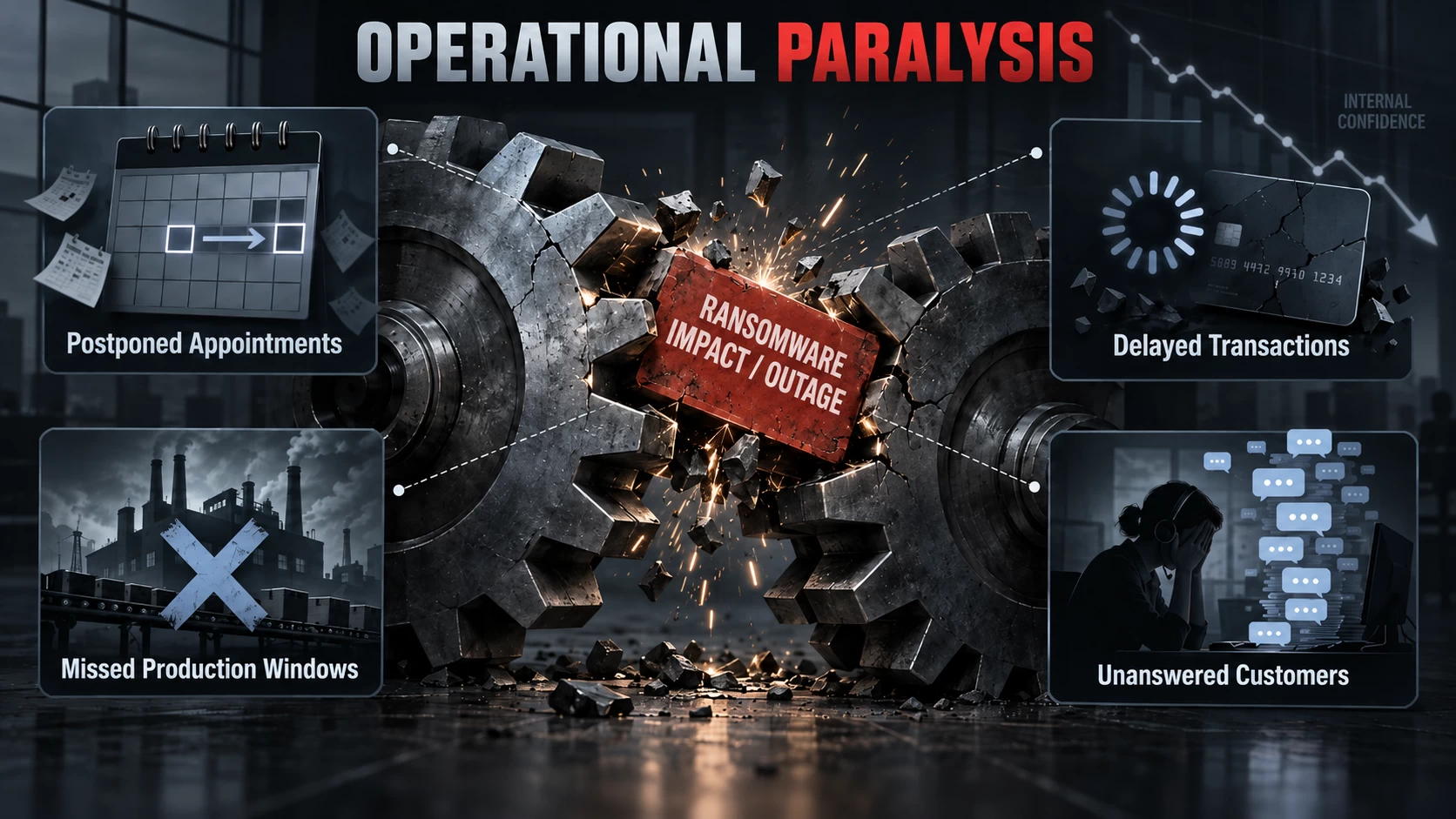
Your organisation can no longer run normally. Appointments are moved. Transactions are delayed. Orders cannot be processed. Claims cannot be handled. Production windows are missed. Teams work around missing systems. Customers wait for answers. Suppliers ask for status updates. Internal confidence drops because nobody yet knows whether the environment is safe enough to use.

At that point, cost is no longer an accounting category. It is operational pressure.
Infographic titled “Operational Paralysis” showing a ransomware outage jammed between two broken industrial gears, with surrounding panels illustrating postponed appointments, delayed transactions, missed production windows and unanswered customers, plus a declining internal confidence trend.
Downtime is no longer measured only in hours.
It is measured in cascading business consequences.

The consequences differ by sector

The cost curve follows the service your organisation must preserve. Use the four sector routes below to see how financial and operational impact develops in different operating environments.

Recovery is not a reset

Even when systems return, your organisation does not simply return to the position it held before the incident. Time has been lost. Decisions have been delayed. Trust may have been damaged. Customers may have changed behaviour. Employees may be exhausted. Projects may have paused. The business may now need to explain, reassure, validate and rebuild confidence while it is also trying to resume ordinary performance. That is why restored systems should not be confused with restored business momentum.

Recovery restores systems.
It does not automatically restore time, trust or momentum.

The business reality of having backups

Backups may be essential to recovery, but they do not preserve revenue, service capacity or operational momentum while systems are unavailable. Nor do they establish that identities, access paths and restoration points are safe to reuse.

Your organisation still needs to answer practical questions. Which services can continue during recovery? Which privileged access must be rebuilt or revalidated? Has sensitive data already left? Which dependencies must return first? What evidence supports the decision to reconnect a restored system?

Recoverable data is important.
Business continuity depends on whether essential operations can be sustained and restored in a controlled sequence.

The cost is layered, not linear

The financial impact of a serious cyber incident does not usually follow a clean sequence. Multiple costs develop in parallel while your organisation is still making decisions under pressure.

Direct response cost
Incident response, forensic support, legal advice, communications effort and emergency remediation.

Operational loss
Lost revenue, delayed transactions, missed output, reduced service capacity and interrupted workflows.

Recovery cost
Rebuild effort, infrastructure work, validation, monitoring and controlled re-entry into normal operations.

Legal and regulatory cost
Reporting obligations, claims exposure, privacy consequences and external review.

Organisational drag
Management time, decision fatigue, internal coordination strain and focus pulled away from growth.

Long-tail damage
Customer loss, trust repair, reputational recovery and slower commercial momentum.

The investment question has changed

The financial case for containment should not be reduced to the ransom demand. The relevant comparison is the amount of disruption and recovery work your organisation may avoid when harmful activity is restricted earlier.

Fewer affected systems can mean fewer rebuild paths and workarounds. Interrupted data movement can reduce the population and obligations created by exposure. Preserved service capacity can protect revenue, customer support and contractual performance while the incident response continues.

Containment also helps prevent avoidable costs created by an uncontrolled response, such as isolating more infrastructure than necessary or beginning recovery before the affected paths have been restricted.

The value lies in reducing the operational and financial consequences that remain after prevention has been bypassed.

The real ROI is not only in prevention.
It is in reducing impact when prevention is bypassed.

What changes the financial trajectory

Early containment changes the cost curve by reducing the number of systems, services and external consequences your organisation must recover from.

The affected field narrows
Fewer compromised systems usually mean fewer rebuild paths, dependencies and emergency workarounds.

More operations remain available
Critical work has a better chance of continuing in a controlled degraded mode.

External exposure may be smaller
Restricting data movement can reduce the number of records, people and obligations involved.

Decision costs fall
A smaller incident gives executives and operational teams more time to choose proportionate actions instead of reacting to continued expansion.

A narrower incident creates fewer consequences to finance, recover and explain.

Where our containment platform fits

Our platform operates in the interval when malicious activity is active but the financial and operational consequence can still be limited. It complements prevention, detection and recovery by giving authorised teams a precise way to interrupt ransomware encryption and restrict harmful movement before more systems and services are affected.

Ransomware Containment is the central platform. Server Intrusion Protection and Virtual Server Protection are additional features that extend protection to compromised administrative access and supported virtual infrastructure.

The purpose is practical: preserve more service capacity, reduce the recovery field and give your executive and operational teams time to make proportionate decisions before disruption becomes a larger business event.

Run a resilience assessment

For organisations that want a focused, practical comparison, we can run a free remote ransomware resilience assessment in a controlled sandbox environment. With your existing security controls left active, we use several ransomware variants to observe how the current security stack responds once encryption begins. We then repeat the same scenarios with our Ransomware Containment platform enabled and compare the outcomes.

Further readings