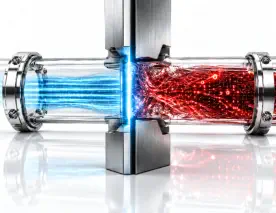
Conceptual 3D visual of volatile sapphire-glass panels being stabilised by a titanium pillar, representing immediate containment when an organisation has been hacked.Conceptual 3D visual of volatile sapphire-glass panels being stabilised by a titanium pillar, representing immediate containment when an organisation has been hacked.

Organisation Hacked:
What Now?

A cyber incident becomes harder not only when systems fail,
but when trust becomes unclear while decisions still need to be made.

Has your organisation been hacked? What to do first

A suspected cyber incident creates pressure to explain what happened before your teams have the evidence to answer. The first objective is more practical: stop the situation from expanding, protect the operations that matter most and preserve the evidence needed to understand what comes next.

Use the structure below if your organisation is facing ransomware, suspected data theft or another serious compromise. It is designed to support the opening phase, when facts are incomplete but delay can still increase the damage.

You do not need the complete picture to make the first safe containment decision.

Create a controllable boundary

The opening phase should reduce uncertainty without allowing the incident to keep moving. Four actions create a disciplined starting point:

1. Contain the activity you can see

Restrict affected accounts, sessions, systems or routes at the smallest safe boundary. Avoid broad shutdowns unless the evidence and operational risk justify them.

2. Preserve the evidence

Record what was observed, when it was observed and which actions were taken. Coordinate isolation and shutdown decisions with your incident-response specialists so that urgency does not destroy the evidence needed for investigation.

3. Protect essential operations

Identify the services that must continue, the degraded modes that are acceptable and the dependencies that could turn a technical incident into a wider operational failure.

4. Name the decision authority

Your security, technology, legal, communications and operational teams need to know who can approve a containment move before full certainty exists.
Stabilise the immediate risk, set a boundary and then validate whether the incident is slowing, moving or changing form.

Questions for the first hour and the next phase

First hour
Next phase
Where is malicious activity visible, and which route can be narrowed now?
Has data been collected, staged or removed from the environment?
Which identities, sessions, servers or shared services require immediate restriction?
Have the original entry path and any routes back in been identified and closed?
Which critical services must remain available, even in a controlled degraded mode?
Are backups, recovery tooling and identity services clean enough to support restoration?
Who can authorise the action and accept its operational consequence?
Which legal, regulatory, insurer, customer and partner notifications require action?
How will your teams confirm that the intervention changed the attack path?
What evidence will support restart, communication and closure decisions?

The questions are deliberately operational. They move the response from a search for perfect knowledge towards decisions that can reduce harm while the investigation develops.

When data may have left

A data-theft incident begins affecting people outside your environment before the technical timeline is complete. Customers, employees or partners may need clear warnings, fraud guidance and a reliable place to verify updates while your internal teams are still establishing scope.

Bring privacy, legal, communications and victim-support responsibilities into the response early. Their work should follow verified facts, but it should not wait for a final forensic report if people already need practical protection.

Odido: public support began while the investigation continued

Odido states that its services remained available during the February 2026 cyberattack, yet the incident affected approximately 6.39 million people and required direct notifications, expanded service support and continuing public updates. Availability therefore did not remove the need for a large victim-support response.

The Dutch police added the Odido dataset to Checkjehack and warned that stolen personal details could make phishing messages and calls more convincing. The Central Identity Fraud Reporting Centre separately explained that a breach does not automatically mean identity fraud, while still advising affected people to monitor unexpected messages and financial activity.

The durable lesson is not about one company. When personal data is involved, your response has two simultaneous tracks: contain and investigate the incident, while giving affected people proportionate guidance based on what is already known.

Sources
Odido — Update over de cyberaanval:
https://www.odido.nl/veiligheid

Dutch Police — Checkjehack aangevuld met Odido:
https://www.politie.nl/nieuws/2026/maart/2/checkjehack-aangevuld-met-odido.html

RvIG / CMI — Datalek Odido veroorzaakt ongerustheid:
https://www.rvig.nl/nieuws/26-02-2026-datalek-odido-veroorzaakt-ongerustheid-cmi-geeft-advies
View more details chevron A white downward-facing V-shaped chevron on a transparent background.
View more details
Close more details

Use our incident resource pack

Our incident resource pack gives your teams a practical structure for the period after the first shock. It brings together three linked needs:

  • Post-theft containment confirmation: check re-entry risk, egress restrictions, evidence preservation and whether the attacker is still active.
  • Safe stabilisation and rebuild: sequence critical services, identity resets and validation gates before reconnecting to the wider environment.
  • Damage control and communication: organise customer guidance, partner updates and decision records while facts are still developing.
Request the incident resource pack or contact us
if your organisation needs a structured first response to a live cyber incident.

Where our platform fits

Our role is to help your teams establish operational containment after prevention has been bypassed. We complement the work of your incident-response, infrastructure, legal, communications, insurer and recovery specialists; we do not replace any of them.

Our platform helps authorised teams detect and interrupt malicious behaviour, reduce spread and preserve a smaller operating environment while investigation and continuity decisions continue. Ransomware Containment is the core platform. Server Intrusion Protection and Virtual Server Protection are additional features running on it, extending the available controls to server intrusion and virtual infrastructure.

The practical value is decision space. When unsafe activity can be narrowed without disconnecting everything around it, your teams have more room to investigate, protect essential services and choose the next move on evidence rather than panic.

A note for private individuals

We support organisations rather than private individuals. If you have personally been affected by a breach, identity fraud, phishing or another online scam, contact the organisation involved and use the official guidance provided by the police, your bank or the relevant national cyber-safety service.

Run a resilience assessment.

For organisations that want a focused, practical comparison, we can run a free remote ransomware resilience assessment in a controlled sandbox environment. With your existing security controls left active, we use several ransomware variants to observe how the current security stack responds once encryption begins. We then repeat the same scenarios with our ransomware-containment layer enabled and compare the outcomes.

Further readings