The deeper risk is not only that the attacker enters. It is that each step creates the next decision before the organisation has regained control. This sequence is the orientation point. The deeper incident-reality pages explain where controlis usually lost and how the cascade can still be interrupted.



Detect - Contain - Stabilise
when prevention fails.
Our platform detects, contains and stabilises
malicious behaviour.
malicious behaviour.
Detect. Contain. Stabilise when prevention fails.
We provide an operational containment platform for the moment something malicious has already slipped through.
Our platform stops ransomware encryption before one foothold becomes a wider operational crisis. Across a wider set of containment capabilities, it also helps detect malicious behaviour after entry, interrupt lateral movement, prevent data theft and protect virtual server environments.
Prevention reduces the chance of entry. Detection shows what may be happening. Neither automatically preserves control once malicious behaviour is already active. The outcome depends on whether credible signals can become safe action quickly enough to stop the cascade.
Our platform stops ransomware encryption before one foothold becomes a wider operational crisis. Across a wider set of containment capabilities, it also helps detect malicious behaviour after entry, interrupt lateral movement, prevent data theft and protect virtual server environments.
Prevention reduces the chance of entry. Detection shows what may be happening. Neither automatically preserves control once malicious behaviour is already active. The outcome depends on whether credible signals can become safe action quickly enough to stop the cascade.

Take an action now
Run a free resilience assessment to see where control is gained or lost when ransomware gets through.
Run a free resilience assessment →
Run a free resilience assessment →

Look at our containment platform
Explore how our containment layer works alongside prevention, detection, EDR, SIEM, NAC, response and recovery capabilities.
Explore our platform →
Explore our platform →
What our platform is built to do
Our platform is fully complementary to your existing security stack, delivering an operational containment layer at the exact moment a breach occurs.
Detect after entry
Recognise malicious behaviour once prevention, identity or access controls have already been bypassed.
Platform informationStop lateral movement
Terminate movement before one compromised identity, server or pathway becomes a wider blast radius.
Server intrusion protection (PDF file)Prevent data theft
Reduce exposure before stolen data becomes legal, customer, regulatory and extortion leverage.
Data exfiltration & exposure controlStop ransomware encryption
Interrupt encryption activity before operational pressure becomes broad disruption.
Ransomware containment (PDF file)Protect virtual environments
Treat the virtual server layer as an active control point, not an invisible infrastructure detail.
Virtual layer protection (PDF file)Stabilise operations
Preserve the room to decide, report, recover and explain while the incident is still moving.
Returning to control (PDF file)Modern ransomware is no longer a single event. It is a sequence.
Access. Movement. Data theft. Extortion. Disruption. Decisions under pressure. Consequences that reach far beyond IT.
That is why ransomware is no longer only a technical disruption. It is a business, legal, and human crisis that unfolds in real time.
How incidents escalate once control slips
A cyber incident is rarely one event. It is a sequence:
Access


Movement
Data theft
Encryption or destruction
Recovery and explanation

Decisions under incomplete facts
Disruption
Extortion pressure
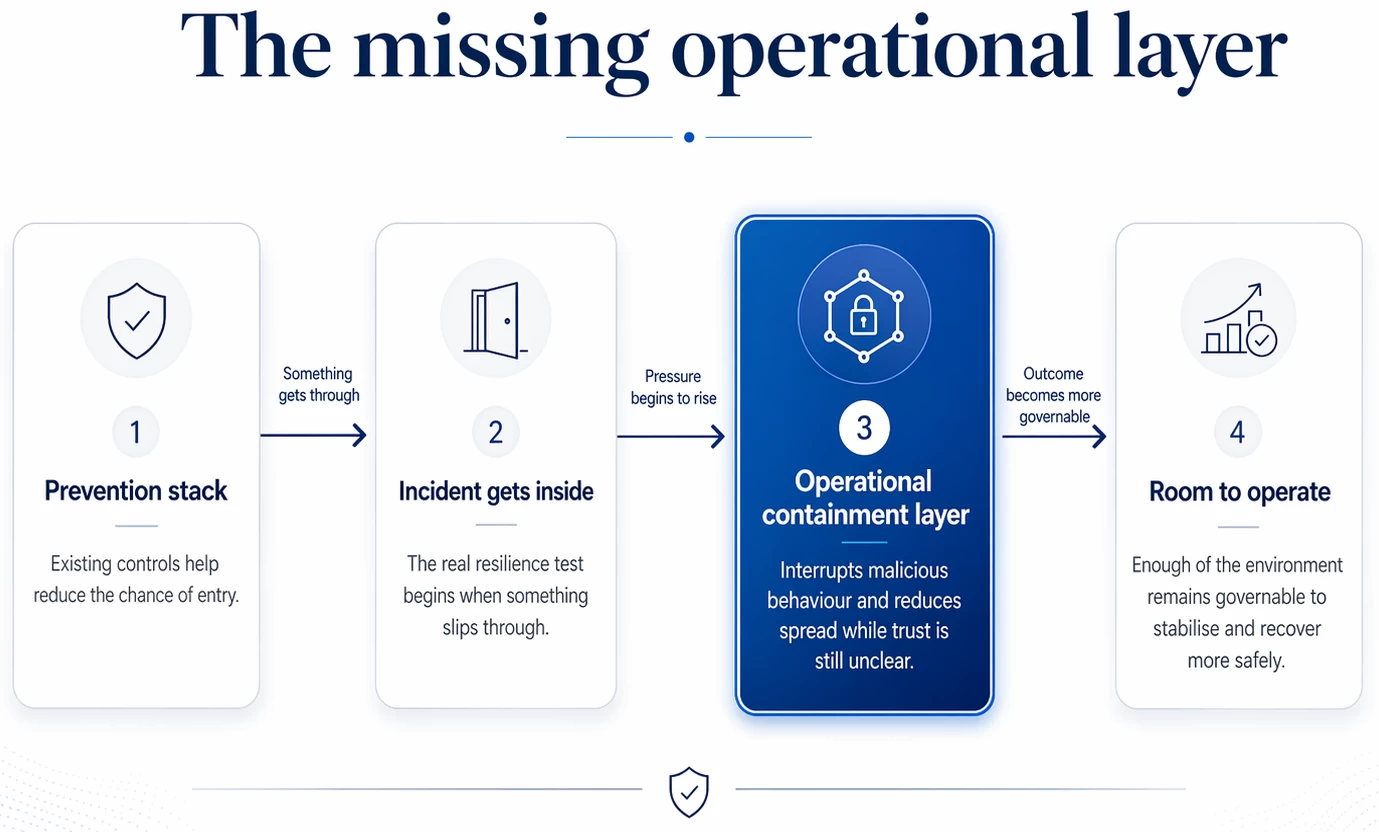
Most security tooling is designed to prevent, detect, or report
Prevention remains essential. But once a boundary has been breached, organisations face a fundamentally different problem: leadership may be able to see pressure building, yet still struggle to act early enough to change the trajectory.
Our platform bridges this critical gap. It is not introduced to add another dashboard, nor to serve as recovery theatre, and it is certainly not a replacement for the security stack already in place.
Instead, it establishes the operational layer required to detect malicious behaviour post-entry, contain it before it can spread further, and stabilise the environment before uncertainty, delay, and widespread damage take hold.
Where our platform fits
Our platform bridges the critical gap between detection and governable action.
While most security tooling is designed to prevent, detect, report, investigate, or recover (layers that remain absolutely essential) organisations face a fundamentally different problem once a perimeter is breached. Your executive team may be able to see pressure building, yet still lack a safe, pre-calculated way to interrupt hostile behaviour before it spreads across the infrastructure.
Our containment platform delivers the vital operational blast-shield required when malicious threats breach your perimeter. It turns a credible signal into decisive, governed action by, amongst other actions, detecting post-entry malicious behaviour, stopping lateral movement and data theft, and neutralising data encryption before it can spread. Our containment platform also actively safeguards your virtual servers. Our platform preserves the systemic stability and operational control your team needs for confident investigation and recovery after the initial breach.
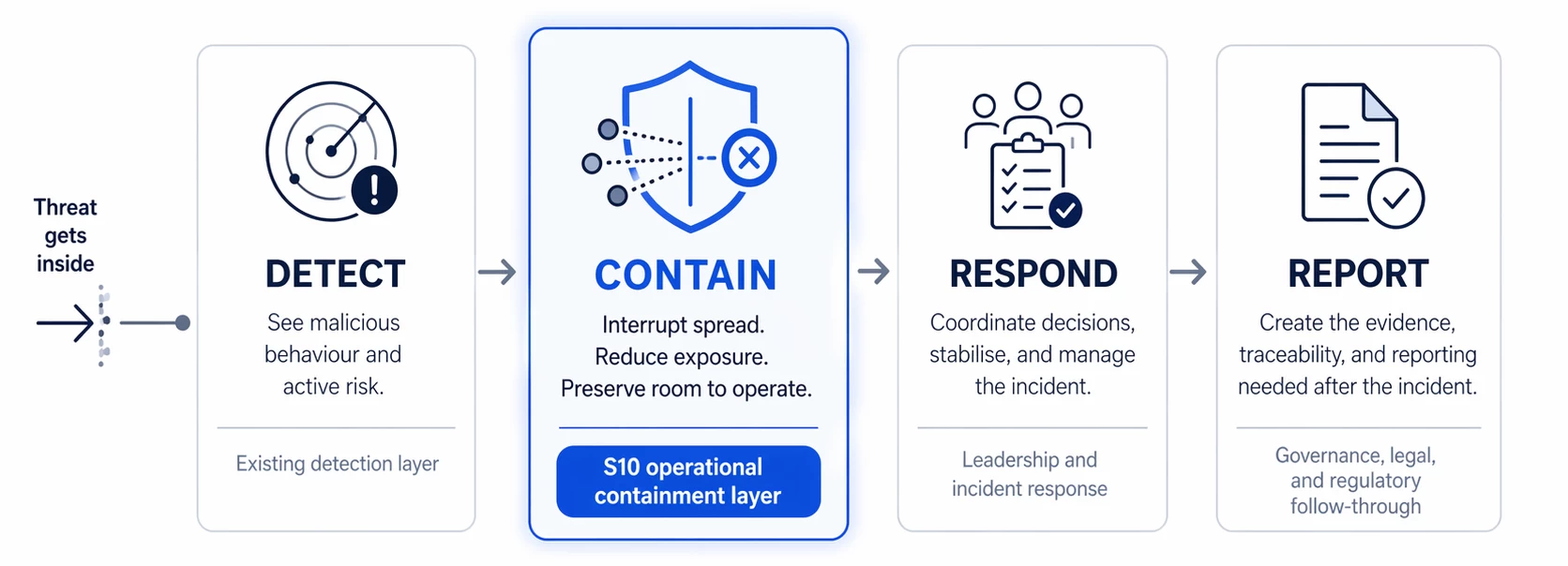
Detection creates awareness.
Containment creates a safe operational move.
Containment creates a safe operational move.
Move from assumption to evidence
Our free resilience assessment is a practical proof step. Compare controlled file-encryption scenarios with your existing security controls active, first without Ransomware Containment and then with it.
The assessment itself is limited to encryption, but alongside the assessment results, we can explain how our platform and its additional Server Intrusion Protection and Virtual Server Protection features, helps detect and interrupt lateral movement, reduce the risk of data theft, protect remote server access and defend virtual environments such as VMware and Hyper-V. That makes the session useful not only as a ransomware-containment test, but also as a practical discussion about what your organisation can still control when identity, privilege and infrastructure trust come under pressure.
If something gets through, what can your organisation still control?
The answer is not another claim of perfect prevention. It is the demonstrated ability to interrupt spread, reduce data exposure, protect virtual environments and stabilise operations before an incident becomes harder to govern.
Contact us to discuss what containment could look like in your environment.
Articles and newsletters
Current evidence and continuing insight
The evergreen pages define our control model. Articles and newsletters connect that model to current incidents, recurring executive questions and recognisable operational moments.
Together, they provide the evidence, context and interpretation that show what control under pressure means in practice.
Articles
Newsletters
Articles translate the evergreen architecture into recognisable operational moments: how incidents unfold, where control is lost and what leadership can still do after prevention is bypassed.
Newsletters track recurring executive questions around identity, dependency, first-hour authority, detection-to-action and other current evidence themes.
Upcoming articles
Wednesday 28 Oct 2026, Leadership-series #8: "Detection Does Not Automatically Create Control"
Friday 30 Oct 2026, Operational Attack-series #8: "When the System That Defines Trust Can No Longer Be Trusted"
Monday 2 Nov 2026, Resilience-series #9: "When Every Minute Matters, Readiness Cannot Wait"

PAGE NAVIGATION
FURTHER READINGS
Stop the cascade