Cyber Incident Consequences: A cyber incident expanding beyond IT into business, legal, data, decision and human consequence.Cyber Incident Consequences: A cyber incident expanding beyond IT into business, legal, data, decision and human consequence.

Cyber Incident Consequences

Prevention reduces the chance of entry.
It does not determine the outcome.

Where consequences meet control

The boardroom reality of managing an active incident under pressure.

Ransomware is no longer a narrow technical disruption. It is a business, legal and human crisis that unfolds in real time.

Most organisations have invested seriously in cybersecurity. That matters. But serious investment does not remove the need to govern what happens when a threat still gets through.

The modern resilience question is no longer merely whether an attacker can be kept out; it is what happens next. It is a question of how far an incident can move, what can still be trusted, which decisions can be made before certainty exists, and how much consequence can still be prevented.

Prevention reduces the chance of entry.
It does not determine the outcome.

The shift that changed the question

Ransomware is no longer best understood as a single event.

It is a sequence: access, movement, data theft, extortion, disruption, decisions under pressure, and consequences that continue after the technical phase begins to stabilise.

That sequence changes the meaning of resilience. It is not enough to ask whether the organisation has tools, policies or recovery plans. The harder question is whether the organisation can still limit damage once prevention has already been bypassed.

The real resilience test begins after the attacker is already active.

Six dimensions of consequence

What organisations face today is not one risk. It is a chain of consequences that unfolds once control starts to slip.

How these six dimensions connect

These six dimensions do not sit neatly apart from each other.

Technical behaviour creates uncertainty. Uncertainty slows decisions. Delayed decisions increase impact. Data exposure expands the incident outward. Financial, legal and human consequences then continue to build while the organisation is still trying to regain control.

Initial incident

An intrusion or ransomware begins
Compact light blue arrown pointing rightCompact light blue arrown pointing down

Trust becomes uncertain

Systems may still run but confidence in identity and control starts to fail
Compact light blue arrown pointing rightCompact light blue arrown pointing down

Leadership decisions

Critical choices must be made before certainty exists
Compact light blue arrown pointing downCompact light blue arrown pointing down

The human toll

Stress, workload, reputation, and recovery burden continue long after the event
Compact light blue arrown pointing leftCompact light blue arrown pointing down

Governance and legal pressure

Board accountability, reporting duties, and external scrutiny become real
Compact light blue arrown pointing leftCompact light blue arrown pointing down

Operational and data impact

Disruption spreads while data theft and exposure increase the stakes

Technical behaviour creates uncertainty. Uncertainty slows decisions. Delayed decisions increase impact. Impact then triggers legal, financial, reputational, and human consequences that reach far beyond the original point of entry.

Incidents escalate when control cannot keep up with what is happening.

Where most organisations struggle

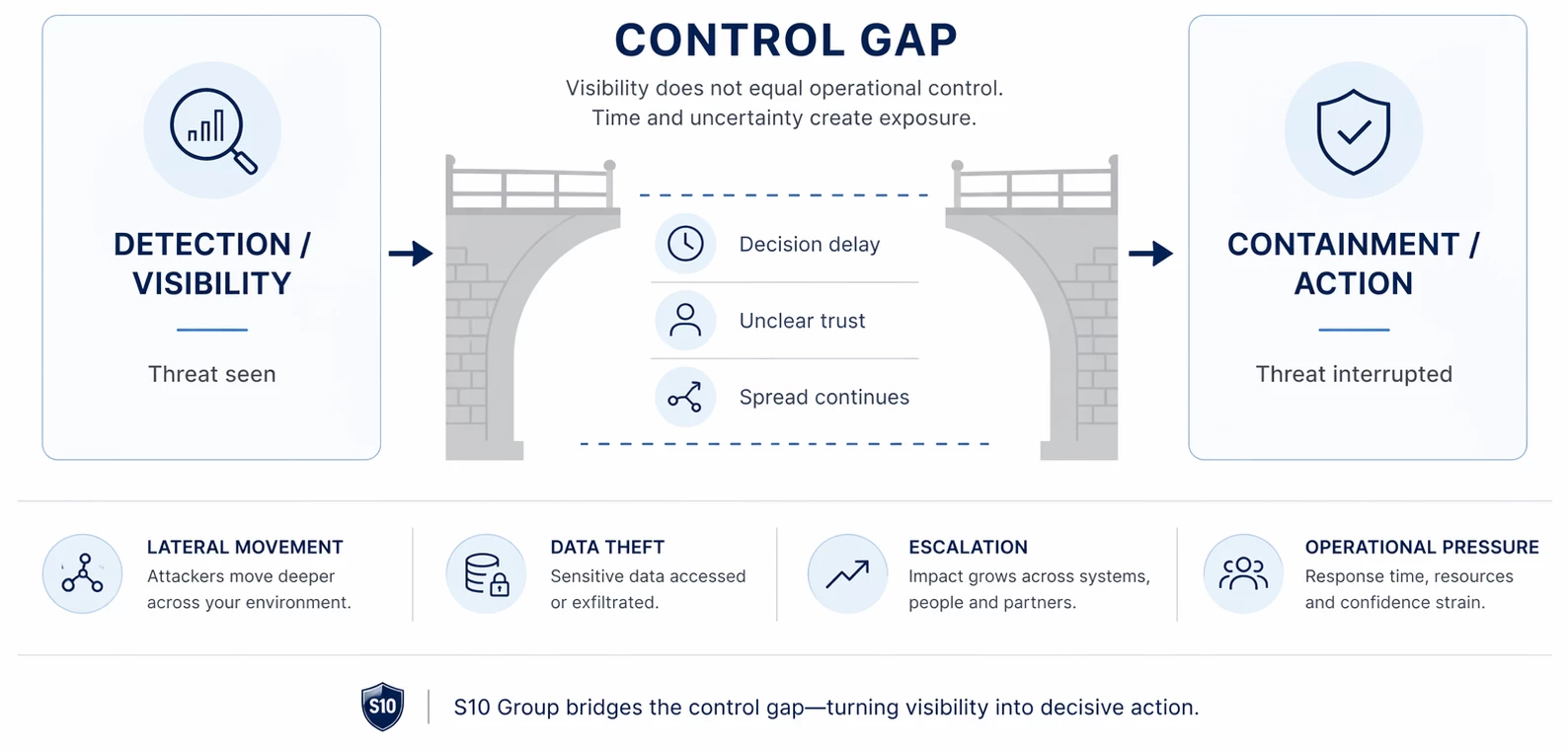
Most organisations are not lacking security tools. They are facing a different gap.

When something slips through, many environments can detect that pressure is rising. Far fewer can convert that awareness into a safe operational move quickly enough to matter.

The ability to act under uncertainty

  • Clear authority during the first phase
  • A safe operational move to limit spread
  • Control once prevention has been bypassed
  • Stabilisation before rebuild becomes unsafe
An infographic titled 'Control Gap', explaining why visibility does not equal operational control. It illustrates a broken stone bridge with a physical gap between a left card labelled 'Detection / Visibility (Threat seen)' and a right card labelled 'Containment / Action (Threat interrupted)'. Inside the gap, text highlights 'Decision delay', 'Unclear trust', and 'Spread continues'. The bottom section details the risks: Lateral Movement, Data Theft, Escalation, and Operational Pressure, concluded by a brand statement: 'S10 Group bridges the control gap—turning visibility into decisive action
The gap is not more tooling.
It is executable control.

The real question

The question is no longer only:

"Can we prevent attacks? 

It is:

"Can we stay in control when something slips through?"

That is the question that now sits behind resilience, governance, continuity, and defensible leadership.

How control changes the outcome: "the managed incident"

Control transforms a moving crisis into a structured, governable event.
Control under pressure is what prevents cascade.

Limit spread

Reduce lateral movement before the blast radius widens.

Protect critical services

Preserve enough of the environment to keep operating, even in degraded conditions.

Reduce exposure

Interrupt data theft before leverage becomes harder to contain.

Support clearer decisions

Create room for better judgement while trust is still being rebuilt.

Changing the trajectory of a cyber crisis

Our platform is not built to promise perfect prevention, nor is it a broad recovery programme; instead, it establishes operational control during the precise window an incident unfolds.

In many environments, a threat can slip through undetected, only becoming visible later in logs, alerts, or forensic reviews. While this forensic data helps explain what happened, it does nothing to stop the incident from actively developing.

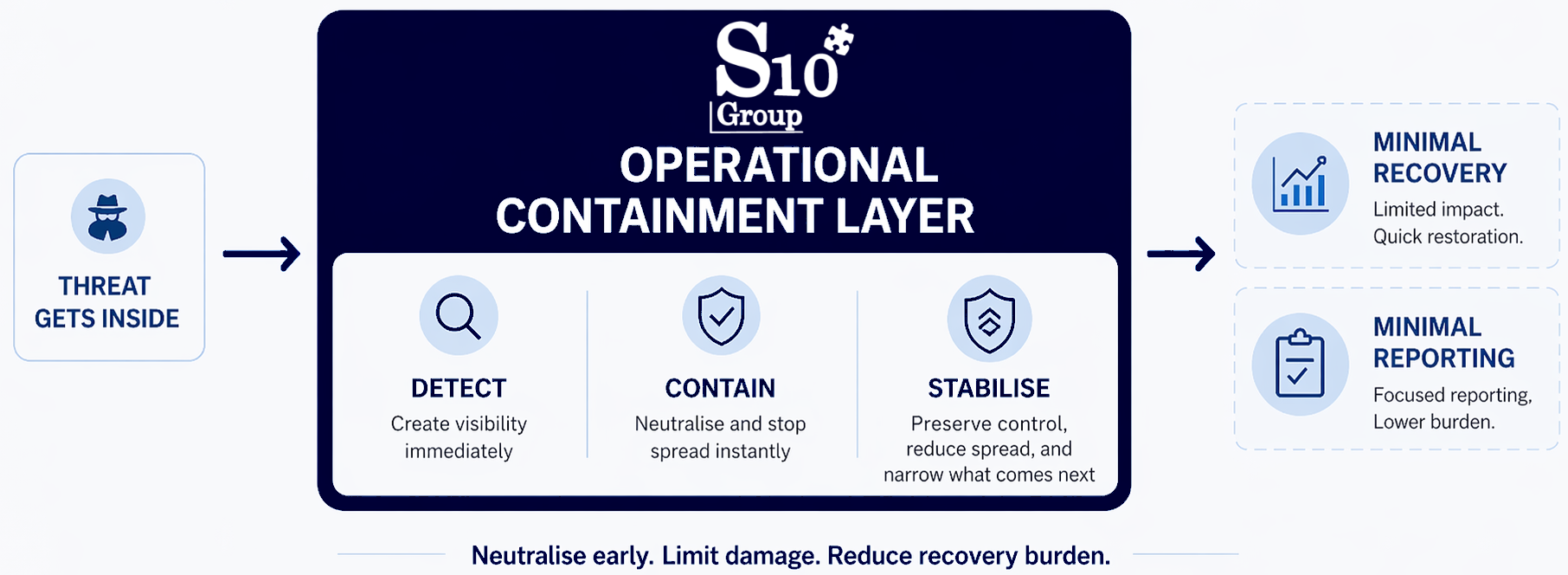
Our platform bridges this critical gap. It provides a dedicated operational containment layer that detects malicious behaviour immediately after entry and contains it before it can spread further. By establishing immediate stability, it protects the environment at the exact juncture where many organisations would otherwise struggle to determine what can be trusted, what must be isolated, and how far the breach has travelled.

The result is a fundamentally different kind of incident. Early neutralisation completely changes the trajectory of what comes next. The scope of recovery narrows significantly. While regulatory reporting remains a necessary requirement, the administrative burden is minimised because widespread damage was prevented. Ultimately, this safeguards organisations from severe downstream disruption, saving the immense time, cost, and long-tail consequences explored in "What happens when data leaves your organisation" and "The Human impact".


A process infographic explaining the 'Operational Containment Layer' by S10 Group. It shows a linear timeline starting from a left card labelled 'Threat gets inside' with a hacker icon, pointing to a central navy blue card titled 'Operational Containment Layer'. This central layer contains three steps: 'Detect (Create visibility immediately)', 'Contain (Neutralise and stop spread instantly)', and 'Stabilise (Preserve control, reduce spread, and narrow what comes next)'. Arrows then point to two right-hand outcome cards: 'Minimal Recovery (Limited impact. Quick restoration.)' and 'Minimal Reporting (Focused reporting. Lower burden.)'. The footer reads: 'Neutralise early. Limit damage. Reduce recovery burden.
The missing layer is not more awareness. It is the ability to act before the incident becomes much harder to govern.

Understand where your organisation stands when prevention has already been bypassed.

Run a controlled resilience assessment to see how your environment behaves under ransomware pressure, where control is likely to be lost, and what changes when containment becomes executable.
Run a controlled resilience assessment represented by four corporate executives in formal business attire—two men and two women—gathered tightly around a large conference table in a darkened glass-walled boardroom late at night. They are looking intently at a document held by a senior executive, with serious, focused expressions, while the empty office interior is visible through the glass partitioning in the background.
DISCOVER HOW OUR PLATFORM WORKSRUN A RESILIENCE ASSESSMENT

Further readings