


Sapphire data chevrons with a red detection node isolated by a blue-edged titanium containment wedge.Sapphire data chevrons with a red detection node isolated by a blue-edged titanium containment wedge.
Part of Cybersecurity Blind Spots

Detection Is Not Interruption

Why a critical alert needs a completed response and a confirmed effect.

The red light is not the control

Imagine a critical alert arriving at 02:00. Your security team identifies suspicious activity on a server and requests isolation. The incident has been acknowledged, the right people have been notified and the response command has been sent. The dashboard now shows that someone is dealing with it.

Your organisation still needs an answer to a different question: has the isolation taken effect? A request awaiting execution leaves the outcome unresolved. Even a completed action needs to be checked against the activity it was intended to stop and the systems it actually covers.

Detection gives your team a reason to investigate and respond. Interruption changes what the affected user, session or system can still do. The distinction matters whenever an alert is treated as reassurance before anyone has established that the unsafe activity has been restricted.
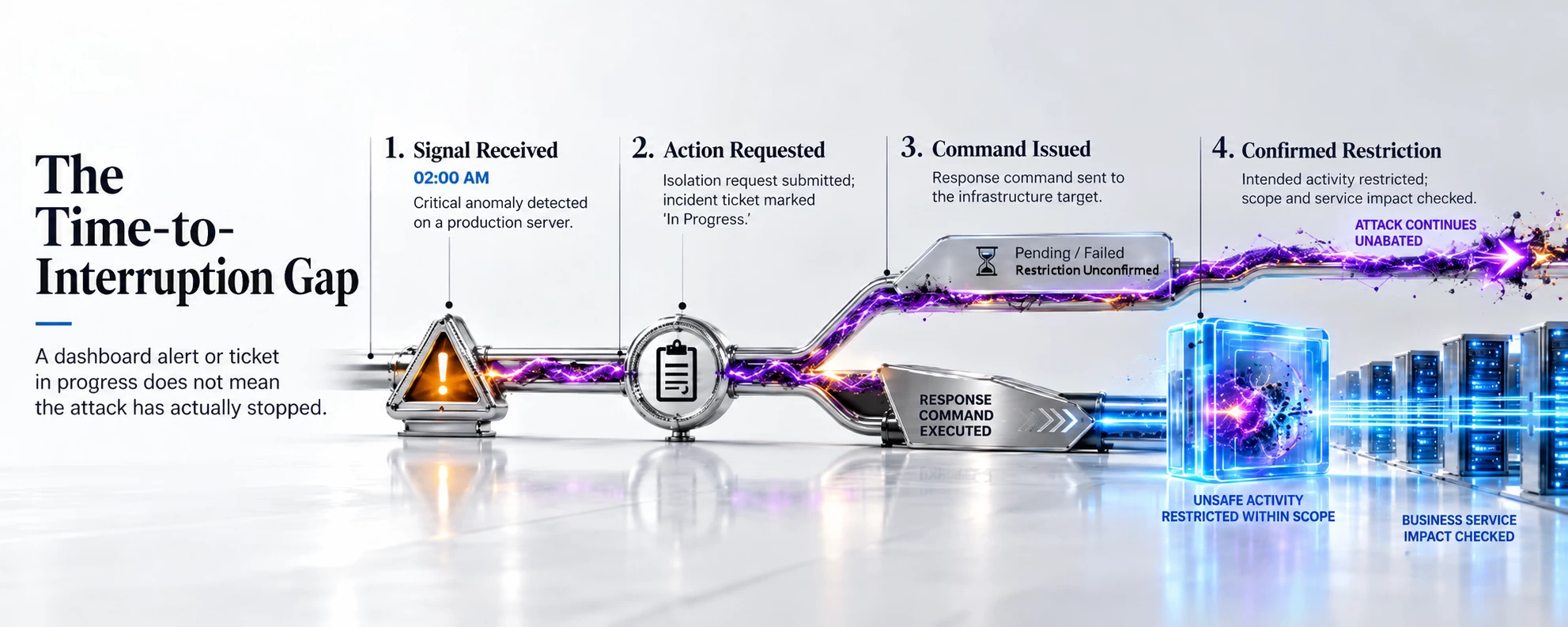

An alert, an acknowledged incident and a submitted response action are different milestones. The outcome to demonstrate is the restriction that has actually taken effect.

Detection can trigger action; the action still needs checking

Endpoint detection and response, identity monitoring, security information and event management, and security operations teams all contribute to recognising an incident. Some products also block activity or automatically isolate affected devices. Your existing investment may already provide an effective response for particular threats and systems.

The useful question is which response is enabled in your environment, under which conditions, and how your team establishes that it worked. Product capability, configured policy and the result of a particular action need to be distinguished. A console offering isolation does not establish that every asset is covered or that isolation was completed for the asset involved.

Measure the interval to an effective restriction

Detection time is a useful measure, but it does not describe the whole response. For a chosen incident scenario, your team should also be able to explain when the signal was reviewed, when an action was selected, when it was authorised or triggered under agreed rules, and when the restriction took effect.

Separate timestamps make a delay easier to locate. An alert may sit unreviewed, a responder may lack permission, or an isolation request may remain pending. Each problem calls for a different correction. Reporting that the incident was acknowledged quickly can conceal all three.

The relevant interval is from the signal your team can act on to the confirmed restriction of the activity in scope. No universal number of minutes proves that every attack is controlled. The acceptable interval depends on the activity, the available response and the consequences of delay. Recording it gives your organisation evidence for a specific scenario instead of confidence based on an alert count.

A cybersecurity timeline infographic on a light background titled The Time-to-Interruption Gap, illustrating incident response milestones for CISOs. The horizontal visual maps four distinct stages of a critical 02:00 AM server alert: Signal Received, Action Requested, Command Issued, and Confirmed Restriction. A sapphire-glass containment layer and a titanium barrier isolate a purple threat stream at the final milestone, demonstrating the difference between a pending ticket and a verified technical restriction.

An exercised plan must reach the people and tools needed

For your organisation, a useful exercise follows the response through the actual handoffs. Can the on-duty team reach the necessary decision-maker, use the agreed controls and confirm the result? External assistance needs the same preparation. Access, responsibilities and communication routes should be usable when the ordinary team or working arrangements are unavailable.

The response needs a usable path and a confirmed result

CISA - CISA Shares Lessons Learned from an Incident Response Engagement
A plan did not provide timely responder access
In AA25-266A, an unexercised response plan lacked procedures for involving third parties and granting access to security tools. Those omissions delayed elements of CISA’s response.
https://www.cisa.gov/sites/default/files/2025-09/AA25-266A_advisory_cisa_shares_lessons_learned_from_ir_engagement.pdf

Microsoft - Take response actions on a device
An action request needs status confirmation
Defender for Endpoint documentation describes response actions and checks for applied isolation, including pending or failed status. It shows why execution needs confirmation even where automation is available.
https://learn.microsoft.com/en-us/defender-endpoint/respond-machine-alerts

What these public records mean for your organisation
The two sources address different links in the response: the people and access needed to act, and confirmation that a technical restriction was applied. Your exercise should follow both, then check the effect within the intended scope.

Note: CISA’s case does not establish that automatic isolation was absent or would have prevented the intrusion. Microsoft’s automatic device-isolation section is Preview and has a defined scope. Availability depends on product, supported target and configuration.

‍

View more details chevron A white downward-facing V-shaped chevron on a transparent background.
View more details
Close more details

Choose a bounded action before pressure makes the choice harder

An interruption decision can affect a legitimate service. Restricting a server may interrupt an application; containing an account may affect several dependent processes. Your security and service teams need to agree which actions are permitted, which consequences are acceptable and which situations require escalation.

Pre-authorisation can cover a human response or an automated action under defined conditions. The aim is to make the first appropriate restriction available without inventing permission during the incident. Where a high-impact action still needs approval, the decision route needs to work outside normal hours.

Identity misuse adds a specific challenge. An account may be valid while the activity performed through it is unsafe. The response should identify what it intends to restrict: a particular session, a device, server access or an account. Those targets are not interchangeable, and their operational effects need to be understood before the action is relied upon.

A bounded action should also have an owner for review and release. Containment can create time for investigation while leaving questions unresolved. Restoring access requires its own decision; the fact that an alert has been closed is insufficient evidence that reconnection is safe.

Confirm the effect and know the fallback

A completed command is evidence of execution. Your team also needs evidence that the intended activity is restricted. If a device was isolated, which communications were stopped and which were deliberately retained? If access was contained, did the unsafe activity cease within the protected scope? Those checks connect the response record to its operational purpose.

The same discipline applies when an action cannot be confirmed. Agree who investigates a pending or failed response and which alternative restriction is available. An unanswered request should remain visible as an unresolved response, rather than disappearing into a ticket marked “in progress”.

Successful containment of one target does not establish that every affected system is safe. The investigation still needs to consider other activity and decide whether to extend the response. Your executive team needs a clear account of what was restricted, what remains uncertain and which service impact is being managed.

Five questions for your executive and security teams

Use a recent exercise or a defined incident scenario to answer these questions with evidence:

  1. When a critical alert arrives at 02:00, which restriction can the on-duty team execute under existing permissions or agreed automated rules?
  2. Which user, session, device or server does that action cover, and which business services could it affect?
  3. What record distinguishes the alert, the submitted action, completed execution and the confirmed effect?
  4. Who notices a pending or failed action, and what is the tested fallback when the intended restriction cannot be confirmed?
  5. Who reviews the remaining exposure and decides when restricted access can safely be restored?

How our platform connects a signal to containment

Our Ransomware Containment platform (RC) agentlessly monitors the protected file environment. When illegitimate encryption starts, RC detects the activity and isolates the responsible user, session and device to stop further encryption within that protected scope.

Server Intrusion Protection (SIP) and Virtual Server Protection (VSP) are additional features running on this platform. SIP detects and contains compromised server access; VSP protects supported hypervisor environments against attacks directed at that layer.

We connect defined unsafe activity to a containment action. The deployment still needs clear coverage, agreed response rules and review of the outcome.

See the effect of containing active encryption

Our remote ransomware resilience assessment demonstrates a specific part of the detection-to-interruption question. In an agreed, isolated test environment, we run controlled file-encryption scenarios with your existing security controls active, first without Ransomware Containment enabled and then with it enabled.

The comparison shows how active encryption is handled within the agreed scope. We can definitely explain the additional features and discuss broader response requirements as part of this assessment →.

The answer your incident report should provide

Detection is valuable because it enables your team to respond. Confidence becomes better founded when the response can be traced through permission, execution and effect, including what happens when the intended action does not complete.

After the next critical alert, your organisation should be able to say which unsafe activity was restricted, when that restriction took effect and what remained outside its scope. An alert acknowledged is a milestone. An effective restriction is a change in the incident.

Further readings