


Conceptual 3D visual of a calm green surface masking volatile ransomware exposure underneath, isolated by a titanium containment plane to show why payment is not recovery.Conceptual 3D visual of a calm green surface masking volatile ransomware exposure underneath, isolated by a titanium containment plane to show why payment is not recovery.

Paying Is Not a Recovery Strategy

A payment may change the pressure; it cannot verify the recovery state

The difference between relief and evidence

A ransom demand compresses time and makes payment look like a direct route back to operations. It may appear to offer a decryptor, a promise not to publish stolen data or a way to shorten disruption. None of those outcomes creates a recovery strategy your teams can control.

Recovery depends on evidence: the attacker has been removed, the entry path has been closed, systems and backups are safe to use, stolen data has been assessed and essential services can return without reopening the incident. A payment cannot establish any of those conditions.

Payment responds to an attacker’s demand.
Recovery establishes a state your organisation can verify and govern.

What payment can change, and what it cannot

A payment may produce a key or a promise. Even when the attacker delivers what was offered, your teams still face four separate questions:

Question
Evidence still required
Can we restore?
A decryptor may be slow, unstable or incomplete. Your teams still need tested backups, clean recovery tooling, prioritised services and validation before scale.
Has the data exposure ended?
An attacker’s assurance that data was deleted cannot be independently verified. Copies may remain, be resold or support later phishing and extortion.
Has access been removed?
Payment does not evict the attacker, revoke credentials, remove persistence or close the original entry path.
Can we reconnect safely?
Restored availability does not prove that identity, shared services, applications and dependencies are ready to be reintroduced to the wider environment.
The decision to pay may still arise under extreme pressure and should involve the appropriate legal, law-enforcement, insurer and specialist advice. The narrower editorial point remains: no payment should be mistaken for evidence that recovery is complete.

Why official guidance does not treat payment as recovery

The Dutch NCSC advises against paying because payment does not guarantee the return of data, does not confirm that returned information is unchanged and may be followed by further extortion or another attack. Dutch police guidance after the 2026 Odido incident adds that paying cannot establish that stolen data is safe; criminals may retain, resell or use it to demand more money.

The FBI takes the same position: payment does not guarantee that data will be returned and sustains the criminal incentive. These sources do not make the incident decision simple, nor do they replace case-specific legal advice. They support a durable governance distinction: an attacker’s cooperation is not a control your recovery plan owns.

A stronger recovery position comes from isolated and validated backups, evidence-led attacker eviction, closure of compromised routes, controlled restoration and communication based on verified scope.

Sources:
Dutch NCSC - Ransomware uitgelegd:
https://www.ncsc.nl/ransomware/ransomware-uitgelegd

Dutch Police - Politie adviseert bedrijven geen losgeld te betalen na cyberaanval:
https://www.politie.nl/nieuws/2026/februari/26/11-politie-adviseert-bedrijven-geen-losgeld-te-betalen-na-cyberaanval.html

FBI - Ransomware:
https://www.fbi.gov/how-we-can-help-you/common-frauds-and-scams/ransomware
View more details chevron A white downward-facing V-shaped chevron on a transparent background.
View more details
Close more details

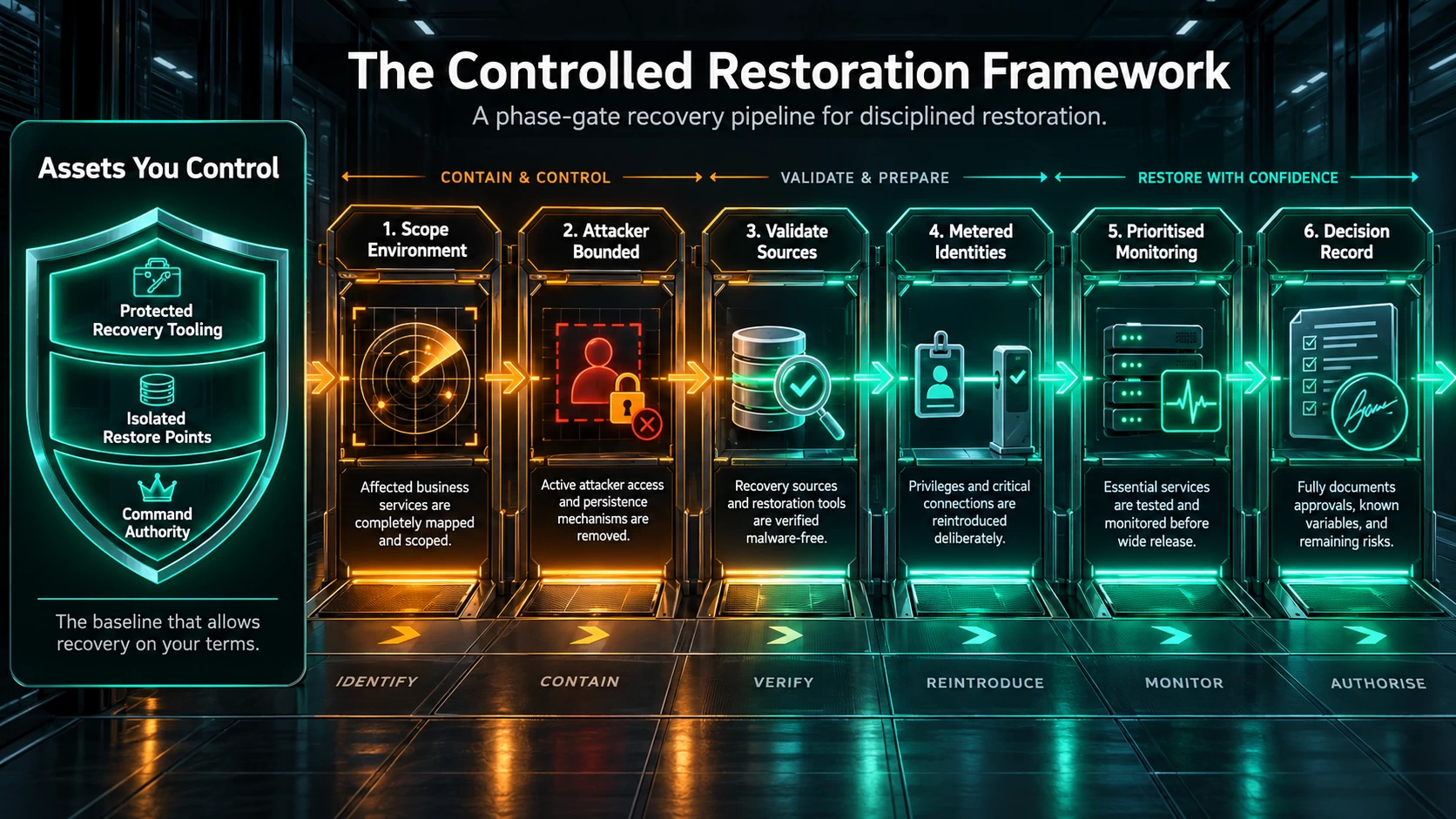
Recovery begins with assets you control

A credible recovery strategy reduces dependence on the attacker before the ransom note appears. It identifies critical services, protects recovery tooling, maintains isolated and tested restore points and gives your teams authority to contain malicious activity before encryption or data theft reaches the widest possible scope.

During the incident, the same strategy creates explicit gates for restoration:

  • the affected environment and business services have been scoped sufficiently for the next decision;
  • active attacker access and known persistence have been removed or bounded;
  • the recovery source and the tools used to restore it have been validated;
  • identities, privileges and critical connections are reintroduced deliberately;
  • essential services are prioritised, monitored and tested before wider reconnection; and
  • the decision record explains what was known, who approved the restart and which risks remain.
Controlled restoration framework showing how isolated restore points, protected recovery tooling and command authority support disciplined ransomware recovery.

Click on the image to view the high-resolution restoration framework.

A system is not recovered because it is available.
It is recovered when your teams can support why it is safe enough to use.

Data theft keeps the pressure alive

Encryption and exfiltration create different forms of leverage. A decryptor may help restore access to files, while stolen information remains outside your control. Customer records, intellectual property, internal communications or identity data can continue to create legal, human and commercial consequences long after systems return.

The recovery plan therefore needs parallel workstreams. Technical restoration cannot wait for every consequence to be known, but privacy, legal, communications and victim-support decisions cannot be postponed until the infrastructure is rebuilt.

How early containment changes the decision

Payment becomes more compelling when the attacker has already encrypted widely, disabled recovery options, removed sensitive data and disrupted the services your organisation cannot operate without. Containment cannot make the decision disappear, but it can reduce the leverage feeding it.

A smaller blast radius means fewer systems to restore, less uncertainty about where the attacker moved and more viable operating room while your executive team weighs the remaining choices. The strongest position is therefore built before negotiation: preserve alternatives so that the attacker does not own the only apparent route forward.

Where our platform fits

Our aim is to reduce the conditions that make payment appear to be the only path out. Our platform adds an operational containment layer after prevention has been bypassed, helping authorised teams interrupt malicious behaviour, reduce spread and preserve more of the environment for investigation and recovery.

Ransomware Containment is the core platform. Server Intrusion Protection and Virtual Server Protection are additional features running on it. Together, the available capabilities can help narrow active encryption, server intrusion and virtual-infrastructure exposure while your existing security and incident-response controls continue their work.

We do not provide ransom negotiation, legal advice or a promise that every incident becomes painless. Our contribution is more practical: create options before disruption, data exposure and uncertainty harden into a false choice between payment and chaos.

FOCUSED RANSOMWARE RESILIENCE ASSESSMENT

Compare controlled file-encryption scenarios with your existing security controls active, first without Ransomware Containment and then with it.

The assessment itself is limited to encryption, but alongside the assessment results, we can explain how our platform and its additional Server Intrusion Protection and Virtual Server Protection features, helps detect and interrupt lateral movement, reduce the risk of data theft, protect remote server access and defend virtual environments such as VMware and Hyper-V. That makes the session useful not only as a ransomware-containment test, but also as a practical discussion about what your organisation can still control when identity, privilege and infrastructure trust come under pressure.

Further readings