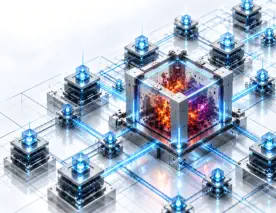
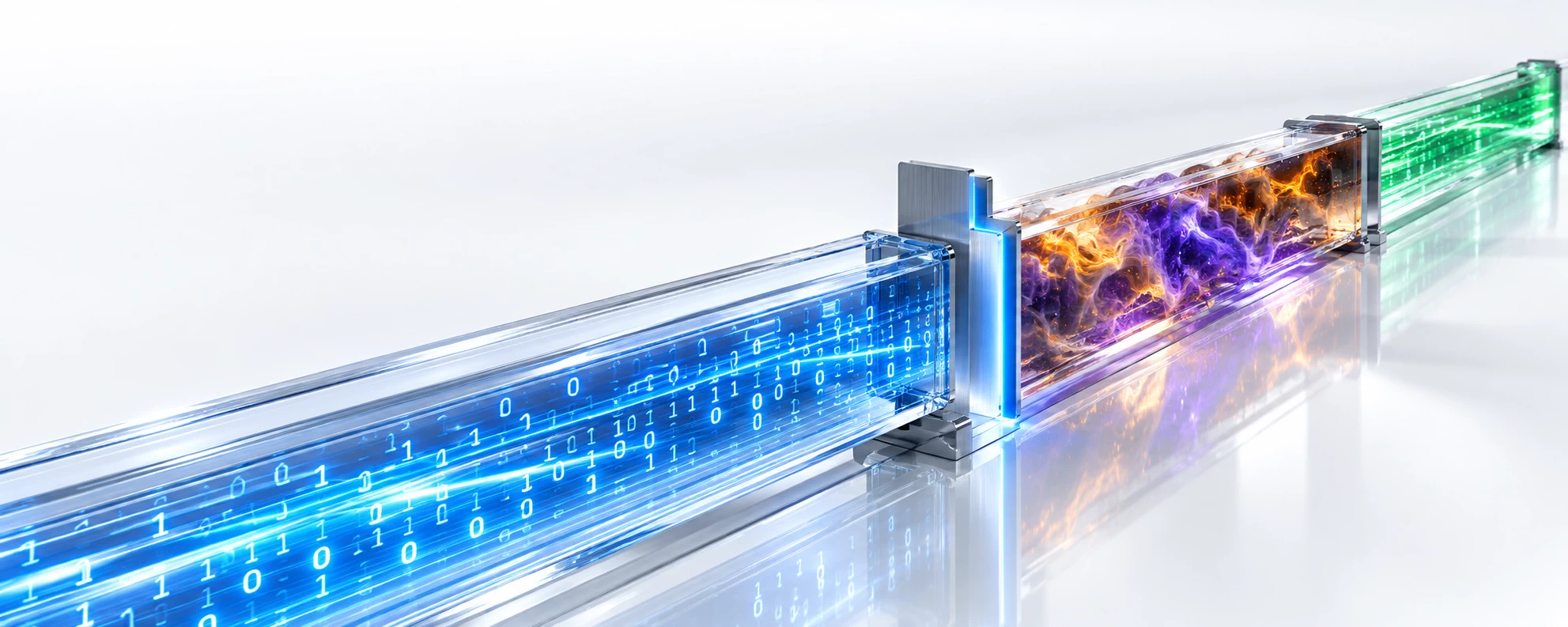

Conceptual 3D incident timeline where a valid access session becomes a volatile threat stream and is isolated by containment before the incident spreads.Conceptual 3D incident timeline where a valid access session becomes a volatile threat stream and is isolated by containment before the incident spreads.

How Incidents Actually Unfold

Why the visible disruption is usually late in the attack

The hidden timeline before visible crisis

A ransomware incident rarely begins with encrypted files. By the time employees see a ransom note or lose access to a service, an attacker may already have entered the environment, mapped its dependencies, expanded privileges, moved between systems and collected data.

The visible crisis is therefore not the whole incident. It is often the point at which a quieter progression becomes impossible to ignore. Understanding that progression helps your teams identify where interruption can still prevent a contained compromise from becoming a business-wide emergency.

SEQUENCE MATTERS
The visible incident often begins after the attacker has already completed the work that creates leverage.

The incident develops before the disruption

Every attack differs, and the stages may overlap or repeat. A useful executive model nevertheless follows seven recognisable movements:

Stage
What changes
1. Initial access
An attacker gains a foothold through credentials, an exposed service, social engineering, a vulnerability or an already approved route.
2. Discovery
The environment is mapped: identities, servers, data stores, security tools, backups and operational dependencies.
3. Privilege expansion
The attacker seeks broader authority through credentials, configuration weaknesses or administrative paths.
4. Lateral movement
Activity spreads through remote services, legitimate tools, sessions and connections that already support normal work.
5. Collection and staging
Sensitive data is identified, gathered and prepared for removal or later extortion.
6. Disruption
Encryption, destructive activity or service interference makes the incident visible to a much wider audience.
7. Operational crisis
Continuity, legal, communication and executive decisions converge while the technical investigation is still developing.
The model is not a stopwatch and attackers do not follow it neatly. Its value lies in showing that the dramatic final stages depend on earlier access and movement. The more of that progression your teams can interrupt, the less leverage reaches the visible crisis.

Authoritative frameworks place impact late in the sequence

MITRE ATT&CK separates the behaviours used to gain initial access, discover the environment, escalate privilege, move laterally, collect information, exfiltrate data and create impact. The framework is not a universal timeline, but it makes one point clear: encryption or disruption sits inside a much wider chain of attacker activity.

Microsoft Incident Response similarly advises teams to establish the current scope, identify affected business applications and remove the threat actor from the environment. Its guidance notes that attackers may disable security services, target backups and use legitimate administrative programs before encryption becomes the defining symptom.

The executive implication is practical. A late-stage alert may explain why operations have stopped, while an earlier behavioural signal may still provide an opportunity to narrow the route, reduce spread or protect recovery assets before the final impact arrives.

Sources;
MITRE ATT&CK - Enterprise tactics:
https://attack.mitre.org/tactics/enterprise/

Microsoft Incident Response - ransomware approach and best practices:
https://learn.microsoft.com/en-us/security/ransomware/incident-response-playbook-dart-ransomware-approach
View more details chevron A white downward-facing V-shaped chevron on a transparent background.
View more details
Close more details

Why the quiet stages are difficult to govern

Attackers can use valid accounts, built-in administration tools and ordinary service connections. An individual action may resemble legitimate work; the sequence, timing, destination or scale makes it dangerous. Better monitoring helps expose those differences, but the alert is only the start of the control problem.

Your teams still need to decide which account, session, host, server route or workload can be restricted without creating a wider outage. The decision becomes harder when the affected path supports essential operations or when several teams own different parts of the same dependency.

OPERATIONAL DIFFICULTY
Hostile activity can travel through the same identities, tools and routes that keep normal operations moving.

Control is lost between awareness and action

Many mature environments can detect suspicious behaviour. The larger gap appears when a credible signal cannot be converted into a proportionate intervention before the attacker moves beyond the boundary your teams understand.

Awareness without execution
Awareness with containment
A signal is escalated while teams debate scope, authority and operational impact. Existing routes remain open and the attack continues to develop.
A signal reaches a known decision owner, a bounded action narrows the unsafe route and evidence confirms whether the attack path changed.

The distinction is not a criticism of detection. Visibility is indispensable. It becomes operationally decisive when your response model also defines what can be interrupted, who may authorise the move and how continuity will be protected afterwards.

The sequence becomes an executive problem

Once movement reaches shared infrastructure, critical data or recovery assets, technical choices create business consequences. Your executive team may need to decide whether to isolate an environment, suspend a supplier route, continue a service in degraded mode or communicate before the full scope is known.

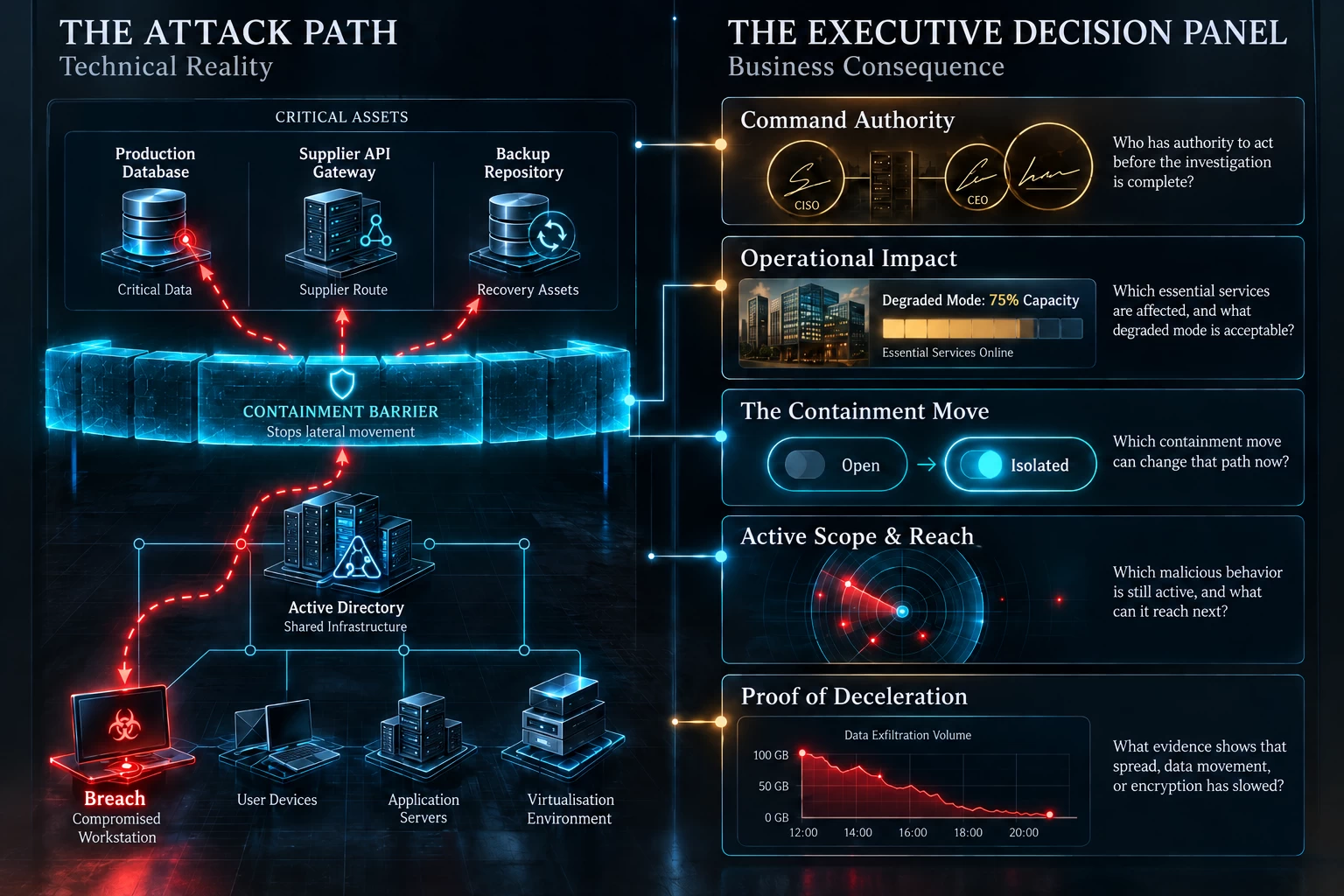
Those decisions should not begin with a generic question about whether the environment is trusted. They need a more concrete operating picture:

  • Which malicious behaviour is still active, and what can it reach next?
  • Which containment move can change that path now?
  • Which essential services would the move affect, and what degraded mode is acceptable?
  • Who has authority to act before the investigation is complete?
  • What evidence will show that spread, data movement, or encryption has actually slowed?
Cybersecurity containment infographic showing how a workstation breach can spread through shared infrastructure toward critical assets, while a containment barrier interrupts the attack path and turns the sequence into an executive decision on authority, operational impact, scope and proof of deceleration.

Click on the image to view the high-resolution Executive Decision Panel.

Where our platform fits

Our platform adds an operational containment layer after prevention has been bypassed. It complements SIEM, EDR, identity, network, incident-response and recovery controls by giving authorised teams another way to interrupt malicious behaviour while an incident is developing.

Ransomware Containment is the core platform. It detects active file-encryption behaviour across SMB and NFS activity and can isolate the affected user or session while your existing controls remain active. Server Intrusion Protection and Virtual Server Protection are additional features running on the same platform, extending the control model to server intrusion and virtual infrastructure.

Our value lies in changing the sequence. A precise containment move can keep more of the organisation outside the incident, protect recovery options and reduce the time, scope and rebuild effort required to return to control.

CONTAINMENT EFFECT
Containment creates value when it changes the incident before progression becomes cascade.

What your executive team should test

  • Can a credible signal reach a decision owner without waiting for a complete attack narrative?
  • Can your teams restrict one unsafe route without disconnecting every service around it?
  • Do they know which identities, servers, data paths and virtual environments require different controls?
  • Can essential operations continue in a tested degraded state while investigation proceeds?
  • Can the response team verify that the intervention worked and detect movement to another route?

FOCUSED RANSOMWARE RESILIENCE ASSESSMENT

Compare controlled file-encryption scenarios with your existing security controls active, first without Ransomware Containment and then with it.

The assessment itself is limited to encryption, but alongside the assessment results, we can explain how our platform and its additional Server Intrusion Protection and Virtual Server Protection features, helps detect and interrupt lateral movement, reduce the risk of data theft, protect remote server access and defend virtual environments such as VMware and Hyper-V. That makes the session useful not only as a ransomware-containment test, but also as a practical discussion about what your organisation can still control when identity, privilege and infrastructure trust come under pressure.

Further readings