


Conceptual 3D visual of a restored blue operational stream with a trailing unresolved threat loop blocked before re-entry, representing post-incident exposure control.Conceptual 3D visual of a restored blue operational stream with a trailing unresolved threat loop blocked before re-entry, representing post-incident exposure control.

The First Attack Is Rarely the Last

Why visible recovery can conceal a second risk period

The hidden exposure of the second risk period

A ransomware incident may appear to be ending once core services return and the most visible disruption subsides. Yet operational recovery can begin before compromised access has been fully removed, stolen data has lost its leverage or the original attack path has been understood.

That gap creates a second risk period. Your teams are reconnecting systems and restoring normal work while they may still be closing credentials, sessions, supplier routes, persistence mechanisms and recovery assumptions shaped by the first attack.

HEADER

Recovery creates a new exposure window

The pressure to move on is understandable. Employees need systems, customers need service and the executive team needs a credible path back to normal operations. Speed becomes dangerous only when availability is treated as proof that the conditions behind the attack have been removed.

A rushed reconnection can reintroduce an unsafe identity, restore a compromised configuration or reopen a supplier path before the response team has established why it is safe. A cautious recovery model therefore asks not only what has returned, but what may still remain.

Four things can survive the visible incident

Residual risk
What may remain
Residual access
Valid credentials, tokens, privileged sessions, remote-support routes, new accounts, altered policies or malicious components may provide another way into the environment.
Residual leverage
Stolen data, screenshots, internal records or knowledge of critical dependencies can continue to support extortion, fraud or targeted social engineering.
Residual uncertainty
Identity services, backups, shared infrastructure and restored workloads may still lack the evidence required for confident reconnection.
Residual knowledge
The attacker has learned which systems matter, how your teams respond, where decisions slow and which operational dependencies create the most pressure.
These conditions do not prove that another attack will occur. They explain why closure cannot be based solely on uptime or the absence of a new ransom note.

Persistence and repeat attacks: useful evidence, with limits

MITRE ATT&CK defines persistence as the techniques attackers use to keep access across restarts, changed credentials and other interruptions. Its catalogue includes account manipulation, additional cloud credentials, new accounts, web shells and modified authentication mechanisms. A password reset or system restart may therefore close one route without proving that every route has gone.

CrowdStrike’s 2025 State of Ransomware Survey, based on 1,100 global security leaders, reported that 83% of organisations that paid a ransom were attacked again, and that 93% had data stolen anyway.

Together, these sources support a careful conclusion: repeat risk is credible when access, leverage or exposure survives the first incident. The practical lesson is not that every paying organisation will be attacked again. The lesson is that a ransom payment does not remove the underlying weakness, prove the attacker has left, or guarantee that stolen data will not remain in criminal hands. Your recovery process still needs incident-specific evidence before it can declare those conditions closed.

That is also why recent FBI and Cybersecurity and Infrastructure Security Agency guidance remains cautious about ransom payment. Their position is not based on survey percentages alone: payment does not guarantee recovery, may encourage further criminal activity, does not prove that access, leverage or exposure has been removed, and does not guarantee that your organisation will get its data back.

Sources:

MITRE ATT&CK - Persistence, TA0003:
https://attack.mitre.org/tactics/TA0003/

CrowdStrike - CrowdStrike State of Ransomware Survey 2025:
https://www.crowdstrike.com/en-us/resources/reports/state-of-ransomware-survey/

FBI - Ransomware:
https://www.fbi.gov/how-we-can-help-you/common-frauds-and-scams/ransomware

CISA - #StopRansomware: Medusa Ransomware:
https://www.cisa.gov/news-events/cybersecurity-advisories/aa25-071a
View more details chevron A white downward-facing V-shaped chevron on a transparent background.
View more details
Close more details
The most useful post-incident question is not only what came back, but what was never fully removed.

Why a second attack may move faster

The next intrusion may not begin with the same actor or the same route. Even so, information exposed during the first incident can reduce the work required to create pressure again. Attackers may already know which services are essential, which suppliers have privileged access, which data carries leverage and how quickly your organisation can isolate a critical environment.

Your own recovery activity can also widen the opportunity if emergency accounts remain active, temporary firewall rules become permanent or systems are restored faster than monitoring and access governance. The second risk period is therefore partly inherited from the attack and partly created by the way recovery is executed.

Payment is one signal, not the whole cause

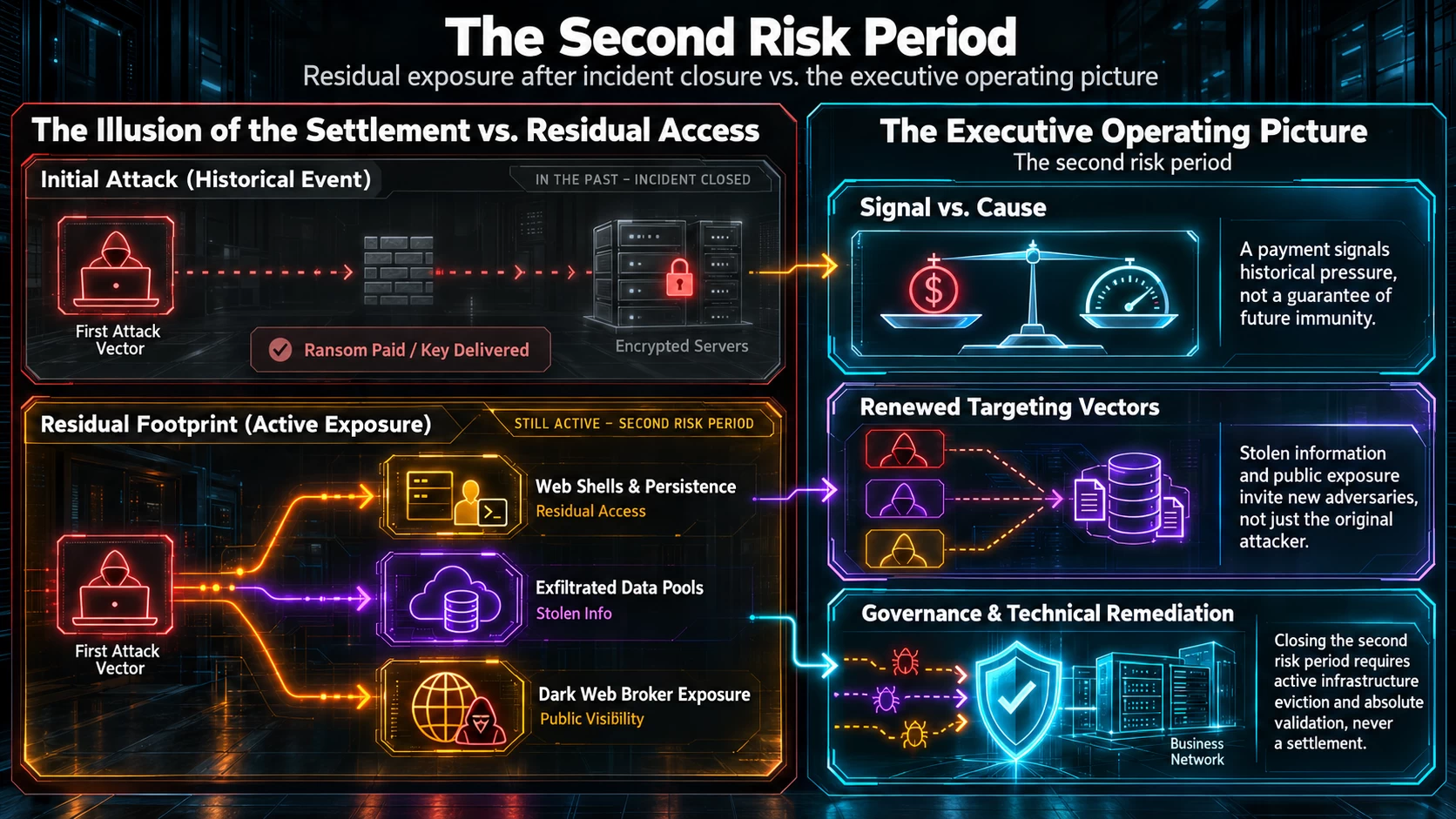
A payment may indicate that the victim experienced enough pressure to negotiate, but it is neither the only reason for renewed targeting nor proof that the same attacker will return. Residual access, stolen information, public exposure and incomplete remediation can create repeat pressure whether or not money changed hands.

Paying Is Not a Recovery Strategy addresses the payment decision in full. The narrower point here is that no settlement with an attacker can replace the technical and governance work required to close the second risk period.

Cyber risk infographic showing that a ransom payment does not end exposure, as residual access, stolen data and remediation risks can remain active.

Click on the image to view the high-resolution risk matrix

Evidence required before closure

Your executive team does not need proof that every future attack is impossible. It does need a defensible basis for deciding that the first incident is sufficiently contained and recovery can safely widen. That basis should answer:

  • Which entry path, credentials, sessions and persistence mechanisms were found, and how were they closed?
  • Which systems, data stores and suppliers were within scope, and where does uncertainty remain?
  • Which recovery sources were validated, and what prevents a compromised state from being reintroduced?
  • Which temporary privileges, routes and exceptions were created during response, and when will they expire?
  • What monitoring will detect renewed activity as services reconnect?
  • Which data or operational knowledge remains outside your control, and how will the resulting human, legal and commercial risk be managed?
Recovery is stronger when closure is supported by evidence,
residual risk has an owner and every emergency exception has an expiry path.

FOCUSED RANSOMWARE RESILIENCE ASSESSMENT

Compare controlled file-encryption scenarios with your existing security controls active, first without Ransomware Containment and then with it.

The assessment itself is limited to encryption, but alongside the assessment results, we can explain how our platform and its additional Server Intrusion Protection and Virtual Server Protection features, helps detect and interrupt lateral movement, reduce the risk of data theft, protect remote server access and defend virtual environments such as VMware and Hyper-V. That makes the session useful not only as a ransomware-containment test, but also as a practical discussion about what your organisation can still control when identity, privilege and infrastructure trust come under pressure.

Further readings