

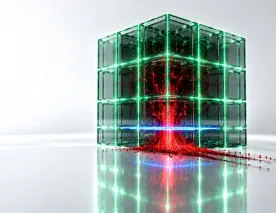
The Dashboard Was Green. The Data Was Gone. Represented by a premium conceptual abstract graphic on a reflective white background illustrating the green dashboard illusion. A sapphire glass cubic matrix on the right glows with a calm emerald-green outer grid, while a hidden red threat stream silently escapes from its core, intercepted and isolated at the base by a razor-sharp neon light-blue containment line to leave the wide left half pristine for text.The Dashboard Was Green. The Data Was Gone. Represented by a premium conceptual abstract graphic on a reflective white background illustrating the green dashboard illusion. A sapphire glass cubic matrix on the right glows with a calm emerald-green outer grid, while a hidden red threat stream silently escapes from its core, intercepted and isolated at the base by a razor-sharp neon light-blue containment line to leave the wide left half pristine for text.

Legal & Governance

Cybersecurity is no longer judged by what was planned,
but by what your executive team can still govern while an incident unfolds

Governing under concurrent pressure

The legal question rarely waits until the investigation is complete. In a serious cyber incident, your executive team may need to report, explain, preserve evidence, communicate, contain, and keep operations moving while the technical picture is still changing. Systems may still be running. Access may still appear to work. Teams may still be reconstructing what happened. But your organisation is already being tested on how it governs the situation.


Governance is not proven by policy.
It is proven by action under pressure.

The moment governance becomes real

Many organisations treat governance as something that sits around the incident: the policies, the reporting lines, the committee structure, the risk register and the annual assurance pack. All of that matters, but during a live ransomware attack, supplier compromise or data breach, governance becomes something more immediate. It becomes the way your organisation decides what can be interrupted, what can still be trusted, what must be reported, what evidence must be preserved and what can honestly be said while the facts are still incomplete. That is where the difference appears between having a governance framework and being governable.

The first governance test is not whether the policy exists.
It is whether the organisation can still act coherently before certainty arrives.

What leaders often assume

It is understandable to believe that good compliance preparation will carry your organisation through a serious incident. The board has reviewed cyber risk. The policy exists. The incident response plan has been approved. The supplier clauses have been checked. The reporting obligations are known. The problem is not the preparation itself. The problem is what happens when the incident no longer follows the comfortable order assumed by the documentation.

In real incidents, leaders may need to make proportionate decisions before the root cause is clear, before the blast radius is known, before data exposure is confirmed and before operational trust has been fully rebuilt.

That is when governance stops being a document trail and becomes a control problem.

The clock starts before certainty exists

Modern regulation increasingly compresses the time available to govern. Under mandates like the “NIS2 Cyberbeveiligingswet”, organisations face a strict 24-hour window to issue an early warning, while frameworks like CIRCIA and SEC enforce aggressive disclosure timelines. Some obligations may require early notification or disclosure while the incident is still being understood, not after your organisation has reached complete clarity. That creates a difficult leadership reality. The organisation may have to say what is known, what remains uncertain, what has been contained and what is being done next while investigation, containment and stabilisation are still in progress.

The old sequence felt safer: investigate, understand, decide, report.

The modern sequence is less comfortable: stabilise, govern, communicate and continue investigating while the environment is still moving.

GOVERNANCE PRESSURE
The clock starts before certainty arrives.

Accountabilitychanges the quality of decisions

Board-level accountability does not mean directors are expected to run the technical response personally. However, global frameworks, ranging from Europe's DORA and NIS2 to the US SEC rules, now codify personal oversight liability for management bodies. Cyber risk can no longer be outsourced or completely delegated to the IT department. It means your executive team is increasingly expected to ensure that the organisation already has clear decision rights, escalation discipline, interruption authority, evidence preservation, communications rhythm and a defensible operating model before the incident forces those questions into the room.

The hard question is not whether leadership had a cyber agenda item last quarter. It is whether the organisation can demonstrate that it remained governable when the incident became real.

You are no longer only responsible for preventing incidents.
You are responsible for how they are handled.

Defensible action is not perfect action

A common mistake is to equate defensibility with perfect knowledge. That standard is unrealistic during a serious cyber incident. Decisions are made with partial evidence. Signals conflict. Technical teams revise their understanding. Legal, operational and communications teams may see different risks at the same time.

Defensible action is different. It means the organisation can later explain why a decision was proportionate based on what was known at the time.

Why was a system isolated? Why was a supplier route paused? Why was a privileged path narrowed? Why was a statement made, delayed or corrected? Why were certain operations kept running in degraded mode?

Those answers depend on evidence, authority and control. Without them, even reasonable decisions become harder to explain afterwards.

What must remain governable

The governance problem becomes practical very quickly. Leadership does not need more abstract reassurance in that moment. It needs a smaller, clearer operating field.

These pillars form the exact intersection where operational reality meets global regulatory scrutiny (such as the CER directive for physical continuity, or the Cyber Resilience Act (CRA) and CMMC for supply chain integrity):

Authority
Who can authorise interruption before full certainty exists?
Evidence
What telemetry, logs and decisions must be preserved before recovery activity changes the scene?
Communication
What can be said confidently while facts are still evolving?
Continuity
Which services must continue, even if in degraded mode?
Containment
What can be safely narrowed, isolated or stopped before the incident expands?

This is why governance and operational controlare now inseparable. A board can ask the right questions, but the organisationstill needs executable moves beneath the answer.

When data leaves, governance becomes external

Cyber incidents rarely remain internal once sensitive data is involved. The moment customer data, employee records, patient information, financial information or operationally sensitive material moves outside organisational control, the incident changes. It becomes a privacy issue, a trust issue, a communications issue and often a legal exposure issue.

This exposure triggers immediate, highly penalised legal liabilities under frameworks like GDPR, HIPAA, and NYDFS Cybersecurity Regulations. Your organisation is no longer only trying to restore systems. It is trying to govern consequence outside its own environment. Affected people, regulators, suppliers, insurers and customers may all require answers while the technical response is still underway.

Once data is exposed, the incident is no longer only a technical event.
It becomes externally judged.

Why stabilisation creates defensibility

The fastest recovery is not always the most defensible recovery. If systems are wiped too quickly, evidence may disappear. If restoration starts before containment, the attacker may return. If telemetry is lost, the timeline becomes harder to prove. If communication outruns evidence, credibility may be weakened later.

Modern governance therefore depends on stabilisation. The organisation must preserve evidence, narrow the threat, maintain enough continuity and avoid making the response itself part of the damage.

Containment is not just a technical move. It is a governance enabler. It gives leadership a smaller problem to explain, a narrower field to operate in and more room to make proportionate decisions.

Making governance executable

Governance only changes the outcome when an authorised decision can be translated into operational action. Our platform provides a containment and control layer that complements your existing security stack, giving your executive team and incident responders a practical way to act while the full incident picture is still developing.

Our platform detects malicious behaviour after entry and helps interrupt lateral movement, data theft and ransomware encryption. It can also protect supported virtual infrastructure and preserve more room for essential operations while legal, operational and communications decisions continue.

Executable containment makes governance more than a documented intention. Your organisation can demonstrate what was decided, who held authority and how proportionate action changed the path of the incident while it was still governable.

Compliance does not create control.
Control makes compliance defensible.

A practical next step

Pressure-test whether your organisation can govern a cyber incident before certainty arrives. Rapid AI adoption and evolving international cybercrime underscore the urgent need for these modern frameworks. While the August 15th enforcement date establishes a strict legal baseline for the EU under NIS2, cyber threats respect no borders. Because operational vulnerabilities are universal, waiting for a live event to test your control is no longer a defensible strategy anywhere in the world.

A resilience assessment should not ask only whether policies exist. It should test whether authority, containment, evidence preservation, communication and continuity decisions can still be executed under pressure.

If those answers are unclear, the governance risk is already present. It is simply waiting for an incident to expose it.

If your organisation had to explain tomorrow what it did in the first hours,
what evidence would support the answer?

Navigating European Mandates

NIS2 Directive
Mandates proactive risk management for critical infrastructure.
Enforces strict 24-hour incident reporting rules.

DORA (Digital Operational Resilience Act)

Targets financial sector operational resilience.
Standardizes third-party ICT risk management.

CER Directive (Critical Entities Resilience)

Secures physical infrastructure against non-cyber threats.
Ensures continuous delivery of essential services.

CRA (Cyber Resilience Act)

Enforces security-by-design for connected digital products.
Mandates lifecycle vulnerability monitoring and reporting.

Navigating United States Mandates

CIRCIA (Cyber Incident Reporting Act)
Requires reporting material incidents within 72 hours.
Mandates ransomware payment reporting within 24 hours.

SEC Cybersecurity Rule

Forces public companies to disclose material incidents quickly.
Requires annual reporting on cyber risk governance.

CMMC (Cybersecurity Maturity Model Certification)

Secures defenses across the military supply chain.
Requires independent validation for contract eligibility.

NYDFS Cybersecurity Regulation

Enforces strict controls for financial services firms.
Requires annual executive compliance certifications.

HIPAA Security Rule
Protects electronic personal health information.
Imposes severe penalties for unauthorized data exposure.

Run a resilience assessment.

Pressure-test what happens after prevention is bypassed: what is detected, what can be interrupted, where trust degrades, and how quickly the organisation can stabilise before wider consequence develops.

DISCOVER HOW OUR PLATFORM WORKSRUN A RESILIENCE ASSESSMENT

Further readings