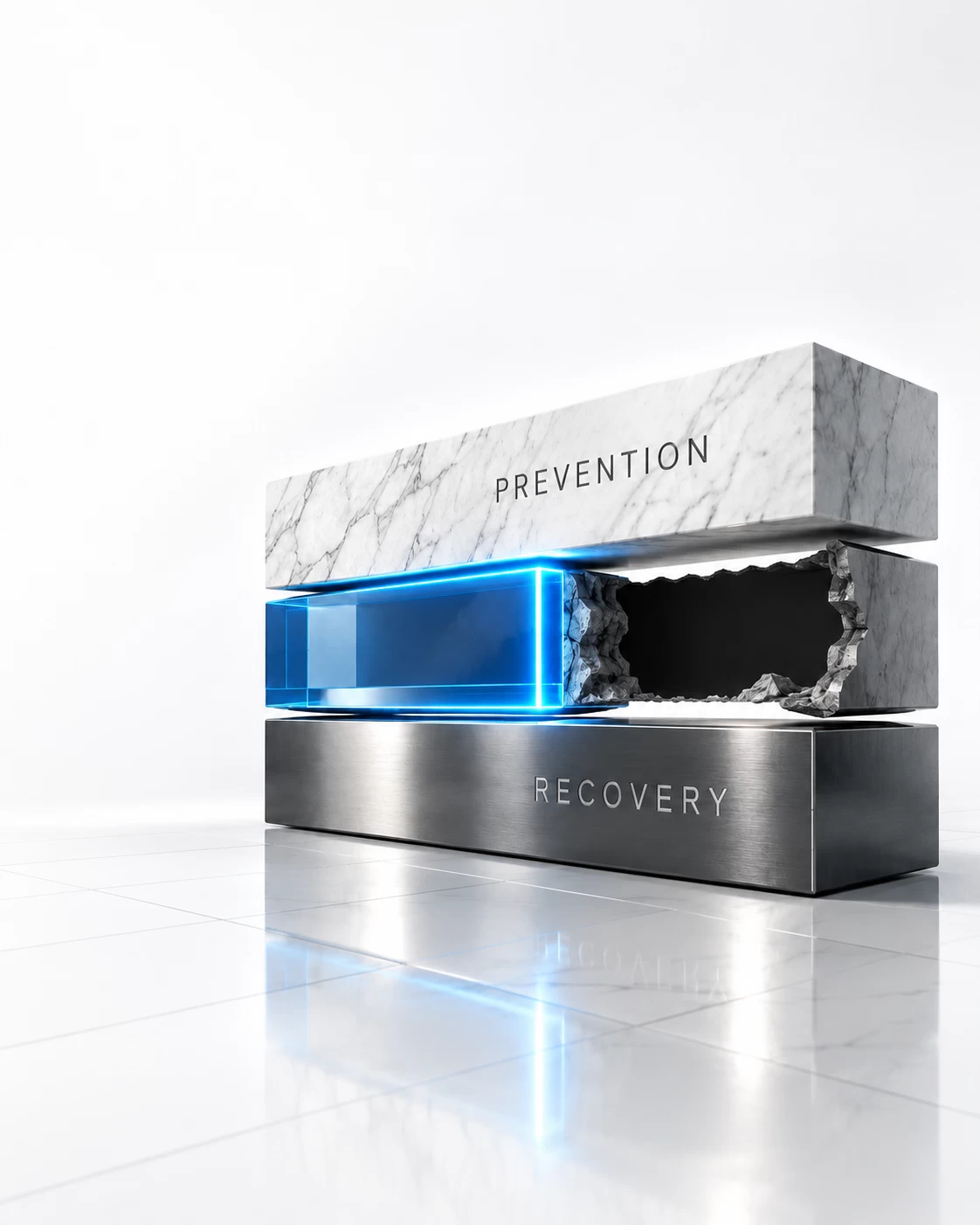
Cyber budget graphic with a gap and blue containment bar between prevention and recovery.Cyber budget graphic with a gap and blue containment bar between prevention and recovery.
S10 Group Article series · Why leadership changed

The Missing Budget Line
Between Prevention and Recovery

Why containment deserves a defined place in the cyber budget
before the next incident
Article #17
Published: 12 October 2026
By Stan van Gemert | S10 Group
By Stan van Gemert
The CISO series


Executive summary

The previous publication, The Backup Existed. Recovery Was Still a Question, showed why the presence of a backup does not prove that your organisation can restore cleanly, confidently or quickly. Once a live incident has already expanded, recovery becomes a wider operational project rather than a simple technical return.

Many cyber budgets fund the controls intended to prevent entry and the capabilities needed to rebuild afterwards, yet leave the active middle without a defined execution layer. Containment deserves a budget of its own because it gives your organisation a way to interrupt malicious progression, narrow unsafe paths and reduce the scope that recovery will later have to address.

The next publication, When Prepared Does Not Mean Ready, turns that investment case into an operating test: can a credible signal produce an authorised, bounded and explainable action before certainty arrives?

The active middle is often unfunded

A cyber budget can look comprehensive and still leave its most consequential moment unfunded. A CISO asks for additional investment. The executive team can already point to endpoint protection, identity controls, EDR, SIEM, backup, cyber insurance, incident-response retainers and recovery platforms. The finance question is reasonable: what capability would the new investment buy that your organisation does not already have?

The answer is often obscured by the way the budget is structured. Most portfolios fund two necessary outcomes: reduce the likelihood of intrusion and restore services after damage. Far less attention is given to the period between them, when an attacker may already be using valid access, malicious movement is still possible, evidence remains incomplete and the eventual scale of recovery is still being determined.

The missing budget line is the capability to contain an active incident before an initial compromise spreads into a significant security breach and a much larger recovery programme.

A cyber budget can fund both ends of an incident and still leave the decisive middle without executable control.

A budget built around the before and after

Prevention is essential. It reduces exposure, removes known weaknesses, strengthens identity paths and blocks hostile behaviour before it affects operations. Recovery is equally necessary. Backups, rebuild procedures, restoration plans and specialist partners provide a route back when systems or data have been damaged.

Funding both capabilities does not make the model complete. Prevention does not decide what happens after an attacker enters through a valid identity, supplier connection, remote-management route or manipulated workflow. Recovery does not automatically reduce the number of systems touched, the data already reached, the forensic scope, the legal pressure or the duration of operational disruption.

Your organisation can therefore invest heavily at both ends of the incident and still lack a practical way to change its trajectory while malicious activity is continuing. Containment belongs in that active middle.

Recovery starts with the scope the incident has already created

Strong recovery capability matters, but recovery is not the same as continuity. It begins with the damage, dependencies and uncertainty the incident has already created.

Backups may restore data and rebuild procedures may return systems to service. Neither can retract information that has already left, remove pressure from affected customers or employees, or make a wide shutdown commercially painless. A technically successful restoration can still leave a substantial legal, operational and communications burden.

Containment does not replace recovery. It reduces the burden recovery must carry by limiting how far malicious activity can spread, how much data can be reached and how many services become part of the response. Recovery answers how your organisation will return; containment determines how much must be recovered in the first place.

Recovery provides the route back.
Containment reduces how much of the environment needs that route.

Downtime is where the budget case becomes visible

A backup may be available, a recovery partner may be retained and a restoration plan may be documented. Your business can still spend weeks operating below normal capacity while teams rebuild systems, validate identities and backups, reconnect services and establish what can safely return.

Sophos's 2026 survey of 2,158 organisations found that full recovery from ransomware took an average of three weeks. Fifty-five per cent recovered within one week, while 17 per cent needed longer than a month. The average recovery cost, excluding ransom payments, was USD 1.70 million.

Those figures do not calculate the return on our platform, and full recovery time is not identical to downtime. They show why the missing budget line matters. Recovery inherits the scope the incident has already created. Containment is funded to reduce that scope while it can still be changed.

Prevention spend does not fund post-entry control

Mature security programmes invest heavily in prevention for good reason. The weakness appears when the budget treats reduced probability as operational certainty.

Modern attackers often use paths that were created for legitimate work: authenticated sessions, helpdesk processes, administrative credentials, supplier access, remote support and familiar internal connections. The account may be valid, the route may be approved and the system may still be available, even though the behaviour has become unsafe.

Once that happens, the investment question changes. Your teams no longer need another description of the perimeter; they need a defined way to interrupt progression without disconnecting every service that still supports the business. That is an executable-control requirement, not another monitoring requirement.

The return is reduced incident impact

No responsible business case should promise a fixed return from every cyber incident. Attack paths, operating models and consequences vary too widely. The defensible case for containment is avoided impact: reducing the scope, duration and operational burden of failure.

Earlier containment can mean fewer systems requiring investigation, fewer identities remaining useful to an attacker, fewer repositories within reach, fewer supplier connections needing emergency review and fewer processes forced into manual operation. Each reduction narrows the forensic, legal, communications and recovery work that follows.

Those variables shape real cost. The return does not come from another alert or dashboard. It comes from preserving more of the environment outside the incident and reducing the work needed to restore credible operations.

Why incident duration belongs in the budget discussion

IBM's 2026 Cost of a Data Breach Report examined 602 organisations affected by breaches. It reported a global average breach cost of USD 4.99 million. Detection and escalation together with lost business accounted for 63% of that average, including crisis management, operational disruption and customer churn.

The report also found a material difference between shorter and longer breach lifecycles. Incidents identified and contained in under 200 days averaged USD 4.32 million, compared with USD 5.65 million when the lifecycle exceeded 200 days.

These figures are sample averages. They do not calculate an S10-specific return and they do not prove that one control caused the difference. They support a narrower conclusion: time, disruption and reachable scope are financially material. NIST SP 800-61r3 reinforces the governance point by treating incident response as part of cyber-risk management intended to reduce incident impact and improve response and recovery.

Sophos on ransomware recovery
Sophos's State of Ransomware 2026 surveyed 2,158 organisations across 17 countries that had experienced ransomware in the preceding year. It found that full recovery took an average of three weeks, 17 per cent needed longer than a month and mean recovery cost excluding ransom payments was USD 1.70 million. The recovery-time and cost findings appear on report pages 23 and 22 respectively.

Full recovery time is not the same as downtime. These findings describe the surveyed population; they do not predict your organisation's service interruption or calculate an S10 Group-specific return.

Sources:

IBM Cost of a Data Breach Report 2026
https://www.ibm.com/reports/data-breach

NIST SP 800-61 Revision 3
https://csrc.nist.gov/pubs/sp/800/61/r3/final

Sophos State of Ransomware 2026
https://assets.sophos.com/X24WTUEQ/at/jbww7pmb8n3gp99wr6hfq4/sophos-state-ransomware-report-2026.pdf

Source note on historical downtime:
Coveware reported an average of 24 days of downtime in its Q2 2022 ransomware cases. That is a historical case benchmark, not a 2026 global average. It measures downtime and should not be treated as equivalent to Sophos's full recovery measure.
https://coveware.com/2022/07/fewer-ransomware-victims-pay-as-medium-ransom-falls-in-q2-2022/
View more details chevron A white downward-facing V-shaped chevron on a transparent background.
View more details
Close more details

Change the investment question

Containment becomes easier to evaluate when the request describes a business capability rather than another product category. The conversation can move from tool count to the action your current portfolio can take during an active incident.

Current objection
Better investment question
What the budget line funds
Current objection:
We already invest heavily in prevention.
Better investment question:
If initial access succeeds, what capability can interrupt further progression?
What the budget line funds:
Post-entry action before more systems and data become involved.
Current objection:
We are strong on recovery.
Better investment question:
How much damage and disruption will recovery have to absorb if the incident keeps expanding?
What the budget line funds:
A smaller blast radius and a narrower recovery programme.
Current objection:
We cannot justify another security tool.
Better investment question:
Does the proposed investment only report activity, or can it change the course of an active incident?
What the budget line funds:
Executable containment rather than another passive dashboard.
Current objection:
We need certainty before affecting operations.
Better investment question:
Which narrow and reversible actions can be authorised at defined evidence thresholds?
What the budget line funds:
Prepared authority and bounded alternatives to an all-or-nothing shutdown.
We have invested in prevention and recovery.
What we have not yet funded is the execution layer that limits the incident while it is still moving.

Where our containment platform fits

Our platform operates in the active middle, after prevention has been bypassed and before recovery becomes the dominant business project. It does not replace prevention, EDR, SIEM, identity controls, incident response or recovery. Nor is it another monitoring layer that merely describes the problem.

Ransomware Containment is our core platform. Server Intrusion Protection and Virtual Server Protection are additional features that operate on that platform, extending containment across server-side activity and virtual infrastructure.

Our platform provides defined containment actions that can interrupt ransomware encryption, constrain unsafe server-side activity and protect virtual environments. By reducing opportunities for lateral movement and data theft while investigation and recovery decisions continue, it helps prevent an initial compromise from becoming a wider and more disruptive security breach.

A separate budget line is justified by that operational difference. The investment buys the ability to change the trajectory after entry, while meaningful scope can still be kept outside the recovery problem.

Test the unfunded middle

If prevention is bypassed tomorrow, what funded capability can reduce the spread before recovery begins?

The answer should identify which malicious paths can be interrupted, which servers and virtual environments can be protected, which actions can be taken without disconnecting everything, which essential processes can continue and who can authorise those moves before the full forensic picture is available.

If those answers depend on improvised workarounds, your budget may still be weighted towards the before and after of an incident while underfunding the interval that determines how far the breach spreads.

The next horizon

Our next publication, "When Prepared Does Not Mean Ready", examines what happens after the budget, plans and roles appear to be in place. Readiness is proven only when a credible signal can trigger an authorised, bounded and explainable action before certainty arrives.

Hear first when a new S10 Group release is published

Would you like to receive a short note when S10 Group publishes a new article or newsletter?

Leave your name and email address below. We will send a short update when a new release is available, with a brief summary and a direct link to the publication.
Thank you! Your submission has been received!
Oops! Something went wrong while submitting the form.

TURN YOUR BUDGET CASE INTO AN OPERATING TEST

Discover whether your current environment can contain an incident before recovery becomes the only option. The purpose is not to discount the investment you have already made. It is to determine whether that investment includes a practical containment path for the active middle.

Our Resilience Assessment compares controlled file-encryption scenarios with your existing security controls active, first without Ransomware Containment and then with it.

The assessment itself is limited to encryption, but alongside the assessment results, we can explain how our platform and its additional Server Intrusion Protection and Virtual Server Protection features, helps detect and interrupt lateral movement, reduce the risk of data theft, protect remote server access and defend virtual environments such as VMware and Hyper-V.

That makes the session useful not only as a ransomware-containment test, but also as a practical discussion about what your organisation can still control when identity, privilege and infrastructure trust come under pressure.‍
Bright conceptual visual of frosted-glass blocks where the first block is stopped by a titanium pillar, representing ransomware containment before wider operational disruption spreads.

Coming soon

Wednesday 14 October, Leadership-series #7: "The Goal Is Not Perfect Prevention."

Friday 16 October, Operational Attack-series #7: "The Foundation Failed While the Building Still Stood."

Further readings