Article #3
Originally published: 19 May 2026
Last updated: 11 September 2026
By Stan van Gemert | S10 Group
By Stan van Gemert

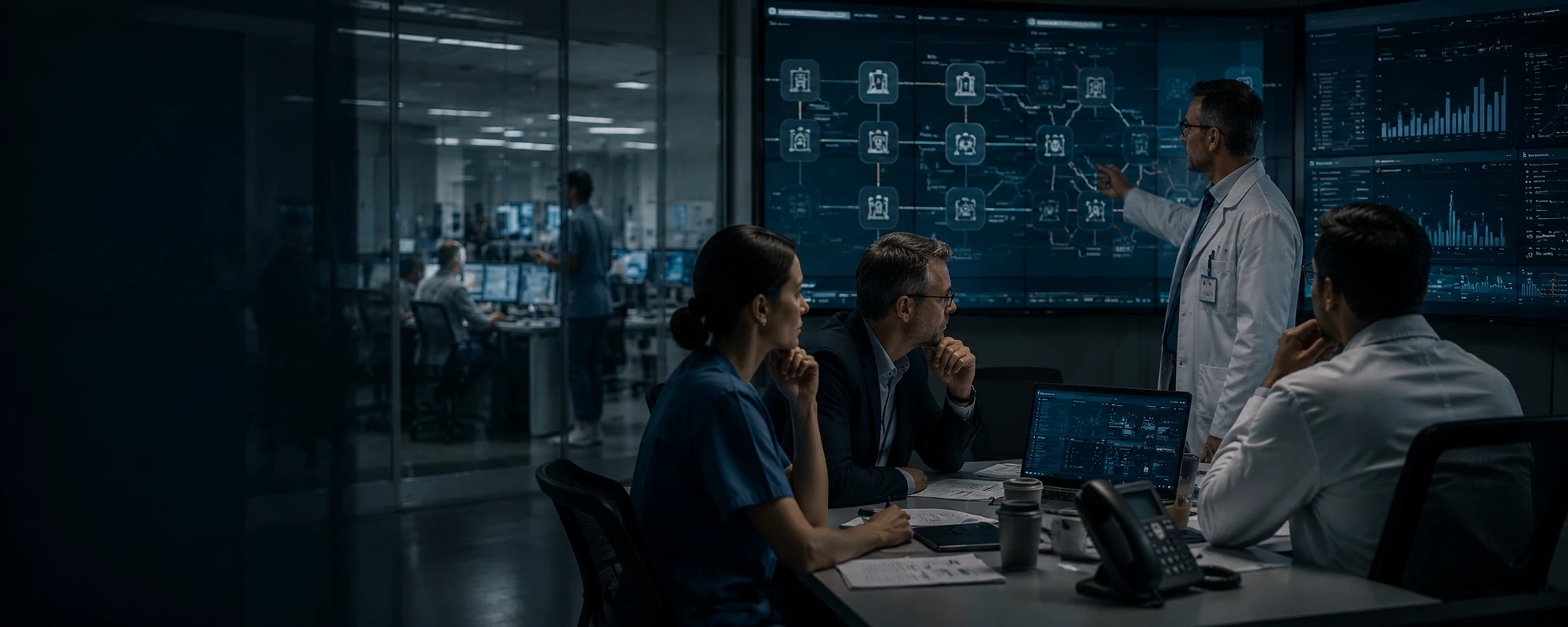
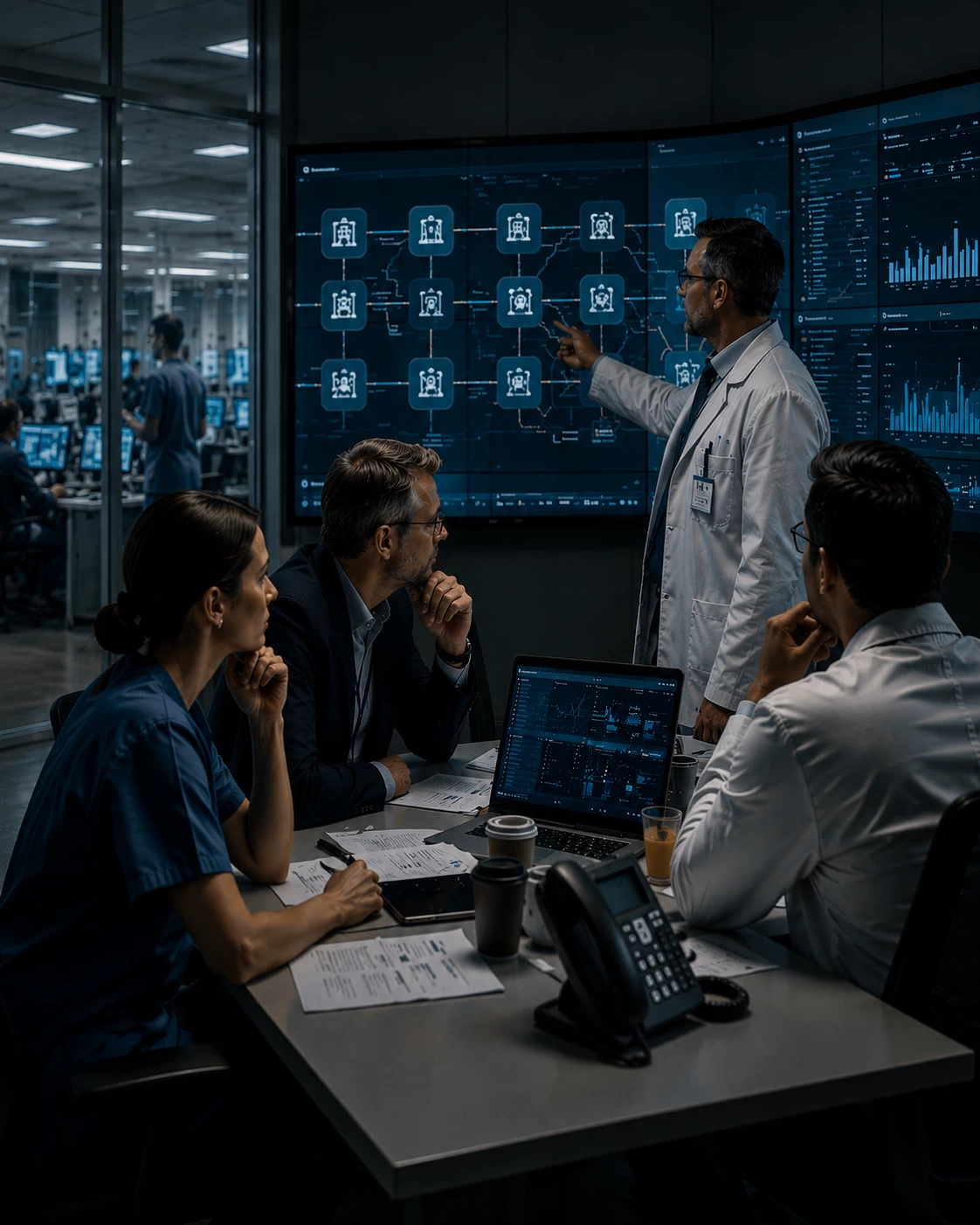
The incident rarely stays where it starts
In healthcare, very little operates in isolation anymore.
Hospitals depend on laboratories, pharmacies, insurers, payment platforms, claims processors, clinical software providers, imaging partners, cloud platforms, identity systems, research networks and managed technology providers.
That connectivity creates speed. It also creates exposure.
When trust breaks in one part of the ecosystem, the effect can travel into places that were not directly attacked. A hospital may still be open. A supplier may still be communicating. A platform may still be reachable. But the question changes: can this dependency still be trusted safely?
The change healthcare incident made this visible at national scale. A cyberattack against one mission-critical healthcare service provider disrupted claims, payments, administrative workflows and access-to-care processes across a much wider healthcare ecosystem. The issue was not confined to the original organisation. It travelled through dependency.
That is the uncomfortable lesson.
The first visible signs of a dependency incident can look deceptively contained.
A system behaves strangely. A supplier reports disruption. A service desk ticket looks unusual. A data exchange is delayed. A support account behaves outside its normal pattern. A department loses access to a workflow that many other teams depend on.
At that point, the organisation may still hope the problem is local.
But connected environments do not always behave locally.
An incident can move through:
That is why the first containment decisions matter so much.
The question is not only: what is affected?
It is also: what could become affected if we do nothing for the next hour?
Healthcare gives the dependency issue a human edge, because operational delay can reach patients quickly. But the pattern is not unique to healthcare.
Kaseya vsa showed how a vulnerability in trusted remote management software could be used as a one-to-many route. The impact reached roughly 1,500 downstream organisations, many of which were not individually selected in the traditional sense. They were reached through a management pathway they trusted.
Solarwinds sunburst showed another version of the same problem. Attackers inserted a backdoor into a trusted software update for orion. Up to 18,000 customers were potentially exposed through a normal update mechanism, turning routine trust into an attack path.
Okta and its third-party support provider sitel showed how supplier access can become identity pressure. The issue was not simply whether a core platform was “down”. It was whether a support pathway with privileged reach could still be trusted, and how quickly customers could understand their exposure.
Notpetya showed the operational extreme. What began through ukrainian accounting software moved into global businesses. Maersk became one of the most visible examples of how a localised software compromise can become a worldwide operational shock.
Different sectors. Different entry points. Same underlying pattern.
Many organisations still imagine escalation as something that starts when systems fail completely.
In reality, the cascade often starts earlier. It starts when trust becomes uncertain.
Can this supplier route remain open? Can this connection still be used? Can this data still be relied on? Can this account still act? Can this segment safely communicate with the rest of the environment?
When those questions cannot be answered quickly, hesitation appears. And hesitation gives the incident space to expand.
This is where detection alone becomes insufficient. Seeing a signal is not the same as being able to restrict the path through which the incident may travel. Recovery planning is also not enough at that moment, because the organisation has not yet stopped the pressure from widening.
The missing capability is executable containment: the ability to narrow trust, restrict movement and preserve essential operations before the full picture is available.
The useful question is not whether supply-chain and dependency incidents are serious. That is already clear.
The more useful question is what can still be done once something has slipped through.
In practical terms, that may mean:
These are not perfect answers. They are containment moves. And in the active phase of an incident, containment is often what separates a difficult event from an uncontrolled cascade.
A breach that spreads through dependencies quickly becomes a leadership issue.
Not because executives should manage the technical response directly. But because the decisions involve trade-offs that technology alone cannot settle.
Which connection can be closed without stopping care?
Which supplier route must be restricted even if operations slow down?
Which identity pathway is too risky to keep open?
Which systems can continue in degraded mode?
Who has the authority to make that decision before the full report is available?
These are governance questions under pressure.
If they are first discussed during the incident, the organisation is already late.
Resilience is not the promise that nothing will get through. It is the ability to prevent one breach from becoming everyone’s problem. That requires more than prevention. It requires the ability to detect enough to understand where pressure is forming, contain enough to stop further spread, and stabilise enough to keep essential operations moving.
This also aligns with the broader direction of modern resilience guidance. Nist csf 2.0 does not describe cybersecurity only as protection. It includes govern, identify, protect, detect, respond and recover as connected functions. That matters because operational resilience is not one control, one policy or one tool. It is the ability to govern and act across the incident lifecycle.
For healthcare, that may mean preserving care pathways while unsafe connections are narrowed. For finance, it may mean protecting transaction trust while systems are reviewed. For manufacturing, it may mean keeping part of production running while affected areas are isolated. For public services, it may mean maintaining citizen-facing services while supplier access is restricted.
The sector changes. The control question does not.
This is where the s10 group platform becomes relevant. Not as a replacement for prevention. Not as another dashboard. And not as a recovery measure that only becomes useful after the cascade has already widened.
S10 group is positioned for the live phase after prevention has been bypassed and before the impact becomes much harder to govern. The platform helps detect malicious behaviour after entry, contain movement before it travels further, reduce data-theft and ransomware leverage, and stabilise the environment while leadership still needs room to act.
In a dependency-driven incident, that room matters. It can mean fewer routes remaining open by default. Fewer trusted pathways being abused unchecked. Fewer systems becoming unsafe because the organisation had to wait for perfect certainty before acting.
If this happened tomorrow, what would you do first?
Would you wait until the full scope was known?
Or would you already know which access path, data flow, supplier connection or operational dependency could be restricted first to prevent the incident from spreading?
That question is where the gap often becomes visible.
Not between organisations that care and organisations that do not.
But between organisations that can see pressure and organisations that can still contain it.
This article focused on the first cascade: how one breach can move through connected systems and become a wider operational problem.
The next article moves deeper into the same issue by asking what happens when the attack path is not an unknown external route, but something the organisation already trusts: a supplier, platform, integration, remote access route or ai-enabled workflow.
Because the more organisations depend on trusted systems, the more important it becomes to contain trust when trust changes.
Control can still be regained — if a containment move exists.
Inspired by public reporting and guidance on dependency-driven cyber incidents and operational cascade: Change Healthcare, Kaseya VSA, SolarWinds SUNBURST, Okta/Sitel, NotPetya/Maersk, NIST CSF 2.0, CISA supply-chain risk management guidance, and modern containment/blast-radius reduction research.