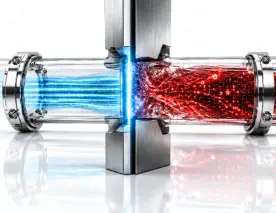
“When victims become the extortion surface” represented by a premium conceptual technology graphic on a reflective white background illustrating external data extortion. A central sapphire glass data cylinder on the right is fractured, allowing a high-velocity stream of data particles to escape outward. This stream morphs from an initial calm green into a volatile cloud of deep amber and royal-purple light representing direct pressure on individuals, which is cleanly intercepted and segmented by a vertical brushed-titanium containment plane outlined in a sharp neon light-blue edge glow.“When victims become the extortion surface” represented by a premium conceptual technology graphic on a reflective white background illustrating external data extortion. A central sapphire glass data cylinder on the right is fractured, allowing a high-velocity stream of data particles to escape outward. This stream morphs from an initial calm green into a volatile cloud of deep amber and royal-purple light representing direct pressure on individuals, which is cleanly intercepted and segmented by a vertical brushed-titanium containment plane outlined in a sharp neon light-blue edge glow.
S10 Group Article series · The operational attack realities

When Victims
Become the Extortion Surface

Why stolen data no longer creates pressure
only inside the organisation.
Article #10
Published: 28 September 2026
By Stan van Gemert | S10 Group
By Stan van Gemert
When attacks move series


Executive summary

The previous publication, "The Door Worked Perfectly. That Was the Problem.", showed how a valid identity can open an unsafe path when authentication confirms access but cannot establish intent. Approved access can carry harmful behaviour without announcing itself as a break-in.

The present special analysis follows the incident beyond that access path. Once stolen data contains enough personal context, attackers may no longer need to keep all pressure inside a negotiation with the breached company. They can contact customers, employees, patients or households directly and use the records themselves to make the threat credible.

The reported Flink incident of last Friday, provides a current example of direct-to-victim demands, while Clinical Diagnostics and documented medical phishing campaigns show why intimate context can deepen urgency. The executive lesson is that the absence of passwords or payment-card data does not make an exposed dataset harmless.

The next publication, When Trusted Systems Become the Attack Path, returns to the environment that allowed the incident to move. It examines how authorised accounts, supplier connections, software channels and integrations can remain operational after the conditions that justified their access have changed.

The demand arrived outside the company

In late September 2026, customers and employees of European delivery service Flink reportedly received messages from the criminals behind a data-theft incident. The demand was unusually direct: pay a small amount in cryptocurrency or risk the publication of personal data.

Flink confirmed that criminals were contacting customers and employees and asking for payment. The company said names, contact details, postal addresses and order histories may have been affected, while passwords and payment data were not. The attackers claimed to hold data belonging to one million customers and 13,000 employees, but Flink did not confirm that scale.

The distinction matters. The absence of financial credentials did not prevent the attackers from creating pressure. The reported records contained enough personal context to carry the incident into individual inboxes and private decisions.

The breached company remained a target, but the people behind its records became direct points of leverage.

The shift in leverage

The familiar ransomware model concentrated pressure on the company through encryption, downtime and a demand for payment. Data theft widened that model because attackers could threaten publication, regulatory exposure and reputational damage even after systems were restored.

Direct-to-victim extortion pushes the pressure further. Once personal data has been copied and can be used, attackers may approach customers, patients, employees or households one by one. Each message turns a corporate incident into a private calculation about exposure, credibility and fear.

A small demand can lower the friction of payment. The amount may feel easier to surrender than the time and uncertainty involved in establishing whether the threat is genuine. Payment still offers no reliable assurance that the data will be deleted or that the attacker will not return.

The attacker is using data your organisation no longer controls to create pressure in places it cannot govern directly. That is the strategic change: leverage has become distributed.

Non-financial data is not low-impact data

A breach notice often reassures affected people that passwords, bank details or payment cards were not stolen. That information can be important, but it does not establish that the remaining data is low impact.

A dataset becomes dangerous when it contains enough context to make a message believable. Names, addresses, email addresses and phone numbers can support targeted phishing. Order histories and delivery instructions can reveal routines, household details, apartment floors, doorbell names or the way someone expects a legitimate service to communicate.

Attackers do not need a complete profile. They need enough accurate detail to make a recipient think that the message could only have come from someone who knows them.

Public communication should therefore avoid implying that the absence of financial data ends the risk. When exposed information can support credible intimidation, impersonation or social engineering, the operational consequence continues outside the original environment.
When Flink customers became direct points of pressure
NOS reported that customers and employees were approached with a demand of roughly EUR 10 to EUR 15 in cryptocurrency and a threat that their data would be published. Flink confirmed that criminals were contacting customers and employees, advised people not to respond or pay, and said names, contact details, postal addresses and order histories may have been affected.

The criminals claimed to hold data belonging to one million customers and 13,000 employees. Flink did not confirm those numbers. Public reporting also stated that passwords and payment data were not affected. The evidence therefore supports a narrow conclusion: personal context can enable direct extortion even when financial credentials are not part of the exposed dataset.

‍Sources
https://nos.nl/artikel/2632473-hackers-persen-klanten-boodschappendienst-flink-af-betalen-of-data-gepubliceerd
https://tweakers.net/nieuws/252608/ransomwaregroep-hackt-onlinesupermarkt-flink-en-vraagt-slachtoffers-om-losgeld.html
https://nltimes.nl/2026/09/25/individuals-sent-ransom-notes-cybercriminals-steal-flink-customer-worker-data

Source boundary
The affected population, attacker identity and complete dataset are still under investigation.‍
View more details chevron A white downward-facing V-shaped chevron on a transparent background.
View more details
Close more details
A dataset does not need payment details to become dangerous.
It needs enough personal context to make the threat credible.

Medical data is the deeper version

Consumer data can make extortion personal. Medical data can make it intimate because the context relates to a person's body, screening history or health uncertainty and cannot simply be reset like a password.

The Clinical Diagnostics incident illustrates the sensitivity. The Dutch Public Prosecution Service reported that personal data belonging to 850,000 people had been stolen and that the laboratory was pressured to pay in cryptocurrency or face the sale of the data. It later recorded 118 individual reports. Government and inspectorate reporting connected the affected data to a laboratory involved in cervical-cancer screening.

Clinical Diagnostics is not evidence of the same direct-to-consumer extortion method reported at Flink. Its value here is different: it shows how the type of context in a stolen record can deepen the human consequence and the credibility of later misuse.

Proofpoint documented another mechanism in 2020: attackers impersonated a medical centre and used purported HIV test results to induce recipients to open a malicious attachment. The campaign was separate from both breaches, but it demonstrates why health-related context can be an effective lure.

The common mechanism is personal relevance. Medical or household context can make a malicious message feel urgent before the recipient has time to verify it.

Personal urgency becomes part of the attack

Direct contact pulls affected people into the incident while facts are still incomplete. The message may refer to an address, delivery context, employer relationship, health record or household detail. The recipient must decide whether the threat is real before the company has finished explaining what happened.

People will respond differently. Some will dismiss the message, while others may worry, pay, contact the police, change behaviour or stop using the service. The article does not need to diagnose trauma to establish the operational point: stolen context can create urgency, fear and a loss of control for people who had no role in the security failure.

That burden is difficult to contain after extraction. Your organisation may provide guidance and coordinate support, but it cannot control every message the attacker sends or every use of the copied data.

Data exposure becomes more dangerous when leverage decentralises.
Once attackers can reach the people behind the records, your organisation is no longer the only party under pressure.

Fear can also have legal relevance

The legal position requires care. An infringement of the General Data Protection Regulation does not automatically create a right to compensation. A claimant must still demonstrate damage and the causal relationship with the infringement.

The Court of Justice of the European Union has nevertheless clarified that non-material damage does not need to cross a separate threshold of seriousness and that fear of possible misuse can, in itself, be capable of constituting non-material damage. The national court still decides the case on its facts.

Direct contact from criminals can make the governance context more serious because the possibility of misuse is no longer expressed only in a notification letter. The data is already being used to create pressure around the affected person.
The legal boundary under GDPR Article 82
In Case C-300/21, the Court of Justice held that a GDPR infringement alone is not sufficient for compensation; damage and a causal link are also required. The Court also rejected a separate threshold of seriousness for non-material damage.

In Case C-340/21, the Court held that fear of possible misuse of personal data by third parties is capable, in itself, of constituting non-material damage. The decision does not make compensation automatic and does not determine the outcome of any Flink or Clinical Diagnostics claim.

Sources
https://curia.europa.eu/jcms/upload/docs/application/pdf/2023-05/cp230072en.pdf
https://curia.europa.eu/jcms/upload/docs/application/pdf/2023-12/cp230191en.pdf
View more details chevron A white downward-facing V-shaped chevron on a transparent background.
View more details
Close more details

What containment changes

Once criminals possess a usable copy, containment cannot retrieve it or govern what they do next. The decisive opportunity sits earlier, before data has been copied, staged, moved or turned into external leverage.

Our platform helps authorised teams act after prevention has been bypassed but before malicious activity has acquired more reach. Ransomware Containment is the core platform. Server Intrusion Protection and Virtual Server Protection are additional features running on it, extending available controls to compromised administrative activity on protected servers and attacks affecting supported virtual environments.

Together, those capabilities can help interrupt malicious behaviour after entry, contain ransomware encryption, restrict lateral movement and reduce the opportunity for data theft while investigation continues. The practical value is not a promise that exposure disappears. It is the ability to reduce how much data, infrastructure and personal context the attacker can turn into pressure.

Recovery restores systems. Earlier containment reduces what the attacker may still be able to carry outside them.

Our platform operates before the loss becomes irreversible.
It cannot recover data that attackers already hold, but it can help reduce the paths through which an incident gains more reach.

The fundamental question for boards is changing

Boards will continue to ask how much data was stolen, whether payment information was affected and whether the right authorities and individuals have been notified. Those questions remain necessary, but direct-to-victim extortion adds another one.

If data left your organisation tomorrow, who would the attacker be able to pressure next?

The answer may include customers, patients, employees, former clients or households whose routines and personal context are embedded in the records your organisation stores. That changes data protection from an abstract confidentiality obligation into a question about the people an attacker may be able to reach.

The incident can keep moving through people

The reported Flink pattern should not be dismissed because the amount demanded from each person was small. Its importance lies in the route the pressure took. The incident did not stop at the environment, the ransom negotiation or the breach notice. Stolen data allowed the attackers to continue through the people behind the records.

Clinical Diagnostics demonstrates the deeper sensitivity of medical context, while documented health-related phishing shows how personal relevance can make a malicious message more persuasive. The cases are different, but each supports the same operational conclusion: data exposure can keep the attack moving after the original access path is closed.

Your strongest opportunity is therefore earlier. Contain the incident before data becomes external leverage and before private people become the next surface of pressure.

If data left your organisation tomorrow, which repositories, identities, supplier routes or integrations would give an attacker enough personal context to pressure people directly, and what can your teams still interrupt before that pressure moves beyond your control?

FOCUSED RANSOMWARE RESILIENCE ASSESSMENT

In a controlled sandbox, compare how the same file-encryption scenarios behave with your existing security controls active, first without Ransomware Containment and then with it.

During the assessment session, we can also walk your team through the wider containment layer. The live assessment focuses on controlled ransomware file-encryption scenarios. It does not directly test identity misuse, lateral movement or data exfiltration. But those questions can still be addressed in the same conversation.
‍
Alongside the assessment results, we can explain how our platform and its additional Server Intrusion Protection and Virtual Server Protection features, helps detect and interrupt lateral movement, reduce the risk of data theft, protect remote server access and defend virtual environments such as VMware and Hyper-V. That makes the session useful not only as a ransomware-containment test, but also as a practical discussion about what your organisation can still control when identity, privilege and infrastructure trust come under pressure.
Resilience assessment represented by a domino effect of glass blocks symbolizes the cascading crisis (the chain reaction of an attack).The first glass block falls over and shows cracks and red stress lines (the initial contamination/data breach). But instead of the whole line collapsing, there stands that unshakable one, brushed metal barrier with the light blue neon line.This one absorbs the blow, absorbs pressure and maintains control, so that all underlying glass blocks (the rest of the critical infrastructure and business operations) remain perfectly intact and unaffected

The next horizon

The next publication returns from the consequences of stolen data to the trusted routes that can carry an incident further. When Trusted Systems Become the Attack Path examines how a supplier account, service credential, software channel or integration can remain authorised after the conditions that justified that access have changed.

It asks whether your teams can narrow or withdraw permission before a trusted route extends the incident across more systems, dependencies or services.


Hear first when a new S10 Group release is published

Would you like to receive a short note when S10 Group publishes a new article or newsletter?

Leave your name and email address below. We will send a short update when a new release is available, with a brief summary and a direct link to the publication.
Thank you! Your submission has been received!
Oops! Something went wrong while submitting the form.

Coming soon

Wednesday 30 September, Leadership-series #4: "Trust Often Breaks Before Systems Fail"

Friday 2 Oktober, Operational Attack-series #4: "The Attacker Had a Map Before Leadership Had a Picture"

Further readings