Article #41
Published: 25 November 2026
By Stan van Gemert | S10 Group
By Stan van Gemert
The CISO series



The previous scheduled publication, “When Ransomware Becomes a Life-Critical Decision”, examined when reduced capacity requires a clinical service to limit, defer or divert care.
Two companion analyses explore related questions. “The Extortion Trap Begins Before the Ransom Note” examines control over decisions: which protective actions need not wait for a payment decision. Our special edition, “When Access Is Part of the Mission”, examines control over consequences: what stops one necessary account, device or session from becoming a much larger loss.
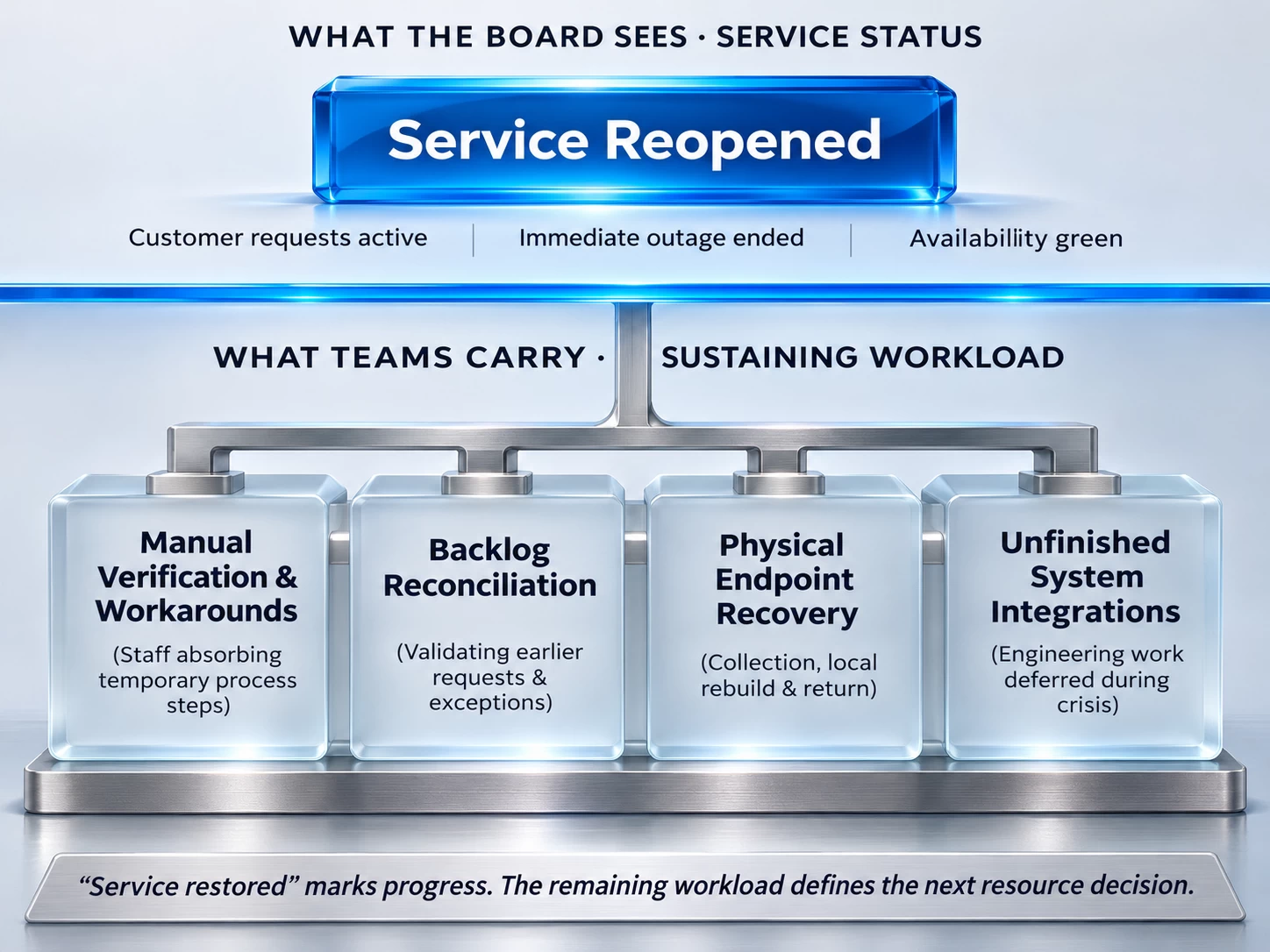
This article follows a recovery update from the CISO to the board. A service may have reopened while manual checks, device recovery and unfinished integration work still depend on exceptional support. Making that workload visible lets your executive team decide whether to extend support, defer competing work or accept a defined period of reduced service.
The upcoming publication, “When One Compromise Becomes Every Virtual Machine”, closes the When Attacks Move series by examining how one compromised management route puts an entire virtual estate at risk, and why protection at the virtual-infrastructure layer matters.
Consider a recovery update in which you tell your board that a customer service has reopened after a cyberattack. Customers can submit requests again, and the immediate interruption has ended. Behind that result, operations colleagues are checking submissions manually while engineers restore the integration that normally handles them. Earlier requests still need to be reconciled.
The service is available, and the update records real progress. It does not yet explain how much work is required to keep that service running, which other commitments have been deferred or what needs to happen before the temporary arrangements can end.
As the CISO contributing to that update, you can make the remaining dependency visible without turning the board paper into a repair schedule. The important distinction is between a service that has reopened and a service that can sustain normal demand without exceptional support.
Availability is an important milestone. It tells your organisation that customers are being served or that a critical process has resumed. It cannot, by itself, explain whether the service has returned to its intended operating model.
In the opening example, reopening depends on manual checks that colleagues can perform within an agreed limit. That may be a sound continuity decision. The unanswered question is whether enough capacity has been provided for those checks while also clearing the backlog and completing the integration work.
Without that context, a restored-service metric can be mistaken for permission to resume all ordinary commitments. Managers may release temporary support while the work that justified it is still outstanding. The reporting gap then becomes an allocation decision, with consequences for the people expected to carry the service.
A concise update can describe both progress and the conditions that qualify it. Your board needs to see which remaining dependency could constrain service delivery and which resource decision would resolve it. The device inventory and individual reconciliation exceptions can stay with the operational teams.
Absolute Security’s 13 May 2026 release describes a survey of 750 enterprise CISOs conducted by Censuswide. The 59% finding concerns respondents agreeing that their organisation required physical possession of an endpoint for remediation and restoration. It is not the proportion of all devices that needed collecting.
CyberRisk Alliance’s May 2024 publisher summary reports that 58% of surveyed organisations had no more than five employees dedicated to incident response. Other employees or suppliers may also contribute. The figure describes dedicated staffing, not the total recovery workforce or the workload of your team.
NIST SP 800-61 Revision 3 connects the selection of recovery actions to available resources and organisational needs. It also addresses criteria for ending recovery and communication of progress. Those principles support a report that distinguishes restored service from the work still required to sustain it.
Sources and further reading:
Absolute Security - Majority of Chief Information Security Officers (CISOs) Consider Paying Cybercriminals to End Ransomware Attacks, According to New Absolute Security Research
https://www.absolute.com/press-releases/new-research-cisos-ransomware-trends
CyberRisk Alliance - Lack of Resources Fueling Burnout Among Incident Responders - 58% Have a Small IR Team or None at All
https://www.cyberriskalliance.com/press-release/cra-cbir-incident-response-lack-of-resources-fueling-burnout-among-incident-responders
NIST - Incident Response Recommendations and Considerations for Cybersecurity Risk Management: A CSF 2.0 Community Profile - SP 800-61 Rev. 3
https://csrc.nist.gov/pubs/sp/800/61/r3/final
A planned manual fallback can preserve an essential service. Its value depends on the people assigned, the volume they can handle, the checks they perform and the point at which the arrangement needs to change.
For the reopened customer service, the operations owner can explain how much demand the manual process absorbs and how exceptions are handled. The integration owner can identify the work required to retire it. Those accounts need to meet when both depend on the same specialists or on support that is due to end.
Suppose the same engineer is needed to complete the integration and investigate a separate incident finding. The customer service remains open either way, so availability alone does not expose the conflict. Delaying the integration extends the manual workload; delaying the investigation leaves its question unresolved. The executive team needs to decide which commitment moves or whether additional support is justified.
That is a more useful escalation than a general statement that recovery remains busy. It connects the work, its consequence and the decision needed to complete it.
Necessary recovery work is not evidence of failed control. The concern arises when its demands remain unrecorded, when the same capacity is committed elsewhere or when no one owns the decision to extend or retire a temporary arrangement.
The opening example gives the update a practical purpose. The customer service has returned, but its temporary operating model still consumes capacity that another commitment may need. A short report can make the choice clear:
Your board can then assess the proposed allocation and the consequence it is being asked to accept. Operational managers retain the detailed schedule and the handling of individual exceptions. The report gives directors enough context to oversee the trade-off without bringing every repair task into the meeting.
The distinction remains useful as recovery progresses. A service may operate satisfactorily while a backlog remains. The backlog may be cleared while a temporary control still needs review. Each remaining commitment needs an owner and resources until its own completion condition is met.
The workload described above is also shaped while the attacker is still active. In a ransomware attack, each additional file encrypted adds damage your teams must repair. Stopping that encryption prevents restoration work from accumulating before the service reopens.
Our platform’s Ransomware Containment detects active encryption on supported SMB and NFS file services without endpoint agents and automatically cuts off its source. Depending on the configured response, it disables the affected account in Active Directory, disables the device’s network adapter or shuts down the device. Stopping encryption early leaves fewer files to restore, shortens recovery and reduces disruption costs.
The recovery update then distinguishes the additional damage containment prevented from the work that remains. A service running on manual checks still needs capacity until its integration is restored and earlier requests are reconciled. Your board receives a clearer account of the protection achieved, what sustains the reopened service and which resource decision will let the temporary arrangements end.
Our controlled Resilience Assessment compares agreed active file-encryption scenarios with your existing security controls active throughout, first without Ransomware Containment and then with it enabled. The comparison shows which files were affected and when encryption stopped. It makes the recovery work avoided through earlier containment visible, giving your team a concrete example of how stopping an attack changes the workload that follows.
The final When Attacks Move article, “When One Compromise Becomes Every Virtual Machine”, follows an attacker from compromised virtualisation management to the workloads it controls. It examines how administrative access becomes a route to widespread damage across the virtual estate.
Friday 27 Nov 2026, Operational Attack-series #12: "When One Compromise Becomes Every Virtual Machine"
Monday 30 Nov 2026, Resilience-series #13: "When Vulnerability Meets Control, the Outcome Changes"
Wednesday 2 Dec 2026, Leadership-series #13: "The First Objective Is Stopping the Cascade"