Article #38
Published: 20 November 2026
By Stan van Gemert | S10 Group
By Stan van Gemert
When attacks move series



The previous publication, “When Security and Operations Disagree”, examined how an executive incident lead resolves conflicting advice about a restriction that also affects essential work.
This article follows a different pressure: an attacker’s demand can draw attention away from protective decisions that already have a reason to proceed.
During cyber extortion, your investigators, customer service team and legal advisers need different findings before they can act. Odido’s response shows a concrete distinction: establishing the full extent of a breach takes time, while discovering that a verification code word has been exposed gives customer service a reason to change that check. Those protective decisions need not wait for an answer to the demand.
The next publication, “When Ransomware Becomes a Life-Critical Decision”, moves to healthcare and asks when a degraded clinical pathway has reached the point where staff must stop, defer or divert care.
By the time a ransom note arrives, several decisions may already be due. If an attacker has copied sensitive records, your investigators may still be establishing what was taken: personal information, intellectual property or confidential business material. Where those records include customer verification details, customer service needs to know whether that information is still safe to use when verifying a caller.
An attacker’s publication deadline draws attention towards the demand. Yet the next protective action may depend on a finding your teams have already confirmed. For a CISO coordinating the response, the difficulty is recognising which work genuinely needs more evidence and which work is waiting for a payment decision that will not answer its question.
A demand may threaten publication of stolen records, continued disruption or direct contact with affected people. It introduces a new decision about how your organisation responds to the criminals. Other decisions arise from what the attack has already changed: a compromised verification method, a personal data breach or an intruder who still has access.
In attacks that also target operational systems, the pressure extends beyond stolen information. Encrypting files interrupts work. Damaging virtual machines takes services offline. Attacking backups removes a route back to normal operation. Together, those actions increase the cost of refusing the demand: your organisation faces both the threatened disclosure and fewer ways to restore its services independently.
A new demand or a shorter deadline may draw the same specialists back into discussion. The risk is that work already justified by the evidence begins waiting for an answer about payment. Keeping the response to the demand connected to the investigation, without making it a prerequisite for every other action, protects the time available for that work.
On 5 and 6 February 2026, attackers gained access to a system Odido used to handle customer enquiries. Dutch police describe someone calling customer service while posing as an IT colleague. Odido says its teams revoked the unauthorised access in both incidents, but data had already been taken in one.
Odido disclosed the breach on 12 February. Calls, internet access and television remained available. The company later estimated that approximately 6.39 million people, including current and former customers, were affected. Reuters reported on 26 February that the attackers had begun publishing customer information after Odido declined to pay.
In its subsequent account of the response, Odido says it notified most affected people within days and contacted others as its analysis progressed. It added more than 140 agents to support customers. When some telephone verification code words were found in the leak, Odido stopped using them to verify customers calling the company. Separately, it introduced an app check allowing customers to verify an incoming call from Odido.
The investigation therefore informed practical changes to customer protection, alongside the company’s response to the publication threat.
Sources and further reading:
Odido - Odido informs customers of cyber attack
https://newsroom.odido.nl/en-us/odido-informs-customers-of-cyber-attack/
Dutch police - Datadiefstal Odido. Herkent u de stem?
https://www.politie.nl/gezocht/opsporingsbericht/2026/september/11-datadiefstal-odido
Odido - Update about cyberattack
https://www.odido.nl/veiligheid-eng
Reuters - Hacking group begins leaking customer data in Dutch telecom Odido hack
https://www.reuters.com/business/media-telecom/hacking-group-begins-leaking-customer-data-dutch-telecom-odido-hack-2026-02-26/
Under EU GDPR Article 33, a controller must notify the competent supervisory authority without undue delay and, where feasible, within 72 hours of becoming aware of a personal data breach, unless it is unlikely to pose a risk to people’s rights and freedoms. Information may be provided in phases without undue further delay when it cannot all be supplied at once.
Article 34 separately addresses communication to affected people where a breach is likely to create a high risk to their rights and freedoms, subject to its exceptions. Its requirement is without undue delay; it is not the same 72-hour notification rule.
Where US sanctions rules apply, making or facilitating a ransom payment involving a sanctioned party or another sanctions nexus may breach those rules. OFAC’s advisory explains that risk. Assessing it does not replace the separate assessment of reporting and customer protection duties.
Sources and further reading:
EUR-Lex - General Data Protection Regulation Articles 33 and 34
https://eur-lex.europa.eu/eli/reg/2016/679/
European Data Protection Board - Guidelines 9/2022 on personal data breach notification under GDPR Version 2.0
https://www.edpb.europa.eu/system/files/documents/2023-04/edpb_guidelines_202209_personal_data_breach_notification_v2.0_en.pdf
US Department of the Treasury OFAC - Updated Advisory on Potential Sanctions Risks for Facilitating Ransomware Payments
https://ofac.treasury.gov/system/files/126/ofac_ransomware_advisory.pdf
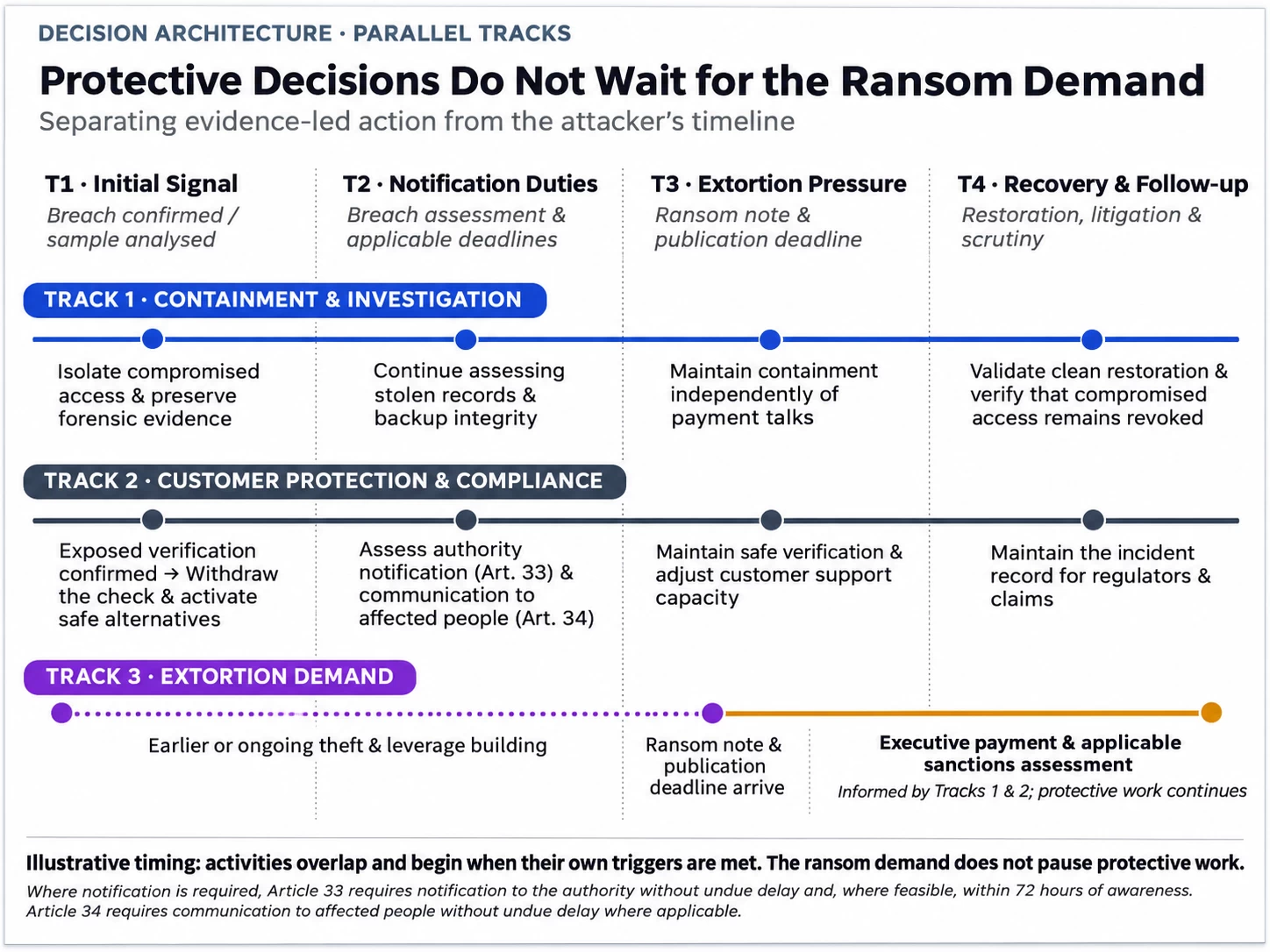
Containment, customer protection and notification duties proceed on their own triggers.
Their findings inform the payment assessment without waiting for the attacker’s deadline.
Odido declined to pay, following guidance from the authorities, and acknowledged that the attackers might publish the stolen data. The consequences extended well beyond the demand itself. Odido says it expanded customer support by more than 140 agents. In July, VodafoneZiggo’s chief financial officer reported that some customers had switched from Odido following the breach, although he described their contribution to its customer growth as small.
The legal consequences also continued. On 9 November 2026, Stichting CUIC brought a collective action against Odido seeking compensation for affected people. The claim concerns alleged failures in protecting and handling their information. It shows how a breach can leave an organisation dealing with customer concerns and legal proceedings months after the original intrusion. These consequences belong to the breach; they do not establish that paying would have avoided them.
The consequences make the payment question understandable: would paying prevent further damage or shorten the disruption?
The Dutch National Cyber Security Centre advises against paying, and the FBI does not support ransom payments. The UK National Cyber Security Centre likewise does not endorse payment. Its guidance, developed jointly with insurance industry bodies, examines the difficult decision organisations still face: what payment promises, which independent recovery options remain and what risks would persist afterwards.
Where encryption is involved, a promised decryption key needs to be weighed against independently verified recovery options. Receiving a key does not mean that every affected system will recover successfully or quickly. Restoring from usable backups may be faster. Payment itself neither removes the attacker’s remaining access nor fixes the weakness that allowed the intrusion.
For stolen information, the proposition is different. The attacker is asking your organisation to trust a promise about copies it no longer controls. Those copies may remain available for sale or another demand months later. The Dutch NCSC also describes victims facing increased demands after an initial payment or being attacked again. Payment therefore does not establish that the incident, or the pressure, is over.
In October 2026, Coveware reported that leaked internal communications from Silent Ransom Group had identified several victims who had paid to keep their incidents private. Their payment had depended on secrecy that remained in the criminals’ hands. When those communications leaked, the victims’ involvement became exposed despite the payment.
A separate problem remains wherever an attacker still has access. Mandiant’s incident investigations describe groups handing an existing foothold to other attackers for further exploitation. Payment does not close those routes. If compromised accounts, backdoors or other access remain usable, the same attackers, or another group acquiring that access, can attack your organisation again. For you as CISO advising the executive team, that changes the payment assessment: what immediate benefit is being purchased, and what exposure will remain afterwards? A working decryptor or a promise of silence does not establish that the compromise has ended. Your executive team needs to weigh the proposed payment alongside the work still required to prevent another attack.
Your contribution as CISO is to connect those technical findings to the business consequences: what recovery your teams can deliver independently, how long essential work can continue and which risks payment would leave unresolved. Service owners, legal advisers and incident specialists contribute their own findings so the authorised executive decision rests on more than the attacker’s account. Meanwhile, an exposed customer verification method still needs attention, whatever happens in the payment discussion.
A victim in an FBI investigation paid the ransom, only to receive another demand from a separate Medusa actor. The second actor claimed that the original negotiator had stolen the payment and demanded an additional amount equal to half the original ransom before providing the “true decryptor”.
The March 2025 joint advisory from the FBI, CISA and MS-ISAC documents this incident. It describes renewed extortion after payment, rather than a confirmed second intrusion. The distinction matters: even completing the transaction did not settle what the victim would receive or bring the demands to an end.
Sources and further reading:
Coveware by Veeam - The Silent Ransom Group Leak Shows Why Paying for Silence Fails
https://www.veeam.com/blog/cyber-extortion-payment-trends-q3-2026.html
Mandiant - M-Trends 2026 Executive Edition
https://services.google.com/fh/files/misc/m-trends-2026-executive-edition-en.pdf
FBI, CISA and MS-ISAC - #StopRansomware: Medusa Ransomware, AA25-071A, 12 March 2025
https://www.fbi.gov/file-repository/cyber-alerts/stopransomware-medusa-ransomware-031225.pdf
Changing a verification method also changes the work at the service desk. Staff need a usable alternative, and customers need to understand how to prove who they are without relying on the exposed information. Otherwise, a protective change risks leaving genuine customers unable to get help or encouraging staff to improvise a weaker check.
That is a useful point of coordination for you as CISO: connecting the technical finding to the team that runs the affected process. Customer service may need extra capacity, updated guidance and a way for former customers to verify that a warning is genuine. These are practical consequences of the data taken, with their own urgency while the demand remains under discussion.
For a CISO reviewing an extortion plan, a revealing question is what would happen if the payment decision remained open overnight. Would an already justified customer protection change still take effect? Would the team assessing a notification have the findings it needs? Following one unresolved demand through the plan shows whether it holds up work for reasons that have little to do with the demand itself.
An attacker can set a publication deadline. The timing of a verified protective step does not have to follow it.
The pressure behind an extortion demand is built while the attacker is still active. Once preventive controls have been bypassed, reconnaissance reveals what else is accessible. Lateral movement opens further routes, data theft supplies material for disclosure, and destructive activity interrupts services or damages the systems needed for recovery. Our platform interrupts that progression automatically across the protected server, file-service and virtual-infrastructure layers.
Our Server Intrusion Protection exposes and traps intruders attempting to gain remote access to protected servers, including those using compromised administrator credentials. It detects reconnaissance, automatically blocks unauthorised access and interrupts lateral movement and data theft. Stopping the attacker during preparation protects the systems and records they were trying to reach. Blocking malicious server activity also interrupts attempts to disable security controls and deploy malware.
An attacker may instead begin encrypting immediately. Our Ransomware Containment detects active encryption on supported SMB and NFS file services without endpoint agents and automatically cuts off its source. Depending on the configured response, it disables the affected account in Active Directory, disconnects the device by disabling its network adapter, or shuts down the device. That stops further encryption and prevents the associated file damage and restoration work.
The attack may also target the infrastructure beneath those services. Our Virtual Server Protection protects supported VMware and Hyper-V environments at the virtual-infrastructure layer. In supported VMware ESXi deployments, it monitors host processes, datastores and virtual disks, and automatically stops malicious encryption or corruption of protected system files and images. Protecting those files preserves the virtual machines on which business services and recovery tools depend.
Those interventions change what your organisation faces before any payment discussion begins. Stopping theft protects information from becoming extortion material. Stopping destructive activity preserves working systems and avoids the downtime and rebuilding that damage would create. Your responders investigate the intrusion with containment already in effect. The attacker has been stopped on the protected route; your organisation has less damage to address and more of its own operating capacity intact. Early containment saves your organisation time and money.

Monday 23 Nov 2026, Resilience-series #12: "When Ransomware Becomes a Life-Critical Decision"
Wednesday 25 Nov 2026, Leadership-series #12: "The Board Sees the Outcome. Teams Carry the Pressure."
Friday 27 Nov 2026, Operational Attack-series #12: "When One Compromise Becomes Every Virtual Machine"