Article #42 (extra edition: 1Password hack)
Published: 26 November 2026
By Stan van Gemert | S10 Group
By Stan van Gemert
Special edition series



This special edition completes our control trilogy. The Extortion Trap Begins Before the Ransom Note examines control over decisions under extortion pressure. When Access Is Part of the Mission examines control over the consequences of one compromised connection. Here, control over architecture asks which powers a compromised system can exercise, which remain beyond it and where malicious use is stopped.
The previous scheduled publication, "The Board Sees the Outcome. Teams Carry the Pressure.", examined the work and capacity still needed after a service reopens.
This special edition looks further back: how does the architecture already in place determine what a successful intrusion can expose or damage?
On 25 November 2026, 1Password disclosed an attack in which source code and administrative customer information had been copied. According to the company, customer vault contents remained protected. The distinction matters because storing encrypted information and holding the secrets needed to read it are different capabilities.
This article follows those capabilities through an architectural risk assessment: what an account can reach, which powers have been kept apart and who can change the protections between them. It also examines why wider AI adoption changes operating speed without removing those architectural questions, and where automatic containment stops malicious use of permissions a working service still needs.
The upcoming scheduled publication, "When One Compromise Becomes Every Virtual Machine", closes the When Attacks Move series by following compromised management access to the hosts and workloads beneath it.
On 25 November 2026, password manager 1Password disclosed an attack on its backend systems. Source code and administrative customer information had been copied. According to the company, customer vault contents remained unavailable to the attacker. The same incident produced a serious breach and a boundary that held.
For a risk team, that combination deserves attention. A breach can expose one part of a service while leaving another protected by its design. The difference depends on what the compromised environment can actually do, including whether it holds the secrets required to read the information it stores.
The useful question is what your organisation has already placed beyond the reach of a successful intruder. Some protections recognise harmful activity and stop it. Others remove a capability from the system altogether. Knowing which protection supports a critical service changes what your executive team can reasonably expect when an accepted connection becomes unsafe.
What happened?
On 19 November 2026, 1Password, a provider of password-management services, began investigating indications that an attacker had accessed an employee’s corporate GitHub account. The company disclosed the incident on 25 November.
According to 1Password, the attacker copied private source code, accessed its software build-and-release system and pushed malicious code to backend services. The code downloaded records for an undisclosed subset of customers: names, email addresses, account and user identifiers, account creation and last-sign-in times, and other account metadata. Certain emailed invitation, provisioning and recovery tokens were also involved.
1Password disabled the affected GitHub account, revoked the stolen token and removed access created by the attacker. It restored clean service versions and rotated or revoked potentially exposed infrastructure credentials. For affected invitation and recovery flows, it lengthened email verification codes from six numeric digits to ten alphanumeric characters. The company said the exposed tokens required an additional sign-in or email check and reported no internal signs of account takeover using provisioning tokens.
The company said its apps and services were operating normally. It reported that vault contents, vault-protection keys, account recovery keys, apps and browser extensions were unaffected. It also warned customers about phishing and engaged external cybersecurity specialists to validate containment and remediation.
The statement does not disclose the original account-compromise method, the attacker’s dwell time or the exact customer count. It is the company’s account of the investigation, rather than a published independent forensic report.
Why it matters here:
Access to source code and backend services exposed administrative information without supplying the missing secrets needed to read customer vaults. Different assets inside the same service had different consequences when access failed.
Sources and further reading:
1Password - Update on a security incident involving 1Password’s backend systems. Customer vaults were not affected and all vault contents remain secure.
https://1password.com/blog/update-on-nov-2026-security-incident
1Password’s May 2026 architecture explanation describes encryption on the user’s device before transmission. Its Secret Key documentation explains how the Account Password and Secret Key contribute to the cryptographic protection. The service stores encrypted vault contents without holding those secrets in a form it can use to read them.
The design also constrains legitimate functionality. For example, 1Password says it cannot offer ordinary server-side searches through readable vault contents. A useful power has been kept off the server, with a product trade-off as well as a security benefit.
The November incident finding and the design description answer different questions: what 1Password says happened in this intrusion, and why access to stored encrypted data does not itself provide decryption capability.
A different attack assumption needs its own assessment. In a separate February 2026 discussion, 1Password addressed research into a fully malicious server and documented limitations around the authenticity of keys supplied for sharing. Those conditions are not reported as the mechanism of the November incident. They show why an architectural claim needs a named attack condition, rather than treating a protected outcome in one incident as a guarantee against every route.
Sources and further reading:
1Password - The architectural reason 1Password can’t read your vault data
https://1password.com/blog/the-architectural-reason-1password-cant-read-your-vault-data
1Password - About your Secret Key
https://support.1password.com/secret-key-security/
1Password - Zero knowledge vs. a malicious server: A look at ETH Zurich’s research
https://1password.com/blog/eth-zurich-zero-knowledge-malicious-server-review
1Password - 1Password Security Design White Paper
https://agilebits.github.io/security-design/
The vault boundary existed before the intrusion. Its value did not depend on the response team first reconstructing the attack and deciding which records to protect. The means to decrypt vault contents had already been kept outside the compromised environment.
That is a practical way to examine architecture during a risk assessment. Your team can identify which capabilities a service needs and which powers would create unnecessary consequence if the service were taken over. Storage, decryption and administration can require different authority. Bringing them together for convenience may also bring their risks together.
Consider a hypothetical document service. Its files are encrypted, and a separate key service supplies the means to read them. If the document service’s account can also request every decryption key, taking over that account may expose both the files and the ability to read them. Two separate boxes in an architecture diagram do not establish two independent protections.
A stronger separation might limit which documents can be opened through one account, or require another independently controlled step before a sensitive collection can be exported. The authority to change that restriction matters too. If the same compromised administrator can rewrite both sides, the apparent separation may not survive the attack being assessed.
Each choice needs to fit the work the service performs. The risk decision is whether the convenience of broader authority justifies the consequence if that authority is compromised. Our companion analysis, "When Access Is Part of the Mission", asks how much damage one necessary connection can cause. Architecture helps determine that damage before an incident begins, by deciding which additional capabilities the connection can reach.
The boundary around vault contents does not erase the information copied from the administrative environment. Names, email addresses and details about invitations or recovery can make an impersonation attempt more convincing. A message that names the right service and refers to a familiar account process may give its recipient more reason to trust it.
1Password warned about that secondary risk. It also changed the checks around certain emailed tokens and replaced potentially exposed infrastructure credentials. Those measures belong to the part of the incident that did require action, even while the company reported that vault contents remained protected.
A risk report can hold both findings together. One class of loss was bounded by the design; other information was taken and other access needed to be removed. Recording those separately prevents the phrase ‘the vaults were safe’ from becoming a mistaken account of the whole incident.
The distinction also changes the quality of risk acceptance. A boundary that protects a highly sensitive asset can be valuable without making every remaining consequence acceptable. The assessment still needs to identify what remains exposed and what further protection is justified.
A discussion about architecture becomes more useful when it follows one compromised identity through the work it is allowed to perform. A development account, deployment service or administrator provides a concrete starting point. The following questions connect that authority to the consequence your organisation is accepting.
What can that identity collect?
Include data, credentials and the ability to obtain more permissions. Direct access is only the beginning if the account can change code that runs with greater authority.
Which required secret remains unavailable?
Identify the material or permission that keeps the protected asset out of reach. The useful explanation describes what happens when an administrator in the first environment is acting maliciously.
Who can change the boundary?
Recovery procedures, emergency access and software deployment can alter a separation that looks sound in routine use. The authority to change a rule belongs in the review alongside the authority to use the data.
Where is harmful use interrupted?
Some services need to read records or administer infrastructure. The question then becomes which control stops malicious use of those necessary powers and whether it remains effective in the compromise being assumed.
What would demonstrate that it holds?
A test needs an assumed compromise, an attempted action and an observable result. Its finding describes those conditions, including any route the test did not examine.
‘Encrypted’, ‘segmented’ and ‘restricted’ each name a protection. The risk decision depends on what that protection still prevents after another part of the environment has been compromised. A useful answer names the asset, the failed control being assumed and the boundary expected to hold.
For the hypothetical document service, that might mean demonstrating that taking over its account still does not release the keys to a sensitive collection. Where the service genuinely needs to read the information, the review instead follows what stops a malicious export or an attempt to reach another server. The result is a defined limit on one compromise, rather than a general assurance that several security products are installed.
AI-driven security can prevent malicious activity, investigate signals and execute a response automatically. Endpoint and workload protection can stop processes and isolate affected devices. Behavioural security can restrict suspicious connections across the environments it covers. Those interventions change what an attacker is able to do; they are not merely faster alerts.
An early adopter can gain time by recognising a pattern sooner or automating work that previously waited for an analyst. That advantage matters. But an advantage based on having a capability earlier becomes less exclusive as the same capability becomes widely available.
Attackers are adopting AI too. The UK National Cyber Security Centre’s 2026 assessment expects it to increase the speed, scale and efficiency of existing techniques. Google Threat Intelligence Group and Mandiant reported on 16 November that adversaries were using agentic frameworks to automate parts of live intrusions. Familiar weaknesses, including compromised credentials and unpatched systems, remained useful; some of the work of exploiting them had become faster.
The curve below illustrates the loss of exclusivity, not a decline in AI’s usefulness. As comparable capabilities spread, AI becomes part of the operating baseline. Defence improves, but the attacker’s work accelerates as well. Access to the technology is no longer enough to explain which side will prevail.
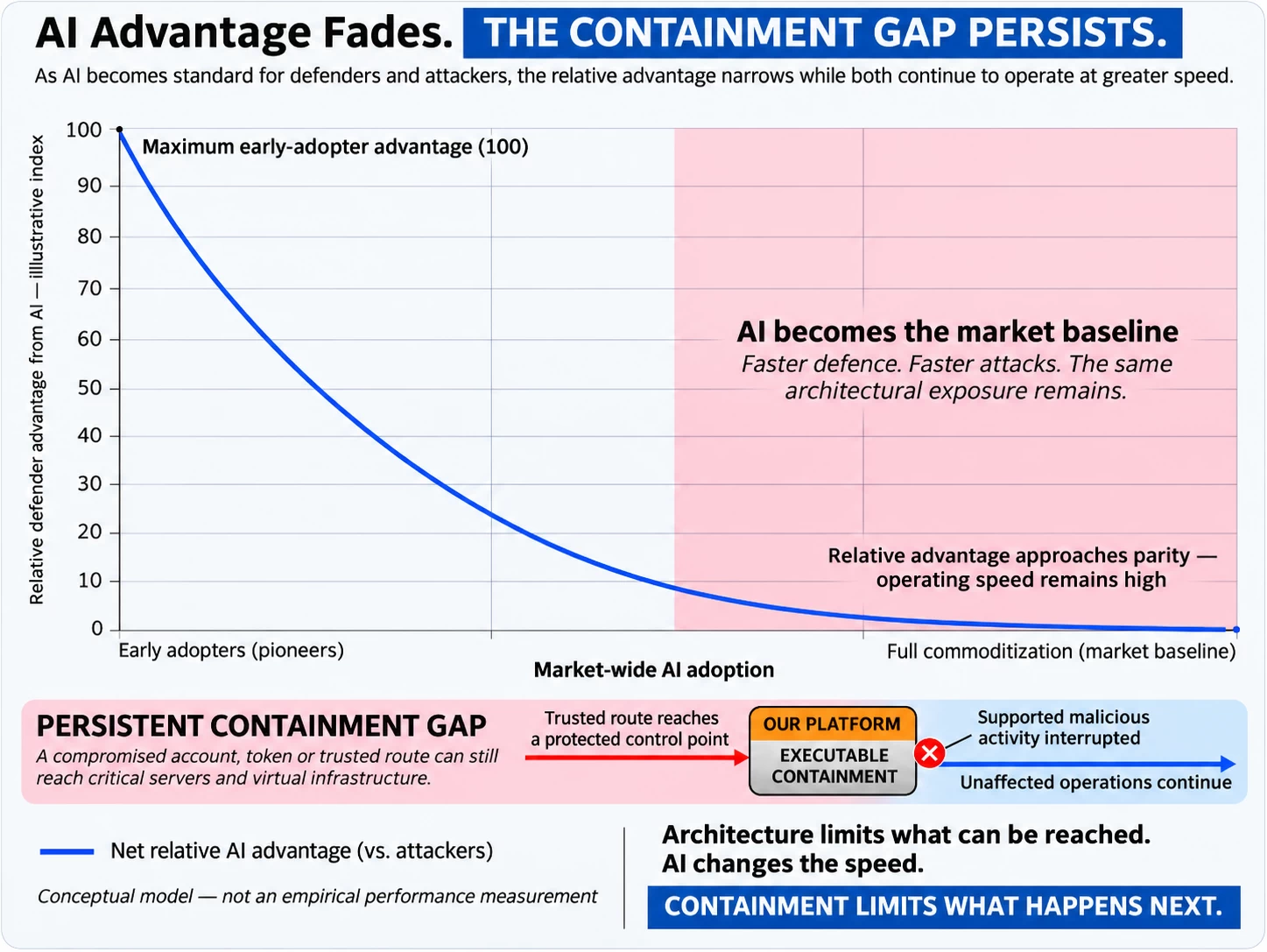
Conceptual model: an advantage based on earlier access to AI becomes less exclusive as adoption spreads. The index and curve are illustrative, not measured effectiveness or a forecast of parity. Architectural exposure is held constant; the lower band shows containment acting at a separate operational point.
The NCSC’s 2026 assessment describes AI as a force multiplier across reconnaissance, social engineering, vulnerability discovery and exploit development. Adoption and benefits remain uneven. It also expects a widening divide between organisations able to use AI effectively for defence and those unable to adapt.
Google Threat Intelligence Group and Mandiant’s November report describes observed use of agentic tools to automate particular phases and tasks during intrusions. It does not establish that all attacks are autonomous or that defenders and attackers have already reached parity.
Our curve is an analytical illustration of a narrower proposition: an advantage based on earlier access loses exclusivity when comparable capabilities spread. It is not a measured result from either source. Skills, integration and deployment still affect outcomes. The model does not assume that AI failed at 1Password; the public incident statement does not describe the company’s AI security controls.
Sources and further reading:
UK National Cyber Security Centre - NCSC Annual Review 2026: The impact of AI on cyber threat
https://www.ncsc.gov.uk/collection/annual-review-2026/understanding-threat/ai-impact-cyber-threat
Google Threat Intelligence Group and Mandiant - GTIG AI Threat Tracker: Agentic Threat Activity Crosses a Significant Threshold
https://cloud.google.com/blog/topics/threat-intelligence/agentic-threat-activity-crosses-a-significant-threshold
Not every business service can work like a vault whose provider cannot read its contents. A claims system needs to process claims. A hospital application needs to display patient information. Administrators need to maintain the servers supporting that work. Removing every useful power would also remove the service.
Those necessary powers create the next architectural question. If a service account can change shared files, what stops it encrypting them? If an administrator can reach another server, what stops stolen credentials carrying the intrusion there? If management access reaches a virtual host, what protects the machines and storage beneath it?
Different controls act at different places. Endpoint protection may stop the process on a managed device. A network control may block the connection. An additional control at the server login, file activity or virtual host provides another place to interrupt the harmful action. Their roles can overlap; the useful assessment establishes what each actually stops in the environment concerned.
Protection is stronger when the control follows the damaging action to the system carrying it out. That turns an architecture diagram into a practical account of what remains protected after one route has succeeded.
1Password’s vault design kept the means to read a protected asset outside the compromised server environment. Many of your own services need powers that cannot be removed in the same way. Our platform adds automatic containment where those necessary powers are being used maliciously: on protected server-access routes, shared file activity and virtual infrastructure.
On a protected Windows server, Server Intrusion Protection challenges a remote desktop login with an additional authentication check. If the attacker cannot complete it, access is refused and the configured automatic response blocks the affected accounts and isolates the source device. A stolen password alone does not become access to that server. If an intruder tries to use that protected route to reach another server, the failed challenge stops the attempted access before the server can be used for further discovery, data theft or ransomware deployment.
At the infrastructure layer, Virtual Server Protection protects supported VMware and Hyper-V environments. For VMware ESXi, protection is installed on the host itself. It adds an authentication check to remote administrator logins over SSH and monitors host processes, datastores and virtual disks for malicious activity. When it detects a malicious process, it stops it automatically. Interrupting encryption or corruption there protects the virtual-machine images on which business services depend.
Where a necessary account is used to encrypt shared files, Ransomware Containment detects active encryption on supported SMB and NFS file services without endpoint agents and cuts off its source. Depending on the configured response, it disables the account in Active Directory, disables the device’s network adapter or shuts down the device. That prevents additional file damage and the restoration work it would create.
These are interventions alongside the endpoint, behavioural and identity protections already in place. The attacker is stopped on the protected route while your responders investigate how access was obtained and which other systems require attention. In the document-service example, stopping malicious access to another protected server keeps further collections outside that route. Stopping encryption protects usable records; stopping destructive host activity protects the machines serving them.
For risk management, the architectural contribution is concrete. A service can retain the powers its work requires while an additional control stops supported harmful use of them. That intervention reinforces architectural separation; it does not replace it. The risk assessment can name both the necessary powers and the technical action that stops their malicious use.
See: our platform and its protection layers →
Active file encryption provides one observable example of that difference. Our remote Resilience Assessment compares agreed scenarios in a controlled, isolated test environment. Your existing security controls remain active throughout, first without Ransomware Containment and then with it enabled. The comparison shows which files were affected and when encryption stopped.
Server Intrusion Protection and Virtual Server Protection can be presented and explained alongside those results. The assessment is free for organisations with more than 250 employees. It gives your team a recorded result for the agreed encryption scenario, as a starting point for discussing the protection required at other architectural boundaries.
The reason the vault finding matters is the order in which the protection was established. The separation preceded discovery of the intrusion. Response teams could then investigate and repair the affected environment with that existing boundary shaping the consequences they faced.
Our three cornerstone analyses examine different parts of that problem. "Control over decisions" follows the choices that remain under extortion pressure. "Control over consequences" asks how much loss one necessary connection can carry. Control over architecture asks which powers were kept apart, and which protections were placed where harmful activity could be stopped, before that connection failed.
When an important account is taken over, its permissions, the secrets it can obtain and the controls it encounters shape the loss your organisation faces. A risk assessment that follows those relationships can explain why a specific asset remains protected even after another control has failed.
The attacker got in. According to 1Password, the vault contents remained unavailable. The boundary that mattered was already part of the service.
26 November 2026 - Publication baseline
The incident account follows 1Password’s statement of 25 November. That statement does not disclose the initial account-compromise method, dwell time or exact customer count. The company has engaged external specialists; its published account is not an independent forensic conclusion. Material new findings on those points, token misuse or architectural changes will be recorded here with their source and date.
Current 1Password incident statement
The upcoming scheduled publication, "When One Compromise Becomes Every Virtual Machine", examines the other side of the architectural question. Where 1Password’s server did not hold the secrets needed to read vault contents, virtualisation management holds powers that can change many systems together. The final When Attacks Move article follows that authority to the hosts, workloads and recovery infrastructure beneath it, asking which protections still hold when the attacker can alter their settings.
Friday 27 Nov 2026, Operational Attack-series #12: "When One Compromise Becomes Every Virtual Machine"
Monday 30 Nov 2026, Resilience-series #13: "When Vulnerability Meets Control, the Outcome Changes"
Wednesday 2 Dec 2026, Leadership-series #13: "The First Objective Is Stopping the Cascade"