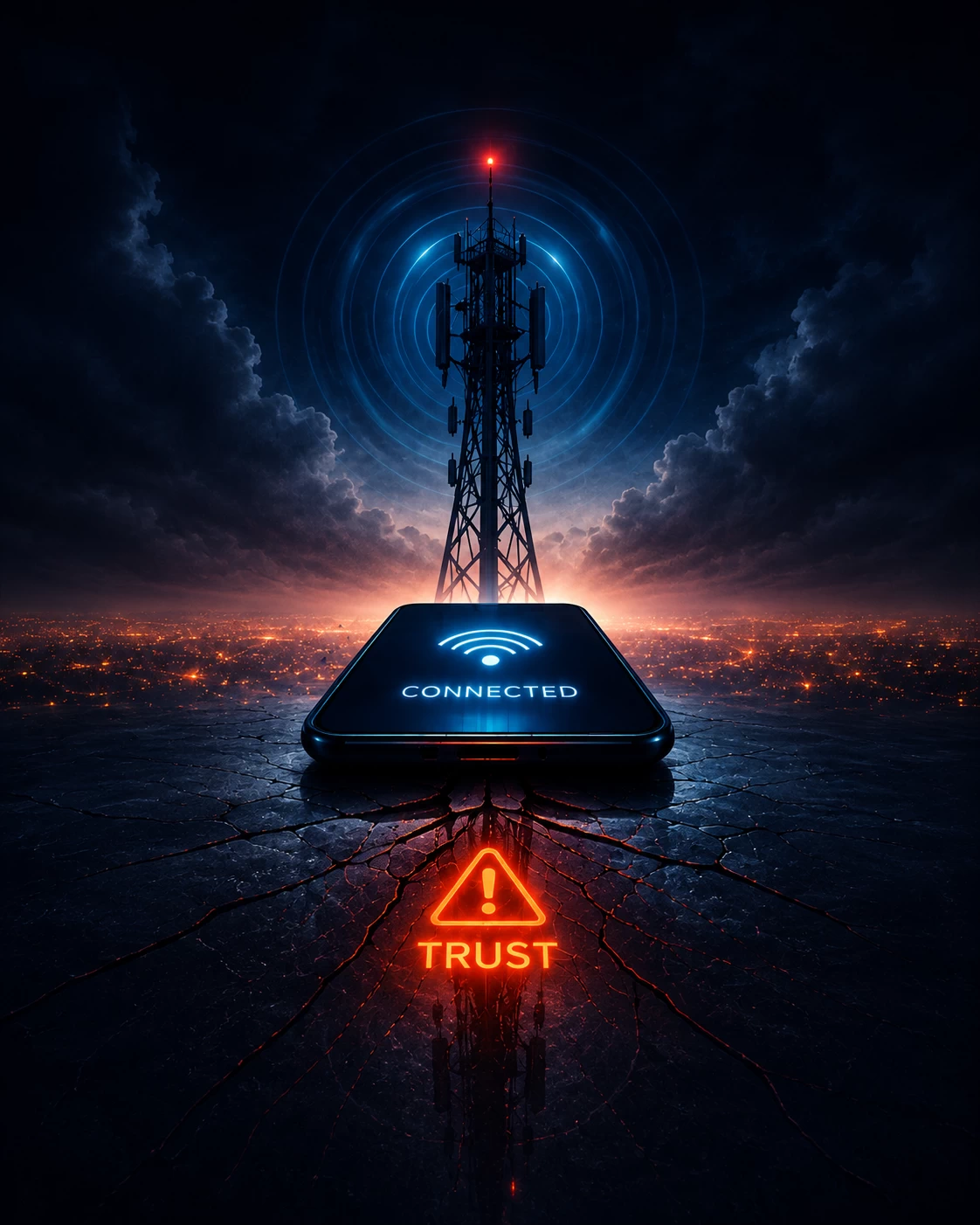
The Odido Lesson: When Access Still Works but Trust Does Not: Access still working while identity trust has already broken.The Odido Lesson: When Access Still Works but Trust Does Not: Access still working while identity trust has already broken.
S10 Group Newsletter · Identity & Containment Series

The Odido lesson:
When Access Still Works but Trust Does Not

Why identity trust is the real fault line in modern incidents.
Newsletter #1
Published: 17 March 2026
Last updated: 9 September 2026
By Stan van Gemert | S10 Group
By Stan van Gemert


Why this series starts with trust

The Identity & containment series starts here because many modern incidents do not begin with a dramatic shutdown. They begin with ambiguity. An account appears legitimate. A system remains available. A workflow continues. But the organisation can no longer be fully certain that the identity behind the access should still be trusted.

That is why the first resilience question is not only whether access can be authenticated. It is whether access can be narrowed, challenged, isolated or withdrawn quickly enough when trust changes.

When trust fails before systems do

In February 2026, Dutch telecom provider Odido disclosed a cyber incident affecting personal data tied to more than six million accounts.

Odido is one of the country’s major telecom providers, serving millions. This incident caught my attention for the scale and because the moment data is already stolen, you’re no longer preventing impact, you’re managing consequences...

The Odido story isn’t interesting because attackers were “clever.” It’s interesting because it shows how quickly a familiar pattern becomes large when warning signals exist, but decision pathways lag.

There’s a moment in many incidents where nothing looks “down”… and yet control is already slipping.
Not because systems failed.
Because trust did.

What makes the reporting uncomfortable is precisely that the incident was not exotic or dependent on a movie-plot zero-day. It emerged from a chain of plausible weaknesses: the social manipulation of an employee, access to a customer contact system and permissions that placed a broad set of records within reach.

ACCESS IS NOT LEGITIMACY
The moment services still run but trust is broken, the problem is already governance — not only recovery.

What happened (the facts)

Odido stated the incident involved personal data from a customer contact system, and that passwords, call details, and billing data were not involved.

Public reporting describes attackers using social engineering — posing as internal IT/helpdesk to persuade staff to approve access — rather than exploiting a novel software vulnerability.

Several write-ups also highlight an uncomfortable detail: this general method was not hypothetical. Warnings about this kind of approach had been circulating, including in relation to widely used SaaS environments and identity/access patterns.

That last point matters, because it changes the leadership question from:
“How could anyone predict this?”
…to something more practical:

When warnings exist, the gap is rarely “more tools.” It’s whether the organisation can reduce the time between knowing and acting — turning a credible signal into fast, governed containment that limits further compromise and restores control.

A practical point: this is also where capability can genuinely change outcomes — not by creating more alerts, but by creating control.
When you can reliably see lateral movement and detect data-exfiltration behaviour early enough, you can trigger containment actions that limit further spread and additional exposure.

The difference isn’t “visibility for reporting.” It’s visibility that enables a governed move: reduce privileged pathways, isolate risky segments, and keep essential operations running while trust is rebuilt.
What the Odido record now confirms
Odido’s current incident update states that an attacker contacted its customer service team while posing as a member of internal IT. Voice-phishing attempts took place on 5 and 6 February 2026. Odido says the unauthorised access was detected and revoked, yet one of the attacks still resulted in data exfiltration. The company’s services remained fully available, while approximately 6.39 million active and inactive Odido and Ben customers were affected.

For leadership, that combination is the point. Availability did not establish control, and access that continued to work was not necessarily access that could still be trusted. Once legitimacy becomes uncertain, the organisation must be able to challenge the session, narrow its permissions and restrict what the identity can reach before apparently valid access turns into irreversible exposure.
View more details chevron A white downward-facing V-shaped chevron on a transparent background.
View more details
Close more details

The decision boundary that mattered

Most organisations will read this and think: “So… train people better.”
Training matters. But notice what that framing does.
It quietly places the centre of gravity on the individual who took the call.

A more useful lesson is structural: a secure environment shouldn’t rely on a single person being impossible to manipulate — and the way access is designed and governed matters.

This is the boundary leaders tend to underestimate:
We treat identity controls as “security”.
But in practice, identity controls are governance — because they define who can act, what they can reach, and how quickly we can reduce risk without freezing operations.

In other words: the incident doesn’t start when data leaves.
It starts when leaders realise they no longer know what “legitimate access” means.
And once legitimacy is uncertain, every response step becomes governance:

This is the part that doesn’t show up in many incident decks:
Detection buys awareness. Only pre-decided containment buys time.

  • How broadly can we restrict access without breaking the business?
  • Who has the authority to do it fast?
  • What do we keep running while we regain confidence?

The move from system failure to trust failure

A system failure is visible: outage, latency, broken process.

A trust failure is quieter: the system is still running, but you can’t prove who is driving.

That is why “we detected it” is not the same as “we controlled it”.
And why “we restored services” is not the same as “we regained governability”.

Odido customers could still use services, according to the company’s own communication.
But the incident still carried weight because identity and access pathways touched sensitive data at scale.

The issue is not only whether the organisation is still operational, but who has the authority to decide when it is no longer safe enough to trust.

Three questions to ask next time

These aren’t technical questions. They force clarity before the next uncomfortable hour arrives.

  • When identity trust is uncertain, what is our “minimum operational mode”?
    What must keep running, and what can be intentionally degraded — by design — to protect control?
  • Who can trigger rapid access restriction, and what evidence is “enough” to act?
    Not “who should be consulted”, but who has authority to pull the first lever when the picture is incomplete.
  • Where do we have concentration risk in access — and do we know it?
    If one compromised pathway can touch “too much,” is that an accepted architectural choice… or an accidental one?

If you want to make this practical, the next step isn’t more policy, it’s a simple pressure-test of the first-hour decisions.

One practical pressure-test suggestion

Don’t start by writing a new policy.
Run a 60-minute identity-trust exercise with three timed phases:
T+0 to T+10: credible signal, incomplete evidence
What do we do immediately that is reversible? Who authorises it?

T+10 to T+30: suspicion of persistence
How do we invalidate active trust (sessions/tokens), and what breaks operationally?

T+30 to T+60: stabilisation
How do we progressively restore controlled access without re-opening the same pathways?

The value isn’t the tabletop discussion.
The value is discovering whether your organisation can execute the first move without debate, confusion, or operational shock.

The most dangerous phase is often not outage.
It is the moment normal access continues while leadership can no longer be sure what that access means.

A closing thought

So, I’ll leave you with a question I find more useful than “How do we prevent every breach?”:

If identity trust broke tomorrow, would your first hour be governed… or negotiated?

Resources for CIOs/CISOs to make this practical

  • Identity under pressure — 7 board questions (Trust vs Authority)
  • Three pressure-test briefings: (Pressure test for leadership control / First-hour containment decisions / Why pressure testing matters)

I can also share how I pressure-test this in practice through a resilience assessment in your own sandbox environment, with your existing security stack enabled.
If any of these would be useful, feel free to contact me.


WHAT CONTAINMENT CHANGES
The most dangerous phase is often not outage.
Containment gives leadership a way to reduce exposure before uncertainty turns into wider consequence.

Hear first when a new S10 Group release is published

Would you like to receive a short note when S10 Group publishes a new article or newsletter?

Leave your name and email address below. We will send a short update when a new release is available, with a brief summary and a direct link to the publication.

No noise. No automated campaign stream. Just a simple signal when there is something worth reading.
Thank you! Your submission has been received!
Oops! Something went wrong while submitting the form.

Further readings

Context & discovery

These independent public sources offer additional context and perspectives on the issues explored here. They are provided for further reading and remain separate from the S10 publication series.