Most
organisations
have
invested
seriously
in
cybersecurity.
And
still,
incidents
continue
to
happen.
Not
because
protection
is
absent,
but
because
the
nature
of
attacks
has
changed.
What
matters
now
is
not
only
whether
something
gets
in.
It
is
what
happens next.
Ransomware has evolved. It is no longer a single event. It is a sequence.
Access.
Movement.
Data
theft.
Extortion.
Disruption.
Decisions
under
pressure.
Consequences
that
continue
long
after
the
technical phase appears more stable.
That
change
matters
because
it
shifts
the
resilience
question.
The
issue
is
no
longer
only
how
to
prevent
entry.
It
is
how
to
limit
the
damage once prevention has already been bypassed.
What organisations face today is not one risk.
It is a chain of consequences that unfolds once control starts to slip. See below six dimensions.
These six dimensions do not exist separately. They reinforce each other.
Technical
behaviour
creates
uncertainty.
Uncertainty
slows
decisions.
Delayed
decisions
increase
impact.
Impact
then
triggers
legal,
financial, reputational, and human consequences that reach far beyond the original point of entry.
A single incident quickly becomes a wider organisational consequence chain.
Where most organisations struggle
Most
organisations
are
not
lacking
security
tools.
They
are
facing
a
different
gap.
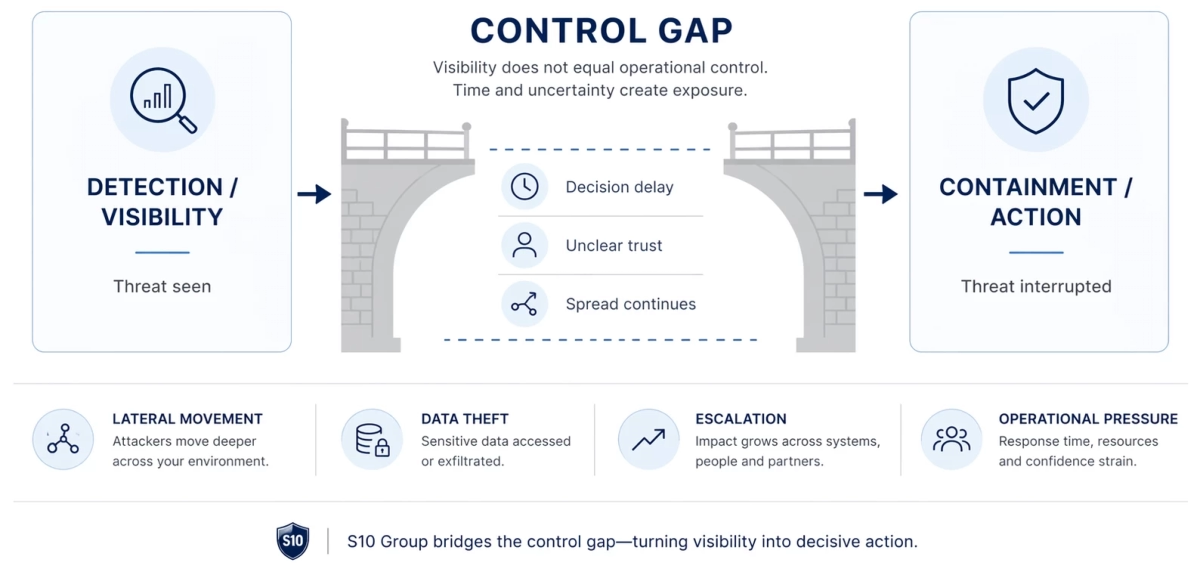
When
something
slips
through,
many
environments
can
detect
that
pressure
is
rising.
Far
fewer
can
convert
that
awareness into a safe operational move quickly enough to matter.
•
The ability to act under uncertainty
•
Clear authority during the first phase
•
A safe operational move to limit spread
•
Control once prevention has been bypassed
•
Stabilisation before rebuild becomes unsafe
Understand where your organisation
stands when prevention has already
been bypassed.
Run a controlled resilience assessment to see how your environment behaves under ransomware pressure, where control is likely to be lost, and what changes when containment becomes executable.




The question is no longer only:
Can we prevent attacks?
It is:
Can we stay in control
when something slips through?
That is the question that now sits behind resilience, governance, continuity, and defensible leadership.
What actually changes the outcome
Outcome changes when organisations can act early enough to interrupt the sequence before it becomes much harder to govern.
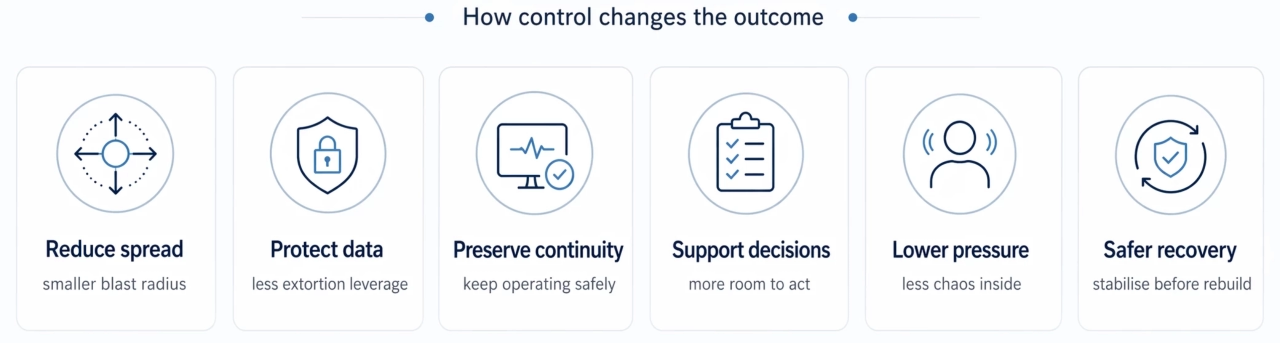
Not prevention. Not a broader recovery programme. But control during
the moment the incident is already unfolding.
In
many
environments,
something
can
slip
through
and
only
become
visible
afterwards
in
logs,
alerts,
or
forensic
review.
That
may
help explain what happened, but it does not stop the incident from developing.
S10
Group
sits
in
that
gap.
It
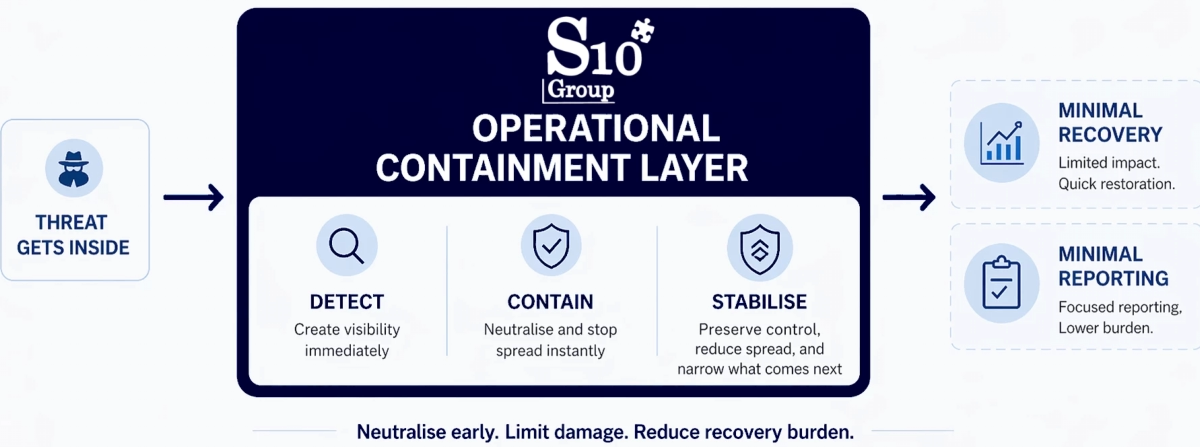
provides
an
operational
containment
layer
that
detects
malicious
behaviour
after
entry,
contains
it
before
it
can
spread
further,
and
helps
stabilise
the
environment
at
the
point
where
many
organisations
would
otherwise
still
be
trying to work out what can be trusted, what must be isolated, and how far the incident has already spread.
The
result
is
a
different
kind
of
incident.
Early
neutralisation
changes
the
shape
of
what
comes
next.
Recovery
becomes
narrower.
Reporting
remains
possible
and
necessary
where
required,
but
the
burden
becomes
minimal
because
wider
damage
is
prevented.
That
saves
organisations
significant
time,
cost,
and
downstream
disruption
—
and
helps
prevent
the
broader aftermath explored in
What happens when data leaves your organisation
and
Human impact.
When trust becomes part of the incident
Reputational
damage
is
rarely
caused
by
one
technical
event
alone.
It
often
grows
when
data
exposure,
operational
uncertainty,
public
disclosure,
and
unclear
communication
combine.
This
page
explains
how
stakeholder
trust
is
affected
during
a
cyber
incident — and why containment can change the trajectory.
S
e
e
m
o
r
e
d
e
t
a
i
l
s








Most
organisations
have
invested
seriously
in
cybersecurity.
And
still,
incidents
continue
to
happen.
Not
because
protection
is
absent,
but
because
the
nature
of
attacks
has
changed.
What
matters
now
is
not
only
whether
something
gets
in.
It is what happens next.
Ransomware has evolved. It is no
longer a single event. It is a
sequence.
Access.
Movement.
Data
theft.
Extortion.
Disruption.
Decisions
under
pressure.
Consequences
that
continue
long
after
the
technical
phase
appears
more stable.
That
change
matters
because
it
shifts
the
resilience
question.
The
issue
is
no
longer
only
how
to
prevent
entry.
It
is
how
to
limit
the
damage
once
prevention
has already been bypassed.
What organisations face today is
not one risk.
It
is
a
chain
of
consequences
that
unfolds
once
control starts to slip. See below six dimensions.
These six dimensions do not exist
separately. They reinforce each
other.
Technical
behaviour
creates
uncertainty.
Uncertainty
slows
decisions.
Delayed
decisions
increase
impact.
Impact
then
triggers
legal,
financial,
reputational,
and
human
consequences
that
reach
far
beyond
the
original point of entry.
A
single
incident
quickly
becomes
a
wider
organisational consequence chain.
Where most organisations
struggle
Most
organisations
are
not
lacking
security
tools.
They
are
facing
a
different
gap.
When
something
slips
through,
many
environments
can
detect
that
pressure
is
rising.
Far
fewer
can
convert
that
awareness
into
a
safe
operational
move
quickly
enough to matter.
•
The ability to act under uncertainty
•
Clear authority during the first phase
•
A safe operational move to limit spread
•
Control once prevention has been bypassed
•
Stabilisation before rebuild becomes unsafe
Understand where your
organisation stands
when prevention has
already been bypassed.
Run a controlled resilience assessment to see how your environment behaves under ransomware pressure, where control is likely to be lost, and what changes when containment becomes executable.




The question is no longer only:
Can we prevent attacks?
It is:
Can we stay in control
when something slips
through?
That is the question that now sits behind resilience,
governance, continuity, and defensible leadership.
What actually changes the
outcome
Outcome
changes
when
organisations
can
act
early
enough
to
interrupt
the
sequence
before
it
becomes
much harder to govern.
Not prevention. Not a broader
recovery programme. But control
during the moment the incident is
already unfolding.
In
many
environments,
something
can
slip
through
and
only
become
visible
afterwards
in
logs,
alerts,
or
forensic
review.
That
may
help
explain
what
happened,
but
it
does
not
stop
the
incident
from
developing.
S10
Group
sits
in
that
gap.
It
provides
an
operational
containment
layer
that
detects
malicious
behaviour
after
entry,
contains
it
before
it
can
spread
further,
and
helps
stabilise
the
environment
at
the
point
where
many
organisations
would
otherwise
still
be
trying
to
work
out
what
can
be
trusted,
what
must
be
isolated,
and
how
far
the
incident
has
already
spread.
The
result
is
a
different
kind
of
incident.
Early
neutralisation
changes
the
shape
of
what
comes
next.
Recovery
becomes
narrower.
Reporting
remains
possible
and
necessary
where
required,
but
the
burden
becomes
minimal
because
wider
damage
is
prevented.
That
saves
organisations
significant
time,
cost,
and
downstream
disruption
—
and
helps
prevent
the
broader
aftermath
explored
in
What
happens
when
data
leaves your organisation
and
Human impact.
When trust becomes part of the
incident
Reputational
damage
is
rarely
caused
by
one
technical
event
alone.
It
often
grows
when
data
exposure,
operational
uncertainty,
public
disclosure,
and
unclear
communication
combine.
This
page
explains
how
stakeholder
trust
is
affected
during
a
cyber
incident
—
and
why
containment
can
change
the trajectory.
S
e
e
m
o
r
e
d
e
t
a
i
l
s