
S10 Group containment platform: the containment layer that keeps control under pressure, represented by an abstract high-end conceptual corporate graphic. A dark slate gray background featuring two distinct structural states separated by a clean spatial divide. On the left side, the background remains empty and dark, creating expansive negative space for header text. On the right side of the frame, a sophisticated isometric view of an active network matrix. A localized, sharp, brilliant white bounding frame or transparent cube structure wraps tightly around a specific section of the matrix, creating an unyielding protective cell. Faint, elegant architectural alignment vectors and timing markers are visible along the perimeter of the cell, emphasizing a calculated, pre-designed, and executed move. Sophisticated, calm, completely controlled atmosphere with high-end financial-tech styling.S10 Group containment platform: the containment layer that keeps control under pressure, represented by an abstract high-end conceptual corporate graphic. A dark slate gray background featuring two distinct structural states separated by a clean spatial divide. On the left side, the background remains empty and dark, creating expansive negative space for header text. On the right side of the frame, a sophisticated isometric view of an active network matrix. A localized, sharp, brilliant white bounding frame or transparent cube structure wraps tightly around a specific section of the matrix, creating an unyielding protective cell. Faint, elegant architectural alignment vectors and timing markers are visible along the perimeter of the cell, emphasizing a calculated, pre-designed, and executed move. Sophisticated, calm, completely controlled atmosphere with high-end financial-tech styling.

The containment layer
that keeps control under pressure

Closing the gap between awareness and executable control

On this page

Containing the active phase of an intrusion

Modern ransomware does not start with encryption. It starts with access, reconnaissance, lateral movement, data discovery, backup interference, and preparation for impact. Encryption is often the visible end of a process that has already been unfolding inside the environment.

Our platform is designed for that active phase: when malicious behaviour is already present, but spread, exposure, and operational impact can still be contained. Our containment technology helps organisations move from detection to action by focusing on three strategic pillars:
Reduce spread
Protect data
Preserve operations
Reduce spread
Contain movement before ransomware reaches more users, servers, file shares, or virtual environments.
Protect data
Limit suspicious access and data movement before stolen information becomes additional leverage.
Preserve operations
Protect critical systems and maintain room to operate while the incident is being stabilised.

Protect your critical infrastructure

Most organisations already have prevention, monitoring, and recovery tooling. The remaining gap appears when malicious activity is already inside the network and your organisation still needs a safe way to interrupt spread, protect critical infrastructure, and preserve room to operate. Our platform is designed for that moment.


What our containment layer enables operationally

Reduces blast radius

Stops a single foothold from cascading into widespread operational damage.
Compact light blue arrown pointing rightCompact light blue arrown pointing down

Protects critical infrastructure

Safeguards the core systems and environments essential for business continuity.
Compact light blue arrown pointing rightCompact light blue arrown pointing down

Preserves room to operate

Secures vital decision space for leadership while internal trust is being rebuilt.
Compact light blue arrown pointing rightCompact light blue arrown pointing down

Secures a safer path to recovery

Drastically reduces the risk of beginning recovery from a massive, unmanageable incident.
Our platform interrupts malicious behaviour
before it can spread, encrypt, or force a wider operational shutdown.

The execution gap our platform is built to close

Most security environments today already include mature prevention controls, endpoint tools, monitoring infrastructure, backups, and response frameworks. That investment matters.

However, with the rise of industrialised ransomware networks and Ransomware-as-a-Service (RaaS), modern incidents still escalate rapidly. Live events become impossibly hard to govern when an organisation can see hostile behaviour, yet completely lacks a safe, immediate mechanism to interrupt it before it results in wider spread, data theft leverage, infrastructure damage, or total trust collapse.

Our platform bridges this critical divide, securing the high-stakes space between awareness and executable control.

Awareness respresented by a minimalist vector line icon of a human head silhouette in dark navy blue, facing left, with a light-blue concentric target crosshair positioned over the mind area to symbolise strategic focus or analytical intent.

Awareness

See hostile behaviour and active risk
Compact light blue arrown pointing rightCompact light blue arrown pointing down
Live-pressure gap represented by a modern tech line icon combining a dark navy semi-circular gauge or speedometer with a light-blue needle pointer, intersecting at the base with a sharp horizontal pulse or heartbeat line to represent operational metrics or active pressure tracking

Live-pressure gap

The critical window where organisations cannot interrupt threats fast enough.
Compact light blue arrown pointing rightCompact light blue arrown pointing down
Executable control represented by a clean corporate line icon featuring a light-blue security shield with a dark navy border and a central tick mark, connected on the right to three horizontal list lines ending in small circular nodes to illustrate security controls or verified compliance

Executable control

A safe, pre-calculated move to contain the compromise.
The real resilience gap is not detection.
It is preventing one compromised point from becoming the whole organisation’s problem.

One platform, three operational protection layers

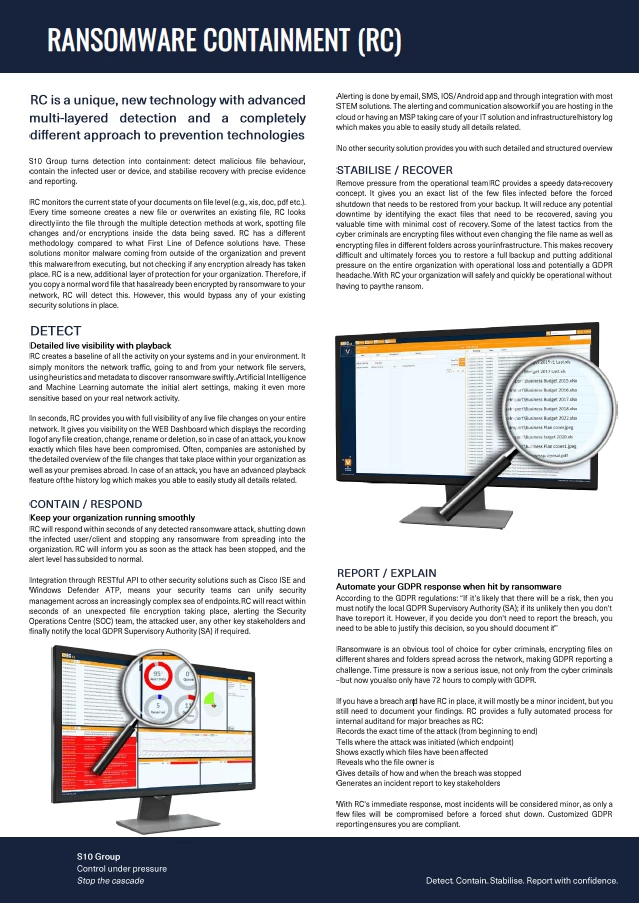
Ransomware Containment

Interrupts active ransomware behaviour, isolates compromised users or devices, and helps prevent encryption from spreading across critical infrastructure.
Ransomware containment image of the first page of the flyer
Solution Flyer (PDF)

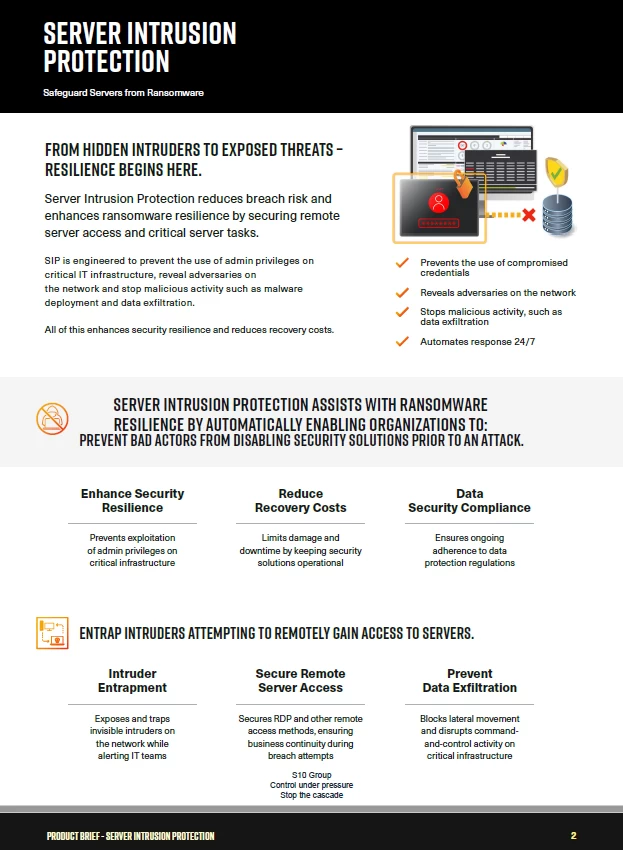
Server Intrusion Protection

Protects remote server access, reduces breach progression through compromised credentials and RDP-related pathways, and helps stop attackers before deployment stages widen the incident.
Server intrusion protection image of the first page of the flyer
Solution Flyer (PDF)

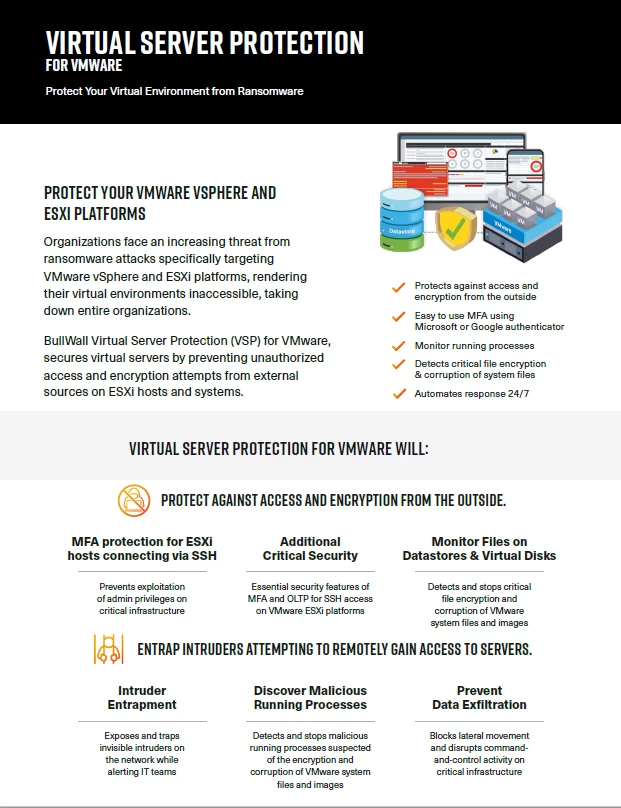
Virtual Server Protection

Protects virtual environments such as VMware and ESXi from unauthorised access, malicious activity, encryption attempts, and wider operational disruption.
Virtual server protection image of the first page of the flyer
Solution Flyer (PDF)

A deeper look at our technical capabilities

Our containment technology operates natively across three distinct threat vectors to isolate attacks at the point of entry.

1. Ransomware Containment overview
2. Server Intrusion Protection overview
3. Virtual Server Protection overview
1. Ransomware Containment overview

Ransomware Containment is focused on active encryption behaviour and the protection of critical data paths and infrastructure. Its role is to detect illegitimate encryption activity quickly, isolate compromised users or devices, and reduce the chance that an outbreak spreads across file shares, application servers, database servers, or other business-critical systems.

  • Detects active malicious encryption behaviour
  • Isolates compromised users or devices automatically
  • Protects critical infrastructure and data paths
  • Supports compliance-ready reporting and recovery visibility
2. Server Intrusion Protection overview

Server Intrusion Protection is focused on one of the most common and consequential early breach pathways: remote server access. Its role is to reduce the chance that compromised credentials, unauthorised RDP sessions, or malicious server-side activity can be used to progress the attack toward deployment, reconnaissance, lateral movement, or data theft.

  • Secures remote server access with additional control measures
  • Reduces risk from compromised credentials and RDP abuse
  • Helps stop breach progression earlier in the sequence
  • Creates immutable records of access activity for investigation and audit
3. Virtual Server Protection overview

Virtual Server Protection is focused on virtual infrastructure such as VMware and ESXi environments. Its role is to reduce the risk that attackers can use privileged access, malicious processes, or encryption attempts to render virtual environments inaccessible or to damage the systems that support wider business continuity.

  • Protects virtual environments from unauthorised access and encryption attempts
  • Monitors malicious process activity and system-file corruption risk
  • Helps contain threats targeting VMware and ESXi environments
  • Supports 24/7 automated response and stronger virtual-environment resilience

1. Ransomware Containment overview

Ransomware Containment is focused on active encryption behaviour and the protection of critical data paths and infrastructure. Its role is to detect illegitimate encryption activity quickly, isolate compromised users or devices, and reduce the chance that an outbreak spreads across file shares, application servers, database servers, or other business-critical systems.

  • Detects active malicious encryption behaviour
  • Isolates compromised users or devices automatically
  • Protects critical infrastructure and data paths
  • Supports compliance-ready reporting and recovery visibility

2. Server Intrusion Protection overview

Server Intrusion Protection is focused on one of the most common and consequential early breach pathways: remote server access. Its role is to reduce the chance that compromised credentials, unauthorised RDP sessions, or malicious server-side activity can be used to progress the attack toward deployment, reconnaissance, lateral movement, or data theft.

  • Secures remote server access with additional control measures
  • Reduces risk from compromised credentials and RDP abuse
  • Helps stop breach progression earlier in the sequence
  • Creates immutable records of access activity for investigation and audit

3. Virtual Server Protection overview

Virtual Server Protection is focused on virtual infrastructure such as VMware and ESXi environments. Its role is to reduce the risk that attackers can use privileged access, malicious processes, or encryption attempts to render virtual environments inaccessible or to damage the systems that support wider business continuity.

  • Protects virtual environments from unauthorised access and encryption attempts
  • Monitors malicious process activity and system-file corruption risk
  • Helps contain threats targeting VMware and ESXi environments
  • Supports 24/7 automated response and stronger virtual-environment resilience

Together, these capabilities create an additional containment layer focused on what happens after entry risk becomes real: hostile movement, active encryption, unsafe access paths, and the widening of blast radius across critical systems.

One platform, three operational protection layers.
One purpose: to stop an incident from turning into a cascading crisis.

How our platform integrates with your existing security stack

Our technology is engineered to complement the security architecture you already have in place. It does not replace your prevention, monitoring, or recovery tooling. Instead, it deploys seamlessly alongside them as a dedicated operational containment layer—giving your teams a decisive move when speed, trust, and blast radius matter most.

Built for frictionless interoperability, our platform integrates bi-directionally with your existing SIEM, network access controls, and broader security solutions via a robust, two-way RESTful API. It requires no architectural overhaul. Its true value lies in making your current investments fundamentally more executable once pressure becomes operational.

How our platform fits into your existing stack represented by an example of four white brand logos in sequence Crowdstrike, Darktrace, SentinelOne and Cisco displayed at a blue background
Our platform strengthens the value of the security stack you already have,
transforming passive visibility into executable control under pressure.

What our platform is NOT

What our platform IS

  • Not another dashboard
    It does not exist to display more passive alerts while an active incident continues to widen.
  • Not another endpoint story
    It is not built around adding heavy, agent-led infrastructure as the sole answer to enterprise resilience.
  • Not a recovery promise
    It does not assume an incident is acceptable simply because you might be able to rebuild systems days or weeks later.

What our platform IS

  • An operational containment layer
    Engineered strictly to interrupt hostile behaviour the moment a breach becomes live.
  • A protection layer for critical infrastructure
    Focused on where ransomware becomes operationally dangerous: file activity, server access, virtual environments, and spread
  • A control-preservation layer
    Designed to safeguard executive governance, ensuring leadership retains absolute command while an incident is isolated and resolved.
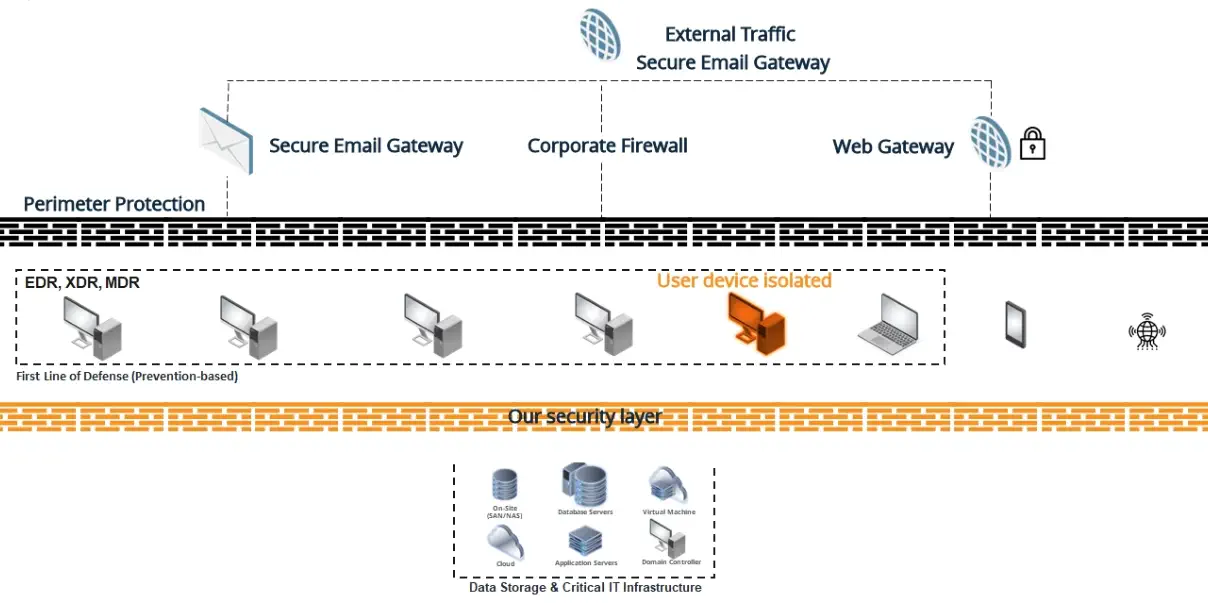
External traffic versus S10 group security layer represented by a technical network architecture diagram demonstrating infrastructure defence layers. The top section shows external traffic passing through a Secure Email Gateway, Corporate Firewall, and Web Gateway, sitting above a black 'Perimeter Protection' boundary line. Below the perimeter is the 'First Line of Defence (Prevention-based)' containing endpoints like EDR, XDR, and MDR, where one workstation is highlighted in orange as a 'User device isolated'. Directly beneath this endpoint layer is a solid orange brick wall labelled 'Our security layer', acts as a containment barrier that completely separates the isolated compromise from the 'Data Storage & Critical IT Infrastructure' at the bottom, which includes SAN/NAS, database servers, virtual machines, cloud, application servers, and the domain controller.
Our platform is not there to describe an incident better.
It is there to change its trajectory entirely.

SEE HOW YOU CAN MAINTAIN CONTROL?

Curious how your security stack responds when ransomware begins to encrypt?

We can run a free, remote resilience assessment inside your own environment.
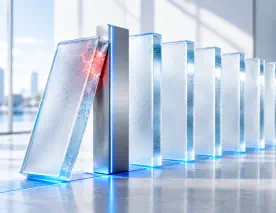
Resilience assessment represented by a domino effect of glass blocks symbolizes the cascading crisis (the chain reaction of an attack).The first glass block falls over and shows cracks and red stress lines (the initial contamination/data breach). But instead of the whole line collapsing,there stands that unshakable one, brushed metal barrier with the light blue neon line.This one absorbs the blow,absorbs pressure and maintains control, so that all underlying glass blocks (the rest of the critical infrastructure and business operations) remain perfectly intact and unaffected.